Handcrafted With Love

So, are you an aesthete? Aesthete is a word in the American English dictionary which means a person who loves and appreciates works of art and beautiful things – anything handcrafted! Are you someone going out of their way to look for handmade artefacts and curios? Do you travel to see art and craft festivals in other cities? If you say yes to all the questions above, you are an art and craft enthusiast or an aesthete.

It is the gifting season and that time of the year when cities in India start wearing a festive look. Streets adorned with colourful streamers and artists displaying handcrafted products are the highlights of the winter months in almost every state. From December-February (and sometimes even March), nearly every city hosts art and craft festivals or a week dedicated to local artists. 

Apart from festivals, online too, stores are selling exclusively handcrafted and customized gifts like stationery, clocks, embroidery, Papier-mâché products, pieces of furniture, metal craft work, cloth puppets, pottery, clay pots, glass products, block print fabrics, ceramics, different types of paintings – glass, oil, pastel, wood, and materials. Antiques form a big part of every house now – wooden/ stone/clay/glass. Aficionados have unique corners reserved in their homes for the same. Thanks to this, a lot of gifting has now become handcrafted, encouraging local artisans to come forward. More people are becoming interested in learning how to make things and gifts. 

Many artists and artisans are conducting online and offline workshops during art fairs, festivals, and on market days. Seeing many DIY (Do It Yourself) kits to make your artefacts in stores is also enjoyable. In addition, children are becoming more interested in making their gifts. Isn’t it a thrill to see a smile and a look of surprise on your loved ones’ faces when they open your gift?

Handmade gifts have always retained their charm over the years. It is still special to receive a handmade card or a gift from loved ones vis-a-vis a readymade gift. I know a gift is a gift, and what matters is the giver’s heart and intentions. Still, there is something magical about opening the strings of a box to discover a handmade piece of jewellery or stationery. To date, I cherish handwritten cards and handmade gifts from my loved ones. 

I encourage my son to make gifts for his friends rather than buy from the shop. The biggest reason is we all will remember these gifts years later and even the person who gifted us. It is the most beautiful moment to open that treasure box years later to discover scribbles in old books, diaries, small origami boats, planes, and artwork given to us by our childhood friends. I still have handwritten letters from my childhood buddy. We both reminisce about those letters and postcards to date and joyously share them with our children now. Letters are gifts in themselves too. Stones wrapped in toffee wrappers, marbles in small cardboard boxes, cardboard, and paper coins, greeting cards (almost obsolete now!), colourful scrapbooks tied with strings, diaries with old pics pasted in them, old sketches of crushes, phone numbers, zodiac signs hurriedly scribbled in books – make you feel so good!

10 Reasons Why handmade Is Thoughtful

1. Personal touch

It is always a different feeling to be treated exclusively where you have the maker’s signature or print on the gift. The maker is your loved one putting extra effort into making you feel special!

2. Souvenirs for life!

Corporations these days love personalising the gifting to their employees. For example, some online retail stores have tie-up with local artists who make small curios or something that symbolizes the company. These remain lifelong with the company logo embossed in them.

3. Memory building

Each handmade gift will have a memory attached to it. For instance, the facility will always remind you of the occasion, date, and year of gifting. But, of course, you can create a memory box too. Then, years later, you will jog in your memory lane when you open it. 

4. Encouraging local artists

If you cannot make something of your own to gift your loved one because of the time crunch, you still have the choice to get a handcrafted gift. Look around your neighbourhood for local artisans and get them to make a customized gift for your loved one.

5. Eco-friendly

Raw materials for handcrafted items are from nature. Hence, they are environment-friendly and safe even for children. For instance, Assam is famous for all its bamboo products like dolls, baskets, toys, mats, shopping bags, and fans. These can be beautiful gifts for anyone.

6. Activates creative juices

It stimulates our brain cells to think out of the box to make different things. It challenges us to do things we usually don’t do.

7. Encourages socializing

Gifting makes sure you meet people and have human contact. Even the most reserved person would find motivation in meeting and gifting their loved ones.

8. Beats blues

Making something with your hands keeps you busy in your mind and helps drive away unwanted and depressive thoughts. It is a good distraction!

9. Children love it

A constructive activity for children to feel good about what they made. Also encouraging minimalism as well as creativity in children. Handmade is always good vis a vis the expensive gifts we buy for birthday parties.

10. Elders cherish it

Older generations have always cherished handmade gifts and even food we cook in the kitchen. Watching them beam with joy and pride if we make something of our own and gift them is a pleasure.

How many of you make gifts for your friends or loved ones? If yes, do share stories behind making gifts. Every handmade gift has a story to tell. Each moment counts, and it adds to all our memories.  So, happy gifting ‘coz we all have an artisan in us !

——

She is a quirky writer/photographer/closet poet and singer who has traversed a non-conventional path. As a former entertainment journalist who has worked in print and online media for a decade, Priya loves talking to people and writing their unspoken stories. She is a single parent of a 7-year-old son settled in Tamil Nadu and a Content Consultant/ Communications-PR Manager. She is also an informal mentor to parents in her local parenting network. She dreams of being an author of a book and maybe the scriptwriter of a film someday!

Follow Priya Rajendran

How I Am To Be Treated

No one showed me how I was to be treated. It may be something most women face. For years, we have been completely denying how a woman is to be treated right. It’s a different story that women are less appreciated and most often taken for granted. However, what is more noteworthy is that women tend to forget that certain boundaries need to be drawn, and they deserve to be treated with respect and empathy.

Women brought up in a family where the men treat the women the right way, know what to expect from the men in their lives. However, not all women are fortunate to have such a background. Many women face discrimination because of their gender right from childhood. This is true worldwide, regardless of which state or country you are from.

Men always have been given the upper hand over everything – from jobs to pay to even having fun! However, women are slowly trying to tear through the tight-knit stereotypes of how they are supposed to act and behave. With multiple hurdles to cross, women are steadily setting the lines straight once and for all.

As we speak about women trying to empower and nurture the lost essence of caring for and processing the feminine understandings, they are also allowing and submitting themselves to a mediocre partnership where they are neither treated as they are supposed to be nor are they appreciated for who they are. It happens because of the lack of guidance and mentoring when young. It is scientifically proven that women who have been victims of gender bias when they are young tend to fall for all the wrong men. It’s perhaps seeking out what is missing. The urge to get whatever is possible. This understanding of womanhood, this misunderstanding of who they are and how beautiful they are, throw them depression, anxiety, self-doubt, and lack of confidence.

If only each woman knows what she is capable of and what she deserves, she shall not settle for anything less. It is, therefore, our responsibility as a generation that knows values and what it is to be valued to show the youngsters what to expect and where to draw the line. Not only are the women to be educated on how they ought to be treated, but the men also are to be educated on the same. Men are to be made to realize that women are equally, if not more, capable and efficient in many walks of life, and it’s alright for them to take control. Wouldn’t it be so cool to have someone appreciate and cater to all your emotional and physical needs!? Well, why can’t you be that for yourself!? The more women seek happiness, love, compassion, and care from others, the more they will find it in deficit. Think about it…

—–

Aakanksha Dinah, a passionate writer, orator, communicator focused on establishing a Training institution centered on creativity and innovation. Aakanksha is a true believer in loving the work we do and strongly believes in smart-work, the reason why creativity works better for her. Aakanksha is enormously focused on making a career in professional writing and publishing. She loves writing poems, self-help articles, and essays. An enthusiast when it comes to learning languages and in short, Aakanksha is a wanderer, an explorer, a mom, a dog-mom, a poet, a cook, a writer, and an influencer.

Follow Aakanksha Dinah

Guilt And How Damaging

The Feeling In A Woman’s everyday Life

Scene 1

I am a working professional. Hold a mid-level management post. Married and have two kids. Today is one of those days I need to stretch my shift and work overtime to complete the task. It’s a hard day. I called up home; my children were screaming in the background. I informed my family that I would be late.

I hang up the call and resume work, grab a coffee to keep me awake so I can finish up, and head home. 

I finish late at night, reach home, have dinner set for me, and get to bed. 

My family is proud of me and supports me since I am the breadwinner.

Scene 2

I am a working professional. Hold a mid-level management post. Married and have two children. Today is one of those days I need to stretch my shift and work overtime to complete the task. It’s a hard day. I called up home and informed my family that I would be late. My children are crying in the background. I can barely listen to or think of anything else now. I imagine they are hungry and missing their MOM. I am consumed by Guilt. Call hung-up. I told my boss I would resume work reaching home.

I reach home, prepare dinner, feed the children, attend to their needs, and tuck them into bed. Check things around the house for what is ‘on fire,’ attend to what I can… then proceed to finish my ‘work’ quietly and sleep exceptionally late. 

My family is proud of me since I am the breadwinner too.

These scenes may sound like a familiar story from different families…or the same family with different individuals. And if I am guessing correctly, you assumed the person in the first scene to be a MAN while that in scene 2 to be a WOMAN!

Well, while we could debate the gender of the people in the two scenes, that is not the point here. The fact is the treatment of the situation by two different individuals. While both scenarios eventually ended on a good note, the 2nd one highlighted something else!

Scene 2 is the story of MOST WORKING WOMEN trying to balance a Career and Family. Scenario 2 highlighted excellent time management and situation management skills. But it also highlighted the extra labour the woman put in because of the Guilt she experienced when she heard her children crying and missing their mother. What this tells us is this – 

While women are great at time and situation management, what they are PATHETIC at, is – GUILT MANAGEMENT!!

Guilt is not a feminine trait; to be specific, all and sundry experience it. But women take it upon themselves to be present everywhere, do everything, and perfect every task/event/activity/notion. Yet, somehow, they believe they must look after everything well. 

Do Women feel more guilt than their Male counterparts?

OH YES! Most definitely. 

And there are reasons for that. But, whether it is social conditioning, moral chivvying, or family-emotional blackmail, they buckle under the pressure; after a while, they become a part of the same system that pulls HER down by this guilt-tripping.

The list of guilts she subjects herself to is mind-boggling, phenomenal, and through the roof. She feels (or is made to feel) guilt for…

  • not spending ‘enough’ time with her children/family
  • not be around to see her children grow up each day 
  • not be there for them whenever they need her
  • not be around for her family/friends
  • not be able to give her 100% at work
  • not be able to tend to her ambition
  • not be able to get time for herself
  • etc. etc. etc

When questioned about how she manages family and work, my friend once said, “Every day is bad for me. If I tend to work, my family suffers, and if I give into family pressures, work suffers!” Sadly enough, this is the story most women will vouch for experiencing personally. They live this 24X7, 365 Days a year.

Guilt, like any other, is an emotion. And it is subjective. It relates to a person’s judgment of right and wrong. Women have a solid inclination to ethics, moral virtues, and fairness. It, added to social and familial conditioning, makes the problem more vicious. 

It goes on to mean that the more moral values you assume and conduct yourself with, the more guilt you may experience when things go wrong (or even do not go as planned.) Moreover, they learn from the conduct and behaviour of their predecessors, i.e., other women in the family/society. These archetypes get deeply ingrained, become a part of the subconscious, and become their intrinsic ‘Nature.’

Over and above this, if you have experienced any past traumas as a child or a teenager, you tend to assume more guilt in adverse situations. It is usually a result of self-sabotaging thoughts you keep revisiting, wondering if somehow there could have been a way to salvage the situation. Could you have averted it? Even when things go well with you but not with others around you, you experience guilt – sometimes referred to as ‘Survivor’s Guilt.’

In essence…

More Morality = More Guilt 

More Empathy = More Guilt

More Assumed Responsibility = More Guilt

More Past Trauma = More guilt

No Trauma = STILL MORE GUILT!!

GREAT!

So, it’s just guilt, right? So, what’s the big deal? BAD NEWS – Guilt is more damaging than you think.

GUILT – How Damaging can it get?

Guilt does not ruin your moment, minute, hour, and day; it runs deeper. However, it can ruin your entire personality. Cumulative guilt can grow so intense that you may find it challenging to get through each day. It gets heavy slowly but steadily and eventually to levels where you find it hard to connect with loved ones, family, friends, and co-workers. Your self-worth is defeated, and you rush from task to task to accomplish everything in one day to feel worthy of being alive.

Personally, you live a battle each day. Tired, exhausted, and defeated every day.

Professionally, your colleagues only see an already-tired, unpassionate, and incompetent person!

So, is there a way to stop this vicious and self-sabotaging cycle?

HOW TO STOP FEELING GUILTY?

Is it possible to stop feeling guilty? How?

YES – And the answer is SELF-LOVE!

Close your ears to the world and indulge in unconditional Self-love. Take a break when you can. Stop negative self-talk. Do not even think of yourself as second or inferior to anyone. The other person may seem to be doing better than you, be able to achieve more and pack more in the day – but remember, ‘Balancing Work and Family’ is MYTH. So let me shout this into your ears one more time – ‘Balancing Work and Family’ is MYTH, MYTH MYTH.

Remember

  • No one gets it all right. Even if they tell you, they can – don’t believe ‘em!
  • Get more accepting of yourself, do whatever you can best in the day, and move on. 
  • Understand that we may fail, and that is okay.
  • Stop aiming for perfection lest you lose yourself. Not everything in the day will be ACE.
  • Last and most importantly – Do not broadcast your life to people who don’t appreciate you. Know what legend says – People can’t ruin what they don’t know!!

——

Veena Gupta, a homemaker, doting mother, and a loving wife, who takes pride in a long-standing career in Banking and Finance. While her life took shape and as she was pursuing all this, something kept tugging her creativity. This pull lead her to decide to express her thoughts through writing. True to her name, her words flow from her pen to resonate with the reader’s mind like the soothing music that the musical instrument Veena creates! For someone who likes to experiment in life through adventure sports, trekking, and other varied interests, Veena likes to bring her experience, background and perspective to her readers through her simple yet effective writing to push the fact home!

Follow Veena Gupta

Screen Time And Health

The Adverse Effects Staring at Screens Has on Both Adults and Children

Screens of various kinds can be found in the homes of virtually everyone in this day and age. Despite the growing body of research suggesting that spending too much time in front of screens can adversely affect both adults and children, reducing the amount of time spent in front of screens can help your family improve their health. This is true even if your family already spends a significant amount of time in front of screens. Find out the negative impacts of staring at displays for extended periods and receive tips on reducing the amount of time you spend using electronic devices.

The effects of screen time on your health

It doesn’t matter if your entire family is gathered around the television or just in the background: spending too much time in front of a screen may be harmful. Your health may suffer in several different ways if you spend an excessive amount of time in front of a screen, as will be discussed below.

1. Obesity

Spending excessive time engaging in sedentary activities such as watching television or playing video games is one of the factors that might lead to obesity. The condition of a person’s heart can impact their risk of acquiring diabetes and their likelihood of high blood pressure and high cholesterol.

2. Not enough sleep

The light emitted by electronic devices interferes with the brain’s natural sleep cycle, making it more challenging to have a pleasant night’s sleep. To get a better night’s sleep, staying away from screens for at least one hour before bed is recommended.

3. Constant Sore back & neck

Poor posture and ongoing pain in the neck, shoulders, and back might result from excessive time in front of a screen. Instead, get up from your seat every once in a while to stand, stretch, or stroll about the room. Make an effort to maintain the device at eye level, and check to see that the chair you’re using provides sufficient support for your back.

4. Feelings of anxiety and melancholy

The amount of time you spend in front of screens may negatively affect your mental and emotional health. Experts believe that spending more time in front of a screen may be linked to feelings of depression, as well as an increase in suicidal impulses and a general decline in one’s capacity to read other people’s emotions.

Some suggestions to cut down on screen time

Although reducing screen time to just a few hours per day might not be possible, the following suggestions can help you and your family spend less time in front of electronic devices.

1. Demonstrate responsible use of electronic devices 

Children look up to and emulate their parents as role models. Remember that you set an example for your children the next time you sit down to watch many episodes of your favourite OTT series in one sitting. Keeping the television on in the background or scrolling through your phone whenever you have a spare minute is probably not the best way to model the behaviour that you want your children to exhibit.

2. Set aside time to unplug

Find a time that works for everyone in your family to turn off the phone, the TV, and the computer. Your family will have the opportunity to spend more quality time together if you can convince everyone to put away their electronic gadgets.

3. Use parental restrictions

You can filter out or block information using the many available options. You can even establish daily screen time limits that lock your children out of apps once they have reached the predetermined length of time they have been using the app.

4. To encourage participation in other activities

It is straightforward for today’s children to become overly reliant on technological devices for entertainment. Please enable them to participate in activities such as playing outside, reading a book, or playing a board game instead of spending time in front of a screen, like you did when you were their age.

5. Keep bedrooms screen-free

 Consider instituting a policy that specifies electronic gadgets are not permitted in the bedroom. This also applies to tablets and other handheld devices, which your children may be tempted to use at night and which may prevent them from getting a good night’s sleep.

——

“Saral hu Saadharn nhi” (Simplicity is not Ordinary). This phrase encapsulates her entire existence. A woman of few words, a daydreamer, who is certain that there is life beyond stars. An HR professional who began her writing journey when corona knocked on our doors. A Content Writer, Screenplay Writer, and published Author. She is die-hard romantic and that reflects in her quotes, poems and short stories and currently working on her first book. She enjoys cooking, dancing, singing, travelling, and is a huge Bollywood enthusiast. She is a wife, a mother and a friend you can most certainly rely on.

Follow Naveeta Shokeen

Keeping the Spark Alive 

We are conditioned to crave the act of falling in love rather than the act of keeping it, so when we are in a long-term relationship, it is inevitable that the “spark” will die out. How many romantic comedies do you know that begin after the wedding and follow the characters as they go about their ordinary, everyday lives?

But the “spark” isn’t nearly as necessary as people make it out to be. There is something inherently reassuring about being with someone who makes you feel peaceful rather than having butterflies. Likewise, there is something much more enjoyable about gorging yourself on the couch and binge-watching true crime shows rather than going on fancy first-date dinners. A little spark prevents a lifelong connection from turning into a friendship. Below are a few simple things you can do to keep the spark alive in your relationship.

1. Try something new

Relationships become boring when habits and rituals become standard. Try something fresh to change your perspective on your partner and your relationship. Nothing “new,” no matter how small, will make you feel like you did when falling in love with your partner and experiencing everything together for the first time. Examples include:

  • Planning a trip to a destination you have yet to visit.
  • Playing a card game when you’re more of a “Scrabble” couple.
  • Trying something new in bed.
  • Even ordering takeout that’s different from your usual go-to.

2. Exercise together

You regularly practice yoga while your partner lifts weights on Saturday mornings, or you may attend an online Pilates session on Sunday afternoons. While spending time alone is crucial, working out is a terrific opportunity to explore your tastes. However, occasionally working out with a partner can be a great way to maintain the spark. Exercise releases endorphins, which may help you strengthen your emotional connection and feel more in touch. It also encourages friendly rivalry.

3. Fulfill one action you wish your partner to take

It would help if you created what you want in relationships and most other aspects of life rather than waiting for them to occur or for your spouse to put in the effort. Be more romantic if you want your partner to reciprocate. In the end, you genuinely desire a more passionate connection, and guess what? You have the power to bring that about. It will become a habit for them to do the same for you if you bring flowers home or compliment your partner. Give your spouse your attention and ask high-value follow-up questions to help them feel heard if you want them to be better listeners.

4. “Love” in your partner’s language of affection

You’ve probably heard about love languages enough by this point to write a book about them. But how frequently do you use it with your partner? For example, take care of a duty that your partner despises, like doing laundry or taking out the garbage, without being asked if their love language is an act of service. Write a love letter if they are more of a “words of affirmation” person. Plan a special evening with them if they place a high value on quality time. Bring them flowers from the grocery store if they prefer receiving gifts, or make an extra effort to be touchy-feely if they prefer physical contact. Make a concerted effort to think of and carry out ways to show your spouse that you care, even if it forces you out of your comfort zone, and watch the spark fly.

5. Deepen your communication

When was the last time you engaged in a thorough discussion? The ability to communicate is essential to maintaining the spark. Still, with all the 24/7 closeness, you can find that you are conversing less because you don’t even have the usual conversation openers like “how was your day?” because you are present. Asking questions like “How are you truly feeling?” or “What can I do tomorrow to make our relationship stronger?” at dinner or a relaxed, happy hour on the couch. Additionally, think of questions with a lot of mileage that may appear corny but will result in a genuine relationship. 

6. Make an effort

 Of course, your partner still loves you whether you’re dressed up or down, but making an additional effort will make them feel unique and valued, and it will also put you in the mood for a little more spark. If all else seems like too much labour for a night in, put on a nice outfit, blow dry your hair, or even spritz some expensive perfume. Not only will it make your lover happy, but it will also—and maybe more crucially—give you additional confidence.

Offer to do something your partner loves but you don’t like: Going out for takeout from a Chinese restaurant when you prefer Japanese or suggesting a movie you know your partner will enjoy but find boring will go a long way. But, on the other hand, what’s a single evening of your significant other scarfing down noodles despite your dislike for them or making them laugh?

In relationships, compromise is necessary, but what is the secret to maintaining chemistry? Allowing your spouse to “win” without making any concessions. In other words, they choose their preferred options only to make them happy. So, rather than always making compromises, always give your loved one what they want. Putting your partner first will improve your relationship more in the long run than a dull movie or lousy meal.

——

“Saral hu Saadharn nhi” (Simplicity is not Ordinary). This phrase encapsulates her entire existence. A woman of few words, a daydreamer, who is certain that there is life beyond stars. An HR professional who began her writing journey when corona knocked on our doors. A Content Writer, Screenplay Writer, and published Author. She is die-hard romantic and that reflects in her quotes, poems and short stories and currently working on her first book. She enjoys cooking, dancing, singing, travelling, and is a huge Bollywood enthusiast. She is a wife, a mother and a friend you can most certainly rely on.

Follow Naveeta Shokeen

Tall N Short Tales For Kids

“Once upon a time” is a phrase most of us heard while growing up, and now our children hear from us. Storytelling is essential, “an interactive art of using words and actions to reveal the elements and images of a story while encouraging the listener’s imagination.” How many of you grew up listening to stories by your parents and grandparents? Most of you will nod and agree – mainly the 80s and 90s generations and the generations before. 

Family time was better back then, and we spent quality time together thanks to limited or almost no screen time. Storytelling was one of the mediums that kept us bound together. Traditionally, the best time for stories was always in candle lights. I am sure you just went into nostalgia mode because I just did too! I fondly recollect the time we kids would huddle up during power cuts and listen intently to all kinds of stories – fairy tales to spooky ones. The reason children and parents bonded well back then was also because of storytelling. That was the magic of storytelling.

As we grew older, we made our own stories and narrated them to our families. It became our time then, where we added characters and changed plots as we wished. We read stories aloud, too, and later enacted them. Storytelling became a part of our favourite playtime activities, where we played role-play. It was a fun and cathartic time when we did not worry about clocks, losing smartphones, or friends. Each day, someone new in the gang would come up with their stories or versions of fairy tales they read at home. Sometimes, a telly character would emerge from the narrative into our storytelling/weaving sessions. 

Cut to 2023. Stories and themes have changed over the years, and so has the storytelling style. Storytime has shrunk over time, too, because of parents’ long work schedules, children’s extra classes/tuitions, and often relegated to weekends. 

So why storytelling?
Here are a few reasons why it can be fun for Kids

1. Emotional connect

The first few words you exchange with your child daily establish a connection with their feelings and how they think and understand their environment. Storytelling becomes a medium to find out what they think and feel.

2. Enhances vocabulary

It improves word usage and helps make new words. Each time you make a new sentence while narrating a story, it adds to the memory and takes the child back to the previous level you described to them.

3. Stir’s imagination

Character sketching becomes easier once you read many books. Each character has something unique about them and will inspire you to create new ones with detailed backdrops and backgrounds. Home activities can include one of these creatives.

4. Cognitive development:

The left and right sides of the brain get activated when you read stories to a child. While the left side of the brain is the logical side, the right side is the creative and imaginative side. Storytelling fulfils both these functions.

5. Empathy boosters

Stories and storytelling have the power to make a child think and develop the trait of empathy. In other words, they are putting themselves in the character’s shoes and feeling for them.

6. Drama skills

The best time for a child to develop their dramatic side and learn narration starts when they begin talking. They considerably observe adults who narrate stories and look up to them, especially parents. The way you magnify each expression, and add pitch and volume to your tone, goes a long way in engaging a child in the character they are listening to.

7. Art & Storytelling

Children who listen to stories develop imagination and can begin doodling and drawing their favourite characters. These doodles develop into matured sketches with enhanced expressions as they grow older.

8. Love for long conversations

Children particularly love when parents listen to them about their day, to whom they spoke, their friends’ stories, and the toys they played with. Storytelling begins right here. Encouraging them to talk in complete sentences (beginning with shorter ones) will go a long way in storytelling. Ask them questions, and you will get a long story in their responses.

9. Bookshops vs. Screens –

Nothing like a good old book to occupy you and your child. Screens make them less attentive and imaginative. They want to keep jumping from one scene to the next. Storytelling can keep them engaged long-term. Characters form slowly in the pages of a book. So, keep your storytelling time minus gadgets with the actual book in your hands.

10. Storytelling dates

As parents, you can arrange for story sessions with children. It can be fun sessions while you or other parents narrate stories to them and probably ask them to weave stories as well.

Magic is everywhere and so are stories too. All you need is a story jar (you can create one – a glass bottle or jar). Ask your kids to write words of their choice in chits and drop them in them. Once you collect enough words, start weaving stories. So, you may not even need a book at times to tell a story. Storytelling is as simple as it is. So, get going and narrate a story. Imagine the same joy you felt as a child and the happiness on tiny faces as they light up listening to your stories.

——

She is a quirky writer/photographer/closet poet and singer who has traversed a non-conventional path. As a former entertainment journalist who has worked in print and online media for a decade, Priya loves talking to people and writing their unspoken stories. She is a single parent of a 7-year-old son settled in Tamil Nadu and a Content Consultant/ Communications-PR Manager. She is also an informal mentor to parents in her local parenting network. She dreams of being an author of a book and maybe the scriptwriter of a film someday!

Follow Priya Rajendran

Resolution Tracking

All the hype, high, and hurray is done. Now what? Somewhere in our minds, we faintly remember some last-minute end-of-year December last week promises. Frantically, you scrambled to the gym or not, stopped eating wrong, decided to walk more, and stayed connected more. Finally, the ball dropped on the new year, and the countdown was done. An old year has gone out in style, and the new year arrives with much-awaited resets happening. You are super excited, but you over-commit. And in a moment of clarity (Usually on Jan 2nd onwards), they seem to disappear or lose their charm. And, suddenly, poof! All the resolutions, promises, and last-minute promises seem more challenging to keep with each passing day. 

So after you make the resolves, you need to follow through. But, as mentioned earlier, it is getting harder to follow through once the high and hype of the year are gone. Mind you, and this is easy for a select few people. But again, only some people are the same.

Well, fear not. You are not alone in this situation. Unfortunately, nearly all of us forget or forgo our resolutions and go back to being as we were in the years gone by. 

So if you’re looking to track your New Year’s resolutions, there are a few different ways. First, you can use a planner or calendar to keep track of your goals and the progress you make toward achieving them. You can also use a to-do list or online goal-tracking tools like Habitica or Way of Life to break down your resolutions into smaller tasks or milestones that you can check off as you go. Additionally, if you’re looking for more accountability, you can share your goals with a friend or family member and have them check in with you on your progress.

A planner can help you stay organized and on top of your tasks. You can write down upcoming deadlines and meetings, create to-do lists, and keep track of important events. You can also use it to set goals and track your progress.

  • Follow a to-do list. Make a list of tasks that need to be completed. This is called the to-do list or a laundry list of tasks.
  • Prioritise the tasks in order of importance or urgency. Base this on the need of the hour and the end goal in mind. Start working on the most important or urgent task first. 
  • Estimate how much time it will take to complete each task. Please give it a ballpark. A guesstimate will allow you to plan your day. Otherwise, you will get overwhelmed.
  • Set a timeline for when each task should be completed. Someone once said a goal without a deadline is a dream.
  • Break larger tasks into smaller, more manageable steps. Helps get more achieved.
  • Take breaks as needed to stay focused and energized. 
  • Track your progress and adjust your timeline as needed. Nothing is written in stone. At least resolutions are not! Also, have fun accomplishing them. Celebrate when all tasks are completed! 
  • Get an accountability partner.

An accountability partner is someone who holds you accountable for achieving your goals. They provide support, motivation and help you stay on track. They can help you set realistic goals, track and measure your progress, and encourage you to stay focused on reaching your goals. They can also offer valuable feedback and advice when needed. You can find an accountability partner by asking friends, family members, or colleagues if they would like to be an accountability partner for you. You can also join online forums, such as Reddit, to find someone who is looking for an accountability partner. In addition, some websites and apps can help you find an accountability partner.

——

Ignatius Deepak Stanley is an experienced business coach, trainer, educational consultant and full time dad. He has worked with several well known corporates before deciding to take time out and be a full time dad to his 3 year old son. Beside being a consultant, he has written and published books. Deepak enjoys riding and driving, reading, writing and travelling.

Follow Ignatius Deepak Stanley

10 Creative Ways To Make Time For Kids

Making time for your kids can be challenging, especially when you have a busy lifestyle. However, making time for your kids is essential, as it helps to create a strong bond and lasting relationship. One way to creatively make time for your kids is to set aside a specific amount of hours each week, such as two evenings or one evening and the weekend. During this time, you can do activities together, such as cooking, playing board games, going for a walk in the park, or playing catch. You can also use this time to discuss any issues or questions your kids might have. Additionally, you can make time for your kids by scheduling short outings or events, such as going to the movies, visiting the aquarium, or attending kids’ theatre performances. These activities together will help create meaningful memories for you and your kids.

1. Prioritize

Make sure your children are a priority and that you are making time for them. Never let them think, even for a moment, that they are second to your other commitments. 

2. Get organized

Make a list of all the tasks and chores you need to do and set priorities. Give your kids activities enough importance as the ones that are very important to you. 

3. Cut out non-essential activities

Cut out activities and tasks that are unnecessary or not helping you achieve your long-term goals. Carve out time for your little ones. And keep it cell-free, meaning it is solely their time and theirs only.

4. Include Journaling

Schedule time for your children by writing it into your planner or calendar. Do homework with them, go camping, Teach them a sport or an instrument or learn together. Whatever it is, do it together.

5. Time-Out

Take breaks throughout the day to spend quality time with your children. The best time to do this is in the evening. After a long day at the office and after the kids are done with school, you all wash up, join at the family table, hash out their homework, and then get some quality time with your family. Make sure you and your spouse make time for each other too. (topic for another article!).

6. Make time for what matters

Don't waste time on activities that don't bring joy or value to your life. For example, I can play chess, but I don’t fancy being a master at it. I would rather play cricket. Guess what? I intend to teach my nephews and nieces the game. Be it fishing, camping, barbecuing, or trekking, I will cheer them on as my brothers and sisters, who are great parents, give their kids great memories and ones they will treasure for eternity.

7. Don’t over-schedule

Make enough time to rest for yourself and your children. Over-Schedule is a killer. Killer of energy and fun. Do not commit to something if it clashes with your already planned goals. But, of course, emergencies do happen, and those are exceptions. Otherwise, try to maintain the schedule as much as possible. Consistency works well in building strong relationships in families amoung each other. 

8. Delegate tasks

Let others help with tasks that don't require your attention. 

9. Make time for yourself

Make sure you recharge and take care of yourself. Do what you have to do. Find, create and do everything you have planned for yourself. The day ahead will be easier to drive if your scheduled goals are accomplished. 

10. Be present

When you are with your children, be present and engaged. Together is the key. However, together means one must be present and involved. For example, cook together, and also eat together, do chores together, exercise together, play and read together, do art and craft together, and study and do homework together. Being present is being there for the other person and doing something together. Kids love being included and involved. They love to be part of anything their parents are part of. So include them and cherish the times and moments together. They don't last forever.

As a parent, there should never be anything more important to you than your child or children. As we all know, children grow up loving their parents or wanting to be nothing like them. If they take the first point and we have yet to teach them that family is more important than work, friends, or other tasks. Then they will need to learn how to prioritize them. However, if we make the correct distinction as they grow up, let’s say you have done a mighty good deed! I have a few friends who live in other countries, or as we lovingly say, “abroad.” And they have adopted this principle with their kids. It is interesting to see how well their kids are doing in school and other areas of life. I believe this is directly because of the firm, reassuring and loving environment my friends have made for their kids.

——

Augustus Manohar Stanley is now serving his life’s calling as a full-time Educator and works in Karnataka. He loves creating short academic videos and is also a music enthusiast.

Follow Augustus Stanley

Why Resolutions Fail


2023 is moving at a fast pace. Since the new year, we all partied like there was no tomorrow and gorged on sumptuous food and delicacies. It was all feast & fun, booze & banter, love & laughter everywhere. Full On PARTY!! And like all good things come to an end, the party fever also faded gradually, and we are back to our jobs/chores/businesses. But, wait, we forgot something very inherent to New Year’s… 

The Resolutions!

We all make them, and we are guilty of breaking them too. OOPS! Yup. It’s that time of the year. Half our resolutions are already forgotten a week post-New Year’s Eve. But, like all other years, we make them and try to keep up with them, sometimes sincerely, and then break them just as systematically. 

The Resolutions are an exciting thing. We make these promises to turn a new leaf with the New Year. It promises to change something undesired, start something new we wish to incorporate into our lives or accomplish a personal or professional goal. While this can be done any time of the year, the start of a New Year feels like the perfect opportunity to say to yourself, ‘New Year, New ME.’

Let’s take a look at some most common New Year’s Resolutions that are made around the world (and broken around the world)

As good-intentioned as they are, we do our best to keep them going till at least the next DAY. But then the dreaded reality of daily routine strikes us, and our so-called ‘benevolent’ plans fail. OUCH!

Yes, it does. And it is more common than you think. If statistics are to be believed, most new year’s resolutions don’t live beyond the first month. A whopping 57% quit after the first month!

A good 1/5th of the resolutioners (i.e., my kind of people) will quit in the first week itself!! And only 1/10th of all will keep it running for the entire year. SIGH.

So, what goes wrong here? We had all the good intentions. Yes, we did try to keep it accurate. We kept up with it. So why do most resolutions fail?

REASONS MOST RESOLUTIONS FAIL

1. Hopping on the Bandwagon

Most of us aren’t even serious while making these resolutions. We may have all the intentions hoping it does, somehow, go well. But the fact is that we made new year’s resolutions because ‘It is New Year’ and because ‘it is the thing to do.’

The fact that we made it just out of the blue makes it lack the seriousness to follow it through, and hence the inevitable happens.

2. TIMING

If we have genuine plans to follow a resolution, then any day is a good day. It need not be a ‘New Year’s Eve’ to resolve. It is just deciding for your plans to materialize ‘One day’ or that day is ‘Day One’ on your plan execution. 

Maybe new year’s morning is not a day you are entirely ready to take on the bet.

3. Motivation

The biggest culprit of all. We lose motivation as we follow the goal. We got inspired initially, made a resolution, and had the motivation steam going strong to see the resolution launch. But somewhere in due course, we lose steam, and slowly the motivation begins to die, causing resolutions to fall apart.

4. LIFE

Yes, Life Happens. And life does take over. You may call it by different names like ‘getting busy,’ ‘prioritizing other things,’ ‘shift in focus, ’ blah blah… but yes, life does take over, and it gets difficult to break the vicious pattern of daily routine that causes plans to fall through.

So, is it the End of the Road? 
Well, not yet…If we understand what causes the fall, we may be on the road to understanding how to keep it going.

HOW TO MAKE
NEW YEAR RESOLUTIONS WORK ?

1. Get your WHY right:

First and foremost, Understand and agree in principle WHY you are resolving. Once you know your reason behind the resolution, and you can look at it daily, you will be able to follow it through.

Yes, it will still take effort but at least not in reminding yourself of the goal each day!

2. Make smaller goals:

Yes, this may sound contrary to popular notion, but think about it…if your goals are more extensive than what you have done so far, you are challenging yourself out of your comfort zone, which is challenging in itself. On the contrary, making smaller goals help your confidence in knowing you can achieve them. If higher goals motivate you, there is nothing like it. Go for it by all means.

But if you doubt being able to follow your dream, it is better not to badger your already shaky commitment. Better to begin small, build confidence and then challenge yourself out of your comfort zone. So instead of making a goal to ‘LOSE WEIGHT’ or ‘SLIM DOWN,’ make a goal to ‘Drink eight glasses of water each day.’ This looks smaller, achievable, and worth a try. And although small, it does contribute to the bigger goal of losing weight!

3. Get CONSISTENT

Motivation is a big word. I wouldn’t go for it. But if you are a self-motivated individual – You are already blessed! You do not need a new year’s excuse to resolve to achieve your goal. 

But if you are the timid kind, motivation is something you struggle with already. So, instead of looking for motivation, look for consistency. Look for how you can be consistent with doing what you have planned. It should become a part of your existing routine and, therefore, manageable. So, instead of planning a big makeover overnight, strive for something you can keep up with daily.

4. One Step at a Time

Yes, there is a lot to achieve, and we must change all that overnight, but that will not happen. Point BLANK. 

So, if you want to achieve something, make only one resolution at a time, follow it through, and then go for the next month. It looks stingy and small to aim so low, but if it works, it is not tiny!

So, my lovelies, even if you are one of my kind who cannot keep your resolutions beyond Week one, don’t lose heart. Lose your self-badgering and start ‘SMALL and STAY CONSISTENT’!!

Veena Gupta, a homemaker, doting mother, and a loving wife, who takes pride in a long-standing career in Banking and Finance. While her life took shape and as she was pursuing all this, something kept tugging her creativity. This pull lead her to decide to express her thoughts through writing. True to her name, her words flow from her pen to resonate with the reader’s mind like the soothing music that the musical instrument Veena creates! For someone who likes to experiment in life through adventure sports, trekking, and other varied interests, Veena likes to bring her experience, background and perspective to her readers through her simple yet effective writing to push the fact home!

Follow Veena Gupta

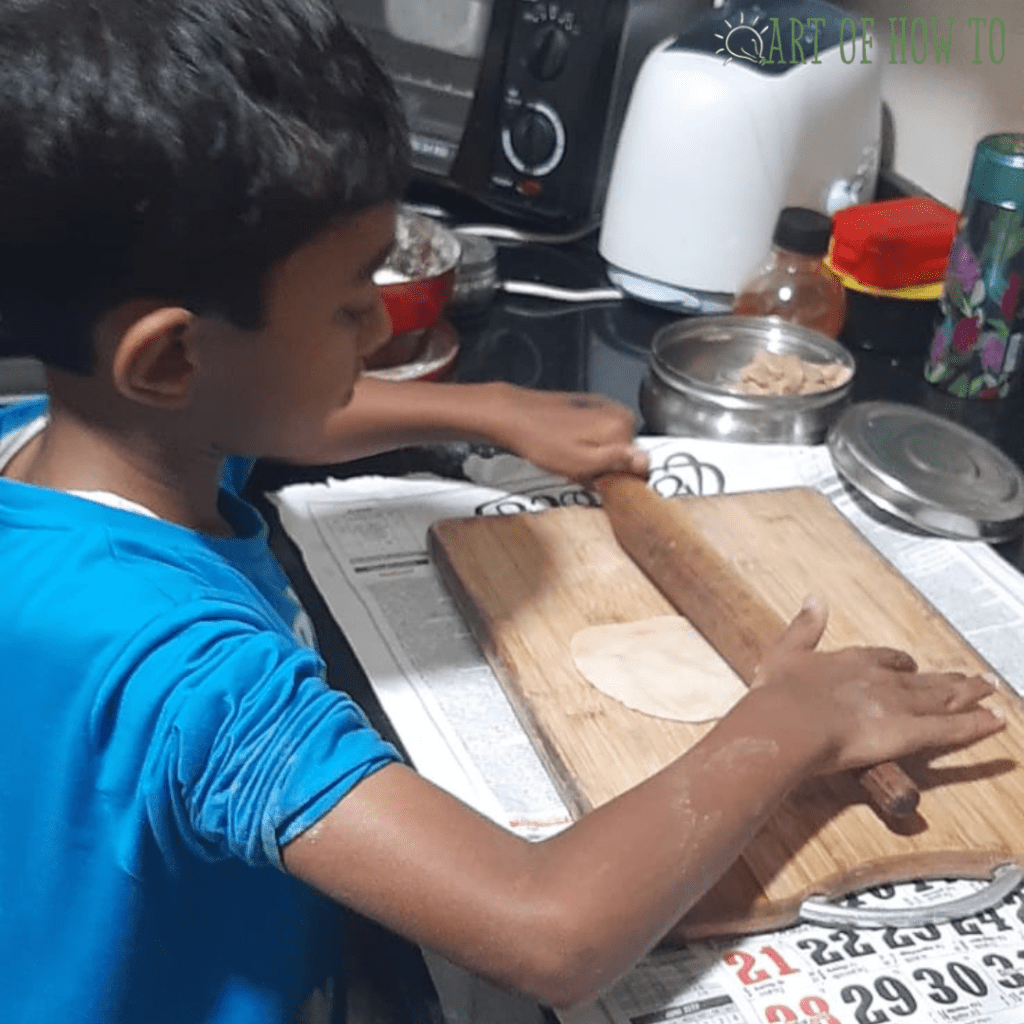
Little Ones Can Cook Too

“Cooking for children is not about ingredients, recipes, and cooking. It is about harnessing imagination, empowerment, and creativity.” – Julia Child. Indeed, cooking is a beautiful experience – a harmony of the three ingredients mentioned by Ms Child and with a dash of unique aromas and tongue-tingling food.

The age of two to ten is a phase of curiosity and learning new things from external experiences. Sensorial experiences rule this age range – taste, smell, vision, hearing, and touch. Of these, taste plays a dominant role in a child’s life. It is time for the child is exploring smells, tastebuds, and flavours. Once children cross four years, their tastebuds start becoming distinctive as well. It is the “my favourite food is this” phase. You will often be hearing about foods they love at this time. 

Have you thought about teaching your children cooking? Wait, most of you will gasp, I am sure, when I say this. Many of you may be thinking: “How can we teach children cooking? Aren’t they too young to learn it? Fire is dangerous, and so are hot vessels”. Well, as they say, you can never be too old or young to learn cooking. You can start with basics (minus knives, sharp objects, or fire). Yes, you can teach them how to do fireless cooking. Begin teaching basics at home, like a topping for a sandwich, encouraging them to spread the filling inside it or sprinkling from the herbs bottle (of course, all this with supervision), and applying cheese on a loaf of bread or paratha. There are many ways to introduce children to cooking at home. 

Just like home is a hearth for love, hopes, and dreams, a school is a hearth for beautiful memories and life skills. What you learn in school is irreplaceable and is for life. For example, cooking is one of the best life skills we can ever gift our children. They say you can survive anywhere in the world once you learn how to cook. 

There have been a lot of gender stereotypes surrounding cooking for years too. For instance, at home, it is a girl’s domain to cook in the kitchen, and boys need not learn to cook since a wife will cook for them in the future. Most of these myths are no longer there, but we still have a long way to go. 

Schools can do a lot to bust these myths by adding cooking to their curriculum. This way, all children can learn this valuable life skill. Have you imagined the school syllabus to have cooking as a formal subject? The higher classes in some schools in India have it as a part of life skills rather than as a separate subject. Mostly, it is only vocational schools in India that teach cooking separately as a subject. Mainstream schools do not do the same, though. 

1. Activates all senses 

While cooking, one needs to use all sense organs – eyes, nose, ears, tongue, and skin. Children will learn how to focus and concentrate on the food being cooked. Once cooking is done, they can also taste and judge for themselves if the cooked food is good or not. 

2. Makes theory practical 

Whatever the children learn at school – Maths, Science, English, and other subjects, can be applied to cooking. For instance, cooking entails a lot of precision in ingredients, and Math concepts can be applied to learn the quantities and volume of components used in a dish. In addition, children can learn to apply scientific concepts to learn more about the combination of certain ingredients and the flavours they will produce. 

3. History, values & culture 

Schools can initiate this by telling children how some dishes originated and their backgrounds. Stories will activate the interest, stimulate children’s imagination, and interest them in cooking.

4. Explore 

While teaching different types of cuisine, a child can develop an interest in tasting new foods and flavours. Many picky or selective eaters start wanting to learn cooking too.

5. Teamwork & skills 

Assigning responsibilities to each child, from adding ingredients, measuring them and mixing in a bowl, and even tasting the dish, can go a long way in children learning to cook. Children learn to cooperate better to make the meals a success. Lesser conflicts are seen when it is a team working together.

6. Builds positive food memories 

School life can be colourful and offbeat thanks to cooking classes and experiments in the kitchen. Children will have fond memories to look back at. Pictures were taken while cooking can be memoirs for both parents and children. Teachers, in particular, can beam in pride at having taught a valuable life survival skill.

7. Builds self-confidence & self-esteem 

It is a feel-good experience for children who make dishes independently or in a group. Confidence levels go up, and children also improve their focus in other subjects. They become more independent and help out their parents better too.

8. Correlation skills improve 

Learning to cook ensures children can link two different concepts better. For instance, while making a dish, they can correlate to an idea they are learning in history – a particular dish can remind them of a historical period and the characters who ate it. 

9. Spelling boosters 

Names of recipes and ingredients can add to their vocabulary. Encouraging them to write or record recipes in notebooks or diaries will help them remember the dish better.

10. Kitchen safety & rules 

Lastly, all of the above points will work only if the child is taught how to handle each kitchen tool in the kitchen effectively. Then, teachers can guide safety measures. This can go a long way in empowering children to tackle emergencies at home and outside effectively.

Parents and teachers, trust me, you will be amazed when you see these tiny kids cook you unique dishes. A message to all the children, “learn how to cook and try out new recipes. It is okay to make missteps but do learn from them as well. Make the kitchen your fun zone and help your parents and siblings! Enjoy new flavours and aromas. Happy Cooking“.

She is a quirky writer/photographer/closet poet and singer who has traversed a non-conventional path. As a former entertainment journalist who has worked in print and online media for a decade, Priya loves talking to people and writing their unspoken stories.

She is a single parent of a 8-year-old son settled in Tamil Nadu and a Content Consultant/ Communications-PR Manager. She is also an informal mentor to parents in her local parenting network. She dreams of being an author of a book and maybe the scriptwriter of a film someday!

Follow Priya Rajendran