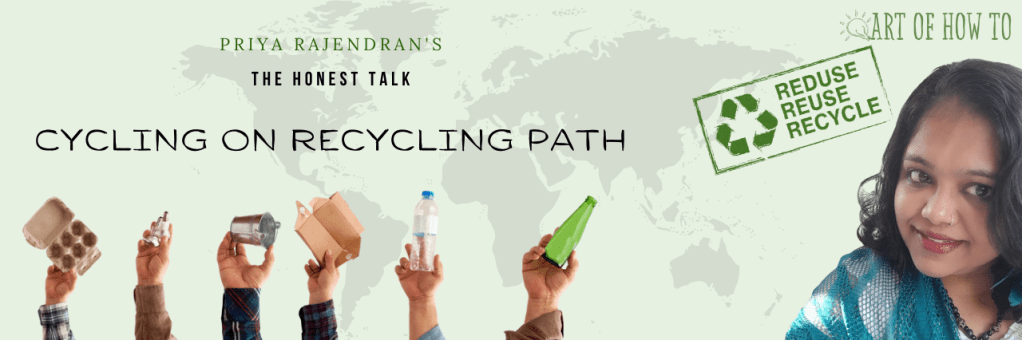
Cycling On Recycling Path


By now, many of you would have completed all festivities. So let me ask you – what happens before and after a festival? How do you celebrate? Spring cleaning, decorating the house with flowers and festoons, lights lit, prayer rooms set. Let’s not forget the fun and food – playing cards on deck and eating yummy delicious sweets and savouries crafted by your mother or family. Finally, how can we forget the holiday shopping for gifts – for family, friends, and self?

As the holiday season approaches, you begin sorting and clearing undesirable items from the house. In Hindi (Indian language), there is a word called ‘kabaadi‘ (old things like plastic containers, vessels, books, newspapers, clothes, and even appliances). Now a few kabaadiwalas, people who help dispose of kabaadi for us are just a call away. They help a lot in sorting and clearing unwanted stuff too.

Since the digital age set in, websites and apps have been assisting in disposing of or selling used goods (in good and bad condition) at reduced prices or clear them from our premises for free. Unfortunately, things that are in highly damaged condition are discarded in trash bins. And then there is a bag of those things you do not wish to throw (painstakingly bought during an exhibition/sale) but must dispose of. But the good news for folks like me and you who refuse to let go of old things is that you can recycle them too. In India, if desired, we can recycle anything. These days no one is disposing of anything that fast. A path in home deco is in trend. You can evolve into an interior decorator. All you need is a practical aesthetic sense with the right combinations of colour palettes and design intent. Voila! You can revamp your house! “Reduce, Reuse, Recycle & Save” is the mantra these days. We call it “viral” and “trendy” in digital language. 

Recycling is a simple process of altering scrap into reusable material. Simply, it is gathering old things and giving them a new look or repurposing them for other use. It is suitable for accomplishing better environmental goals as well. For instance, recycling non-biodegradable things can be given a new look instead of disposing of them in waste containers. These things will take a million years to break down and decompose into the soil and may even damage the ecosystem if they get absorbed in water or soil. So why not give them a new look? Get creative!

India is a country of innovation. Almost every other house converts old things to new or makes an alternative to old things. Whenever I visit old friends and relatives’ homes during celebrations, I would often admire the décor and interiors. Once during a visit, I adored the curtains in a house. When asked, I was told it was designed by stitching old dupattas(shawls) together to make unique curtains! How simple and how resourceful was that!

Still remember the metallic shoe shelf (made of iron and painted) kept outside my house. A cloth was placed over the rack to shield the metal, stringing old greeting cards and wedding invitation cards (all sent by friends and family members over the years!) like a necklace. Colourful cards transformed the look of a plain-looking stand. We can reuse and recycle clothes, furniture, old photo frames, plastic and glass bottles, vessels in the kitchen, old plant pots, soft toys, and children’s toys. 
These days, mega brands sell recycled products. So look for those, buy recycled products, and collaborate with them to support the cause. Products like shopping bags and handbags made from old pieces of cloth, newspapers turned into table mats, earrings made from old plastic and wooden beads, money pouches and satchels made from old hosiery leggings, fancy paper bags embellished from old gold threads – you name it, and they sell it all!

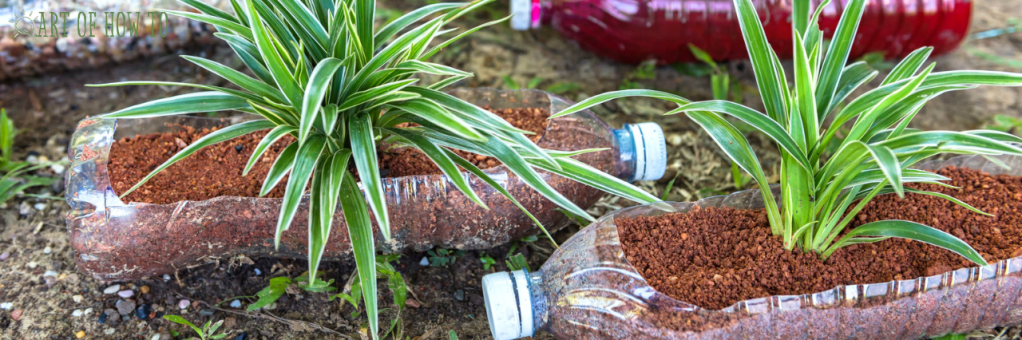
We have to ensure the next generation comprehends to innovate and give a twist to old items. Schools and educational institutions are already doing it with their “Eco Clubs.” Mother Earth has given us so much. Time to give back to her! Non-biodegradable items are a challenge these days, especially e-waste. So why not find a way to give a new face to them? Take plastic pots, paint them and hang them on your balcony or gardens. Broad plastic containers can double up as planters. This will ensure the earth isn’t polluted! Utilize existing items instead of buying more. In this way, you are minimizing personal expenditure too. Try and recycle existing resources, and lower contamination too. Products packaged in recycled boxes also make a difference to the environment. 

Regular cleaning drives will ensure adequate waste segregation in societies. Sorting biodegradable and non-biodegradable waste reduces pollution, landfills, and water bodies. Apartments, offices, and independent houses must participate more actively in waste drives. 

Recycling also ensures that lesser waste is burnt. This means reduced air pollution too. Many people burn waste, thinking it will reduce the garbage around. But it simply adds to breathing and other health issues among people. If people find eco-friendly ways to convert waste or unwanted things at home, it will go a long way in preserving our planet. 

Why not donate old items to recycling centers? Charity begins at home, they say. So why not give away things you don’t need – old toys, clothes, machinery, appliances, and furniture?  

It takes 450 years for plastic to break down. So why wait for the earth to crumple? Instead, let’s take a pledge to detoxify our beloved planet. Instead of throwing plastic into waste bins, why not reuse it to reduce pollution? And why not recycle them for other purposes? 

Follow Priya Rajendran

Phubbing

Phubbing is a new addition to the modern vocabulary that means ‘ignoring someone or people we are physically hanging out with and being held up with our phones to be connected to the virtual world and friends’. This behaviour or act has existed since mobile phones have taken over most of our lives. We all have either phubbed others or been phubbed by others almost daily!

If we look at it with eyes open, mobile phones have become an integral part of our daily lives. We have replaced several other devices and skills over the years with just one device – the mobile phone. 

Not having a mobile phone is more like lacking a limb for many – it has become so crucial for our survival that today, people find it an investment like any other! From alarm clocks to reminders and notes, from calculators to phone books, from dictionaries to books used for references, almost everything is replaced today. Even our brains, for that matter, are less used. We don’t calculate as much as we used to. We don’t read newspapers or books like before. We don’t try to remember phone numbers, birthdays, and anniversaries; we laugh less, talk less, text more with fewer words and letters, and call it the ‘SMS language’! We use short forms for everything and have lost the value of the actual act or the essence of the word – as LOL has taken over the front of laughing out loud; we hardly mean it nowadays when we use it in text. 

Phubbing ruins relationships. It destroys personal connection and can cause harm to our mental health. It causes anxiety issues like FOMO and whatnot! It drains our attention from the things that matter and things that need to be more valued. Phubbing also adversely affects our physical health, causing ailments like text-neck and stress-related issues. It is also one of the significant causes of depression and anxiety in today’s world. Though mental health concerns were prevalent earlier, today, it has taken a different avatar with the rise of mobile phones and the internet. The reason why a lot of people among us feel a lot left out and lonely is because of the constant use of the phone and social media, not being satisfied or content with our own lives; wanting and desiring to live a life inside a box, a dash of sham, glam and nothing real perhaps! 

No, phones are not all harmful and nothing good. They are technological progress, and we ought to be tech-savvy and relate to newer inventions and inclusions in life. However, like every coin has two sides to it, the use of technology does too. When we know how much to use, when, and where, we mature and rise above the downside of it. We must not let smartphones outsmart us. 

Phubbing is also not something that causes harm to all – many people are introverts in nature and have social anxieties. They deal pretty well with the act of phubbing. They don’t seem to feel lost in the crowd with their smartphones by their side. They can deal with their lives their way – just like the coin’s other side! 

Let us educate ourselves and our children, who are the future, to not give in to the lameness part of the online world and believe that we are falling behind. Instead, we are the ones who created this convenience and shall experience, use, learn, progress, and relish the same. 

Follow Aakanksha Dinah 

Ever Been Gaslit


” I am successful, confident, beautiful, focused, and unstoppable.”
” I can be whatever I want to be.”
“I am grateful for everything I have in my life.”
“I am independent and self-sufficient.”

Chant this to yourself daily. These affirmations are optimistic messages to self. It helps us to uplift and boosts ourselves. So, as a part of your daily ritual, please chant this mantra. Often times it is more uncomplicated to affirm others than ourselves. However, we must remember to encourage ourselves more. You will know why I told you this by the time you finish reading this.

Ever heard the term “gaslighting”? Imagine if someone coaxes you to believe what you saw you did not see! Better, what you heard, you did not hear! Or what you sense, you are not feeling! Picture this, what if someone is always trying to convince you that your reality, truth, and facts are entirely inaccurate.” 


Gaslighting is manipulating someone psychologically by making them doubt their sanity. Just like a gas stove is being lit and extinguished, you end up in the same way with the knob in the abuser’s hands. The abuser knows which buttons to press to make you happy or unhappy and tests all your emotions. A point to note, the abuser finds happiness as long as their ego is massaged. Therefore, they can be wholly indifferent and oblivious to your emotions and feelings. As a result, you will often be confused, unhappy, and depressed as a victim. There will often be a haze around you, and you will doubt every decision you take. 

This happened a while back. One time, a mommy friend confided in me that she wanted to learn swimming, and we spoke in detail about the classes around where she could go to learn. After a few days, we met again, and I happened to ask her if she had started swimming lessons. ‘My husband told me I shouldn’t learn swimming because I might drown while learning,’ said my friend. My jaw dropped, and I expressed, ‘the whole point we should learn to swim is to stay afloat.’  By then, she had already decided she won’t learn to swim. Since I knew the couple, I recognized what was going on. He had body-shamed her and convinced her that she could never learn it. Slowly, no answer to my calls, and she started ignoring my messages, and ultimately our friendship faded. Her husband had convinced her to believe, ‘I am a bad influence.’ 

An abuser has the incredible ability to convince the victim that their friends or anyone close to them are no good, and they persuade them to stop talking to them. These are classic signs of a person who gaslights. They want all the limelight and attention for themselves and ensure the victim is always isolated. If the abusers find a well-meaning friend trying to expose them, they make sure they are out of the picture by convincing the victim that it is the friend who is rotten. So “praise a little, criticize more in the name of love and live in denial” is their policy to keep the victim next to them. After each abuse cycle, they will tell their victim how precious they are to them.

Identifying A “Gaslighter”

Following are a few classic statements that a gaslighter makes. You can get an estimate of the ploy they use to control victims. Many a time, you wouldn’t even know you are gas-lit. They very cleverly abuse you without your knowledge for years. But victims who are the survivors will vouch for these below statements:

"You know I tell this for your good" 
"I love you a lot, so I am telling you this. You don't know what the others say behind your back."
"Hey, I never said all this. I am sure you imagined all this."
"So, you think you are the best? You don't know anything about yourself, then."
If you participate in this contest, our family will be cut off from us."
"If you do not listen to me, you will land in hell someday."
"I am sick and tired of listening to you complain. I will leave you someday. You don't know how lucky you are that I tolerate you daily."
"I will tell your friends about you, and soon they will stop talking to you if you don't stop telling me what to do."
"Have you seen yourself in the mirror? Don't wear this, or people will make fun of you."
"You are insecure and jealous." 
 "It would be best if you did not talk to XYZ. She is not a good friend. She wants to spoil our relationship. Beware of her."
" I can take better care of the child than you. You are irresponsible." 

These are a few statements I have listed. But there are many more. So, what are the elements you noticed in these statements? Doubt, fear, body shaming, slut shaming, insecurity, anger, and jealousy. See if you can find more. 

Often, their statements will begin with how much they love and care about you and finally taper down to insulting you. Ultimately, the gaslighter will guilt-trip you for something you never did and may even get convinced. If you do happen to call out their actions, they will deny it altogether – even call you a liar. If you don’t get confident on the first day or the first few days, this pattern will persist until the remote control of your feelings falls into their hands. Once the remote control falls into their hands, they will press the buttons and make you dance to their tunes.  

“Love Bombing,” Their Tactic

Love bombing is praising you excessively. They may often compliment your looks and attitude. However, you will get surprises as well. Once the “honeymoon” phase ends, they will start criticizing you for no reason. You may start feeling bad initially, and when you call out their critical behaviour, you may even receive a volley of abuses for doing so. After abusing – physical/verbal, they will approach you again with gifts or come to soothe your hurt. Beware when this begins. 

Walking On Eggshells!

The abuser suddenly starts finding fault in the victim and shaming them internally. Later, they make them liars and guilt trip the victims. The aim is to debilitate the victim and keep control of them. There are many ways of weakening them, too – cutting off the victims from families and friends to draining them mentally, emotionally, and financially.

Psychologists are talking about this term a lot now, and many can identify with the word. They can detect the toxic patterns and trails left behind by “gaslighters” on their victims. The perpetrator will initially begin with “love bombing” and then pull you down so badly that you will live in constant fear and walk on eggshells. 

A rational or logical human being will be willing to listen to you and want to know why you are upset and probably even rectify your behaviour. You will even find consistent changes as well. But in a gaslighter’s case, you will find extreme inconsistency and mood swings. They will leave you dumbfounded and stunned by their behaviour. One minute, they will be critical, angry, and grumpy. You will see them upbeat and happy the next minute, praising your behaviour. An outsider is more likely to detect this pattern easily. They will ensure you do not walk away from them using this “stick-carrot” method. Stick refers to the verbal/emotional/physical abuse, and carrot refers to the compliments/gifts/surprises that will shower on you post every cycle. 

The Abusers’ Lies & Ego Massage

We all have such characters – family members, friends, acquaintances, and relatives who may initially praise you and later start commenting on your appearance, make negative or sarcastic remarks about your behaviour and judge anything you do. They will lie to you and even spread lies about you to your immediate family, so much so that you will be resented by friends because they will also get convinced by the abuser.

Their timing is always perfect! You will notice that you hear these critical remarks right when you have achieved something significant, crossed a career milestone, and even celebrated your birthday. These folks cannot just restrain themselves from passing statements that will hurt other people. They will even be extraordinarily smug and happy doing this. You may even find them smiling at the end of the conversation. But, ultimately, they will conveniently tell you (if you happen to protest or call out their behaviour) that something is wrong with you. 

Constructive Criticism vs. Toxicity

One may argue that constructive criticism is good, but how do you draw the line between both criticisms – constructive and toxic? After all, we are conditioned to believe that any kind of criticism is good for self-grooming. We must correct our “unacceptable” behaviours, especially if it is our life partner or any older authoritative person like a parent. Many gaslighters may even call these critical remarks “constructive criticism.” 

So, what exactly is destructive, you may ask in your mind instantly. In the English language, destructive is the opposite of constructive. In other words, it is essentially toxic criticism and may have a damaging effect on people or even scar someone for life. For instance, my friend, a victim of gaslighting (whom I mentioned above), did not pursue her passion for swimming and many more things she could have followed. Instead, her husband decided things for her and controlled all her actions, decisions, and movements. This will be a repeated phenomenon. So, do take note of this pattern next time you hear it.

Whatever you do, identify the red flags. Anything that brings down your self-esteem or damages your will to do things by a “person you love” is the first sign to retrace your steps back from the relationship – marriage/ dating/even family or acquaintances. It is good to cut off from toxicity as soon as possible.

Remember… the affirmations.

” I am successful, confident, beautiful, focused, and unstoppable.”
” I can be whatever I want to be.”
“I am grateful for everything I have in my life.”
“I am independent and self-sufficient.”

Follow Priya Rajendran
Time Is Money

People in the world that we live in now appear to place excessive value on monetary success. However, time is the most important resource to us and the one we value the most in our lives. When you miss even one minute, there is no way to get it back, no matter what you do.

We all have the same amount of time in a day, which is 24, but how we choose to spend that time is up to us. Therefore, what you decide to do with your time is the single most crucial factor in determining the quality of your day and your entire life.

Some of the bad things that can happen when you don’t use your time well are being unhappy, not getting enough sleep, not being able to finish tasks, and feeling stressed.

When you understand the significance of time, you will be able to achieve more tasks, increase the number of activities you enjoy, and save sufficient time for a time-out.

1. Time cannot be replaced.

The most valuable resource is time because we cannot replace it. How will you spend the time that is yours? Since you cannot regain time lost. The answer to this question is critical. Money is frequently seen as a person’s most valuable resource, and while it is crucial since it allows you to purchase the goods you require and desire, you can also get your money back. But time is a non-tangible resource; once it’s gone, it’s gone.

2. Time lost cannot be recovered.

Time does not wait for anyone, as you have heard countless times, and this is true. Nobody has the authority to pause or slow time. Whether you like it or not, it will continue to move. You may already be aware that time lost cannot be made up. As a result, you should make an effort to take advantage of every chance and utilise your time wisely.

3. Nobody is aware of their remaining time.

Nobody knows how much time they have, which is why it is crucial. Nobody can anticipate the future, and people can pass away at any age and for any reason. Therefore, how you conduct your life can change dramatically once you become aware of this unpredictability.

4. The present is the only time we genuinely have.

As human beings, we are conscious of the three epochs that make up the passage of time: the past, the present, and the future. We can gain knowledge from our experiences in the past, and we can make plans for our lives in the future, but the only thing we truly have control over is the present now. According to research, increasing one’s awareness of what is occurring in the here and now and focusing one’s attention on the present can improve one’s mental and physical health.

5. Happiness depends on how we see time.

When it comes to the past and future, how someone views these two eras significantly affect their pleasure and sense of well-being. Many of us dwell on the past or worry excessively about the future. We would feel better and calmer if we could let go of the past and the things that cannot be altered and look ahead to the future with hope rather than fear.

6. Time is a teacher.

The best teacher of them all is time. People make mistakes and take their time to correct them. It took time and experience for every successful person we see today to get to where they are. Only through attempting, failing, and trying again till one succeeds can one learn.

7. How much time you put in will affect your skills.

While the exact quantity is currently unknown, it is still true that acquiring abilities takes time. In the recent past, there was a common assumption that it took roughly 10,000 hours to perfect a talent. Of course, the precise amount of time depends on the individual and how well they manage their time, but in general, it pays off to be willing to put in the time and work on a skill.

8. How much time you put into a relationship may make or break it.

The community has a crucial role in a person’s health and happiness. Relationship maintenance requires effort, and whether it’s a friendship or a love relationship, time is essential. Healthy relationships take time to mature. The major distinction between a relationship that is deep and meaningful and one that is superficial frequently comes down to how much time each person invests.

9. Time heals.

Your current discomfort will eventually pass, and all that will be left will be a recollection. Even though the memory could sting each time you think about it, the discomfort will eventually fade. Even the most severe wounds can heal with time.

10. Time can help you develop self-control.

Let’s be honest. Self-control is a complex trait to master. Break negative habits like staying up late to watch TV and delaying; it takes effort and commitment. That does not, however, imply that it is not possible. You won’t have time for procrastination if you have good time management abilities.

Your ability to manage your time effectively will increase as you become more disciplined. You’ll soon reach the stage when you don’t allow anything to waste your essential time.

You can do things you never thought possible with self-discipline. As a result, it positively affects areas of your life where you were previously unable to achieve your goals due to a lack of self-discipline.

Follow Naveeta Shokeen

5 Ways to Beat Back-to-Work Blues


BACK TO the OFFICE!!! I am sure many of you have started working from the office now. So, how are you coping with the transition? After the double vaccinations and booster shots, most people have opted to work from the office, and most establishments have opened their doors again. There has been a mixed bag of responses from employees responding to the transition from “Work from home” to Hybrid to the “In person” office mode. At the same time, many found it a relief to begin work in the office since they could meet in person and catch up with their teams now. It was back to mingling as well. 

The truth is many secretly were happy to be out of their homes because they did not have to multitask between work and household chores anymore (gender, no bar!). However, some, surprisingly, were unhappy too. They felt they had to go through the daily grind of waking up early, getting ready, and spending time on the road. All this while, remote working had saved them this commute. 

Ever since the Pandemic struck in 2020, most companies announced remote working. It was a sudden transition for people then, and hard to cope. People struggled to focus on work, and many fought to keep calm because of multitasking at home and during office work. Gradually people got used to this system of work. Zero commutes to work got people relaxed, laid back, and lazier than before. There were no more wearing formal attire. Some struggled to cope with virtual work, while some enjoyed the same. A lot of work got done by companies. Work productivity increased since more employees saved commute time and used that time to work better. It couldn’t have been a more fertile ground for organisations to mushroom and flourish. Not all sectors bloomed. Entrepreneurs started their own start-ups and ventures while working with existing companies. Many defined this era as a golden era for the corporate workforce! A lot of international collaborations began. Zoom and various cloud-based peer-to-peer communication platforms became the most sought-after platforms for companies across the globe to merge and collaborate better. The world suddenly shrunk, and the timings of communication ceased to matter for people hosting meetings at all times of the day and night. 

Many who lived near work moved their base to their hometown, living with their parents or in-laws, and have set up a remote work style and set their family and kids schooling away from the physical office. Convenient for the person who works but inconvenient for all those living with them. Some parents and partners secretly hope their spouses or kids move out of their homes so that they can have their life back and breathing space. 

The pain is real for those with complex relationships, and it worsens. The rise in domestic violence cases during the Pandemic has immensely changed home dynamics. Mental health experts state that cocooned life, lengthy and untimely work-from-home style, and growing stress levels due to the Pandemic are the reasons for the rise of domestic violence from 2020 till today. While many women are facing domestic abuse from their partners – married or living in a relationship; many men also face the same abuse. Unfortunately, men find it harder to speak about these situations than women. The other group who are vulnerable are children in these circumstances.

IMPORTANT MESSAGE
Don't hesitate to contact a crisis resources center near your area if you or anyone you know needs help and support.
Seeking help is human, and it is the first step to recovery.

Initial productivity slowly declined. Businesses want to handle concerns about productivity loss and higher stress levels while working from home. Now, however, offices are happier to re-host their employees, and bosses are equally satisfied for this to happen so that companies can restore work culture and build the team culture again. Team breakfast, lunch, and dinner have to be brought back. A work-life balance lost has to be restored.

Cut to 2022, post-pandemic, slowly the scene is transforming. Many companies have slowly started this transition from work-from-home to the in-person mode by beginning the hybrid mode. Hybrid is essentially partial work from office. For instance, a five-day work with three days works from the office and the rest work from home. Sometimes, four days at work and one from the home office. It differs from company to corporation, employer to entrepreneur. 

As companies move towards the hybrid mode, many people are forced to cope psychologically with these changes. It is taking time to process new work and home routines for many. Organisations have ‘Return to Office Guides’ to help employees with the transition. Workplaces are slowly reverting to methods of team bonding – team lunches, activities, and camps to reignite work productivity. Just like most prepared our children to return to school post-pandemic, it is time we did the same to return to the office.

5 Ways to re-gear yourself Back-to-Work

1. Reset old routines

Focus on getting the routine of waking up early, working on yourself – exercising, meditating, or what it is that you love. Re-establish healthy sleep and meal routines. Plan meals ahead so you don’t spend too much time thinking about what to cook. One good routine most people learned during the Pandemic was meal prep, so continue that or take on meal prep as a practice and plan your meals to take to the office. Meal prep will change your life.

Commuting to work is back, which means planning. Try to talk to friends and colleagues living in the suburbs to share the car and go to the office. Pool in resources and save time, fuel, and energy to commute to work. This way, you won’t burn yourself out driving to work daily.

2. Arrange for childcare 

Any parents, married, single, or divorced, every parent have to make arrangements to look after their children when work is essential. Until the Pandemic, we all took turns being with our children. However, after schools have reopened, most families are now seeking support or stay-at-home support systems for children because both parents have to go to work now. One real struggle every parent goes through is the struggle to find good child care. But, indeed, the new normal is here to stay, and we need to make arrangements for our kids so that we, as a parent, can work peacefully. We can send kids of school-going age to school, and thankfully, the school is now open for good. Those who have infants and toddlers have a particular problem, finding childcare providers.

The childcare cost is skyrocketing post-pandemic, and those without the means to a supportive family or a home system will have to rely on a childcare provider. Some hire domestic help to stay at home to manage the house and children, and some hire childcare helpers to take care of the child alone. 

3. Prepare yourself (use the Big B mirror method) 

Once the above structural or physical changes have been done, we must mentally prepare ourselves. You can motivate yourself by talking to yourself (no, nothing is abnormal!). It is good to prepare yourself to go back to work mentally. Start listing out things to be done before leaving home.

New routines can take a toll, so starting the routine a week before joining work is advisable.

4. Go shopping

New clothes are a sure-shot way to pep yourself to look good and sashay into your workplace with a refurbished wardrobe. Retail therapy is priceless, even though you will burn your budget slightly more than usual. We have made our bid on online shopping in the last two years. Nonetheless, the feeling of trailing something you love in a physical store is priceless too. Shopping makes us happy for a short period, and we know that. It sure gives us an emotional boost. Yet, buying new clothes and shoes is okay.

Dress for yourself to impress yourself. Wear what you like and be comfortable. When you do that, it gives you the confidence to be yourself and who you are. Please do it for yourself. 

5. Icebreaker

Since returning to the job after a long gap, it will be nice to be part of the icebreaker and fun sessions to kickstart back to work. So, try to make time to join the team-arranged breakfast, lunch, or dinner, and make an effort to be part of office events and activities if possible. This is something we should make a step to be part of when we all return to our workspaces. Team bonding helps to know each other and will help to work better together. In addition, a celebration, cheering, and lightness during a casual team catch-up with teammates can make life lighter, work more attractive, and increase productivity.

Since returning to the job after a long gap, it will be nice to be part of the icebreaker and fun sessions to kickstart back to work. So, try to make time to join the team-arranged breakfast, lunch, or dinner, and make an effort to be part of office events and activities if possible. This is something we should make a step to be part of when we all return to our workspaces. Team bonding helps to know each other and will help to work better together. In addition, a celebration, cheering, and lightness during a casual team catch-up with teammates can make life lighter, work more attractive, and increase productivity.

The Pandemic gave workers a sense of freedom and belongingness, so any team leader needs to work towards providing this feeling to team members. They had the autonomy to work at a comfortable pace. Whether hybrid work model or full-time work from the office, every workforce should be mindful of the sense of independence the employee experienced. It is hard to ignore it. 

Mental health is an important aspect to address. Every organisation, if they have the avenue for and financial capacity for this support, should provide support and assistance to workers. Loneliness, exhaustion, and unhappiness have affected people more than ever. The two-year Pandemic, the forced lockdown, and the prolonged cocooned life has increased stress levels. It will need a lot of unlearning; unlearning anything needs support, help, and proper recommendation. 

As they say, there is resistance to every change, and humans take time to accept new things. This phase will also pass, and things will be back to normalcy. So, let’s beat our post-pandemic work blues!

Follow Priya Rajendran

Depression Is Real

Easier said than done; depression and anxiety are not easy to cope with. Mental health is as significant, if not more, than physical health. Being void of diseases is not what well-being is all about. A person’s complete and wholesome well-being combines physical and mental health, including psychological, financial, spiritual, and social aspects too.

People often misunderstand depression and anxiety. Someone may not continually cry or look upset to be affected by either or both. Someone who appears absolutely “normal” and acceptable in the eyes of others could also be dealing with something within.

Always ensure you check up on friends and family. Not every day is the same. You never know what someone is going through until you fill their shoes or be in their situation.

Offer to help. Offer to talk and offer to listen. Sometimes and phases exist when someone wants another person to listen to them. Letting out what is within and being open about what is going on can, in a way, heal the person.

If someone is not willing to be open and speak up, restrain from going on asking what the problem is. Some people prefer to keep it to themselves, and you must respect their choice. Instead, offer a hot coffee or tea, take them out to get some fresh air, or even watch a movie – perhaps leave them alone if they demand so.

Anything you can do to help someone cope with their mental health will go a long way. Fortunately, many of us seek support and acceptance in this wild world for many reasons. Some seek mental health support for personal causes, and some for professional help. Things that worry someone may not even seem big enough as a reason to fear for you – but for some, it is indeed a difficult situation. Therefore, respect people by not being judgemental, responsible, and assisting in relieving someone of their pain in the best way possible.

Never judge someone who needs your shoulder. Always be there for someone who needs you – you might need someone someday! Depression and anxiety can be very different from what they may seem to you. It is not a small thing or something that can be brushed under the carpet. It is as real as daylight, and the world needs more mindful and understanding people. Now, more than ever.

Follow Aakanksha Dinah

Growing Up Then And Now

Childhood is a phase that most of us would love to get back. The fun, joy, happiness, and carefree attitudes, need I go on? The best part is that we never learned anything systematically or logically for years. Unfortunately, today’s kids are being battered with so many schedules, classes, and events. I feel overwhelmed as an adult and also sorry for the children. Trust me. I am not saying we were given a run-of-the-mill and allowed to ride wild. However, we had a chance to play and have some fun, even when mummy and daddy were busy or occupied. If we compare three generations, I am sure we will begin to see a stark difference in the approach taken to how children are being brought up.

I recall spending time with my dad and his siblings growing up, especially during our holidays. They would regale us with stories of their childhoods. I fondly remember tales of adventure, some true, few a little exaggerated. Stories of mud being eaten, rivers being conquered, snakes chased, trees climbed, limbs hurt or broken, you get the gist. All these surprisingly and little terrifying experiences, but they all had one thing in common. They were all fun experiences, learning experiences, and, most of all, being with a gang of sorts. This is from the ’50s and ’60s. Cut to the ’80s and ’90s. If not double the madness, we may be half the crazy things our parents did. They were playing mud, chasing lizards with sticks, and playing football, where 200 of us played on no teams: mud-covered uniforms, book bags with fountain pens in spills. A time when going to school meant unlimited fun because our besties were there. There was no internet or a million-channel cable TV yet. These were fun days, with no math clubs, karate, or hectic schedules. I mean, kids were kids. Doing things only kids could do. Get in trouble for eating tons of candy, bunk classes, play silly invented games. I am sure you all have fond memories of similar experiences. And if I am not wrong, you took a few moments with a quick flashback of the good old days!

My heart breaks, though, when I see the kids of today. I have nieces, nephews, my kid, and friends’ kids exposed to the internet, mobiles, and too much technology. Kids with so many extracurricular programs can make a CEO blush. I often wonder why we as adults forget what it meant to be a child. A recent experience from a child development program left me in near tears when I saw what children had to go through. Extra Math and writing classes, Judo, Kung Fu, Ballet, Piano recitals, Violin classes, poor kids being overwhelmed with so much that you saw their childhood fade before their eyes. At the same time, they lived their parent’s dream. Having a vision for our kids to live their best lives is not unhealthy. But it is not fair to dump unwanted schedules and programs on their little heads expecting the next Indian Idol or Rocket Scientist from your little one.

Do your kids have downtime? Reading time? Time to play and do nothing important? Maybe even do some household chores and get some rewards? Anything that will not bog them down with a tight jam-packed schedule? If you say yes to all the above, I will tip my hat off to you! But if not, please start giving them breaks and time to be kids.

Simple things to do to avoid the trap of overburdening your child:

1. Remember your childhood. If you have had a relaxed one or not, allow your kids to have one too. If not, it will enable them to have one still.
2. Do not live your dreams through your child. Let them find themselves. Give them opportunities, no doubt.
3. Encourage them to discover themselves.
4. Be patient. Rome was not built in a single day. As a mentor of mine always says, it was built over several days.
5. Replace the screen time with books, playtime, fun games, and a family outing.

It is promising to allow children to live out their childhood learning skills and behaviours that will help them in the future. Of course, additional skills like music, dance, etc, are good too but in moderation and not as if their lives depended on it.

Follow Ignatius Deepak Stanley

Re-Parenting And Healing

You must have heard these as a kid or yelled at for asking questions – “why are you asking silly questions” or “Don’t waste my time. I don’t have time for your questions.” You are stupid” or “you cannot do anything right.” To make you do things, did you hear this: “It’s my way or the highway!”? How could you cry? You will never have a good relationship because you are not good enough.

The above list can be endless. These are a few of the myriad statements most of us heard as children and during our growing years. Sad, if you did listen to them! Over time, we have normalized these statements and are now saying the same to our children. These are essentially damaging lines that can scar anyone for life.

If you think you have undergone the above, please observe your behaviour towards your children. At times, we subconsciously incorporate toxic parenting styles due to the neglect and abuse we faced/suffered as children. The same statements are repeated in déjà vu mode to our children and get transferred to every generation.

Before you label yourselves as “bad parents,” you must know that recognizing toxic patterns is a sign of a sensitive parent and that most of us subconsciously do it. Hence the need to Reparent ourselves. Treat yourself with lots of love and care.

A child’s self-esteem, confidence, and personality are crucial early years. The adult version of the child has a lot to do with what they are ingrained in their young years. So, parents must be cautious in their speech, body language, and non-verbal communication. The child’s brain catches these sensitive things quickly, and they will end up normalising them as adults because their parents or caregivers did it. Society often mistakes authority as ” ideal,” and social conditioning happens in that name. Hence it is vital to “Reparent us” using professional help.

What is Reparenting? According to the world wide web’s definition: Re-parenting is a state of psychotherapy in which the therapist actively assumes the function of a new or surrogate parental figure for the client to treat psychological disruptions caused by inadequate, even abusive, parenting.

In my earlier article on Cycle Breakers,” I mentioned how vicious cycles need to be broken. Unfortunately, a parent can have an equally abusive relationship with the child. Gaslighting and emotional abuse are normalized in most families. The questions/statements that I listed above are examples of toxic parenting. Reparenting is one way of helping a damaged adult heal. 

One reason toxic parenting continues to date is the abuse of authority, encouragement of toxic gratitude, and forced apologies in families. Older generations think it is good to “teach” kids to say “thank you” and “sorry” without the children feeling it. I am sure all of you, at some point, have told your children to “be respectful” towards adults who visit your home or relatives who visit too. “Beta, come and say hi to XYZ uncle/aunt” – is extremely common. Children who don’t do it are labeled “bad” kids or “mannerless.” This is just one of the few examples that happen when you are a child. We carry forward these when we are adults and do the same to our children. Some cycle breakers like me will be labeled as “bad parents,” too, since we do not teach our kids to be “good” to everyone! 

The worst is hearing the “bad kid” label aloud from the visiting adult and the parents instead of speaking for the child and agreeing with the person. It can affect the child the most since the innermost voice tears up thinking: “oh, my parent doesn’t love me.” It is the worst you can do to any child at that time. Even if you do not hit the child, this inner child is “hit” virtually for life!

The concept of Reparenting came about in the 1960s by an unconventional psychotherapist Jacqui Lee Schiff. She and her husband pioneered a therapy based on the transactional analysis theory in psychology. It is a form of treatment that involves assessing and analyzing an individual’s social interactions as a Parent, Adult, and Child. Social interactions were considered “transactions,” The therapist generally empowers the client to become more robust and independent in their approach towards life, minus blaming the caregivers or guardians in their life. Schiff and her husband called the therapy (that they formulated) Total Regression Reparenting. They claimed to have cured Schizophrenic patients using regression. The patients were in their care for years till they got fixed entirely. Their therapy was, however, rejected back then by leading psychologists and psychoanalysts. This concept is coming back, though, and is being termed “New Age Psychotherapy.” There were many variations of Reparenting introduced by psychologists after Schiff. 

Modern Transactional Analysis or TA includes elements of “psychoanalytic, humanist, and cognitive ideas.” It uses a person’s “ego” state to heal them. It helps the person to alter the ego state (Parent-Adult-Child) and learn new life skills to move away from “pity” mode, mind games, compulsive behaviours or OCDs, poor problem-solving skills, and other issues affecting an individual. The therapist sort of dons the role of a parent and helps the “inner child” in you to deal and cope with the problems mentioned above in an improved way. 

Once we identify our behaviour towards children – how we react to them in various situations, we will get a fair idea about our parenting style (no need for a quiz). But yes, do examine the statements right at the beginning of the article. 

Activity: 

Consider doing a role play with your children and ask questions to them. For instance, ask your child to imagine themselves as a parent and you as a child. Give hypothetical situations to them:

  1. I spill milk on the table. What will you do?
  2. I scream and sing at the top of my voice. What will you do?
  3. I get low marks on my tests. What will be your reaction?
  4. What would you do if I did something wrong and refused to apologize?
  5. What would you do if I did something for you and did not say “thank you”?
  6. What would you do if I watched TV twice a day without your permission?
  7. How would you react if I went out with my boyfriend and came back late?
  8. I lie to you and go out for a movie with friends. You come to know later that I lied. How will you react?

The sample of questions you can set for your children. Be open to hearing their responses and answers. Keep an open mind.

Remember that you will get honest replies and must be mentally prepared for them since they will await your reactions too. I will not predict the answers for you here. But this is an exercise I practice with my 8-year-old regularly and keep checking for my behaviour from time to time. 

Disclaimer: These are not indicators that you are a terrible parent. You need not be obsessive about doing this all the time. But may give you an indication that you need to re-examine parenting. It may give you an idea of the primary signs of parental neglect you may have faced based on the answers your children give. You may also revisit your childhood voices, who may have heard these statements above at one point.

Sending healing vibes to all unhealed parents out there. Signing off with this thought: “A happy parent means a happier child and a joyous childhood”!

Follow Priya Rajendran

Red Flags

Red flags. Is it common in a relationship? It seems so. Not just in any romantic affinities. One can see it in any relationship – between colleagues, friends, sisters, brothers, or family members. So what is a red flag? A forewarning indication that reveals harmful and unhealthy or manipulative conduct. 
A committed relationship between partners needs work and effort. Period. The point to cite here is ‘commitment from both ends.’ Applies to any relationship. First, what should one be aware of?

Stay put and believe in yourself over anyone else. Do not hold another accountable for what your thoughts are. Likewise, do not allow anyone to hold you responsible for something you haven’t done. There should be mutual respect for what two people believe and do. 

Anger is a gigantic red flag. Someone who does not know how to control anger is a person who needs help. On the other hand, you must not lose your cool and end up being a toxic person, either. Anger management takes time, and anyone willing to work on it will eventually bear fruit. 

Jealousy, over-possessiveness, lack of trust, and lack of emotional maturity are other red flag in any relationship. One must allow another to grow, develop and explore at their own pace. It would help if you were not forced or forced to see beyond what you see. Over-dependency of any sort is a killer – may it be an emotional, intellectual, financial, or social dependency. Allow yourself space and time to figure out your life. Likewise, allow your partner or friend to do so too. Autonomy is good for overall well-being. A lack of space in a relationship will ruin any connection in the long run. 

Abuse of any sort is a red flag that must not be left unnoticed. Abuse is not always physical and does not always involve violent acts. Unfortunately, some abusers know very well how to play the cards. Emotional, financial, psychological, and social abuse is all widespread but often unrecognized. Never allow anyone to take the best of you, and do not let yourself down for anyone. 

You are feeling guilty and playing the victim. Some people live in self-pity, and it is often too confusing to understand who the victim in such situations is. As human beings with emotions and mood swings, we are all quite toxic in our ways – the best of us know how to handle things better and live accordingly. Therefore, it is essential to recognise where you need help and be vocal about the whole thing. You must not feel guilty for doing something you always wanted – you must not let anyone else feel so. 

Red flags can be anything that destroys the foundation of a good relationship that stands strong with love, trust, kindness, honesty, loyalty, and humane. Be the person who sets your boundaries first and helps others to set theirs and respect others when they say no. 

Follow Aakanksha Dinah 

Radio Still Relevant

The impact of Radio in India is monumental. The country as a whole was fundamentally reshaped as a result. Over time, there has been a shift in the dynamic of how people consume entertainment. Television, printed media, mobile music apps, and Radio are just a few of the media that have evolved alongside the progression of time. For example, it was predicted that Radio would cease to exist soon after the turn of the century, giving way to the dominance of television in people’s homes. At first, Radio’s popularity dropped for a short time. However, in the decades that followed, Radio made a strong comeback by adapting its programming to the tastes of a new generation of listeners. As the number of listeners grows, competitors in many fields are moving up the success ladder by offering valuable and different services from their rivals. 

Expansion of Private FM Stations 

Private radio stations first appeared after the reform of 1991, mostly in major cities. As of December 2018, there are more than 369 private Radio stations nationwide. However, commercial Radio turned into a lucrative market after the second stage of development, which included new auctions and altered license prices, and overseas competitors entered the fray. The administration has made significant attempts to have a presence in even the most remote towns and villages after realising the reach and usefulness of this medium. The frequencies now reach out to people in the country’s most remote areas, where other forms of connectivity and communication may still be non-existent.

RJs – The new celebrities

When we think of Radio, the first thing that comes to mind is tuning into a frequency and hearing a voice that enchants you through the show and the music. This is what we picture when we hear the word “radio.” While this remains true even in the present day, the connection that listeners have with the RJs has developed over the years because they are increasingly interested in getting to know them personally. Today, Radio is listening to your favourite RJ, with whom you can easily connect on Facebook live, meet them as contest winners, and interact with them during on-ground activities. You may also meet them as a contest winner. Because of their increased popularity, radio jockeys (RJs) are now frequently asked to appear on various types of reality television shows. The connection between a radio host and his listeners is of such a nature that listeners adore them even when they are broadcasting on other mediums. RJs have celebrity status and are recognised wherever they go, which contributes to the popularity of Radio and further strengthens its appeal.

Shows across different genres finding their way on Radio

To sustain its listenership at a time when Radio is closely compared to television as a favoured medium for infotainment, radio show formats have experienced a dramatic alteration. Rather than focusing primarily on comedy and romance, the networks are now running a variety of programming that appeals to various audiences and caters to niche needs. Sports, popular culture, trivia, the mechanics of generating music, and other intriguing show formats have created a whole new universe of thought-provoking entertainment that can be enjoyed while travelling. This has also enabled it to effectively reach more than one group of people with a single brand. 

The innovations pandemic brought to the industry?

Despite obstacles, some opportunities can be taken advantage of by using locally sourced goods and services. The options made possible by developing digital connectivity have significantly boosted consumer and content provider involvement. More innovation in content formats and economic strategies is expected as we advance. Radio has long been recognized for bringing together communities in trying circumstances. Additionally, radio stations have successfully innovated through collaborations with music streaming applications to get the best of Radio to the digital landscape for a broader range of people as the world continues to advance with enormous advances in the digital arena. Radio has also become more futuristic thanks to its many partnerships with the digital world and active ties to virtual audio platforms. This makes it ready for technological changes in the next few years and the next several decades. 

Radio-jockeying – From a part-time job to a career

When privately owned FM stations first appeared, radio jockeying was a part-time occupation. People questioned the RJs’ means of subsistence, thinking they weren’t making much money and should seek another profession to secure their financial future. The recognition of being an RJ then gradually began to emerge. Like celebrities, they have followers, are taken seriously, and have an impact. Everyone was made aware of how much effort goes into being an RJ due to this. Radio jockeying is currently recognised as a viable career choice because of its fame, the obligation of being the empowering voice behind a brand, and the technical skills and expertise needed to succeed. For those who are eager to become RJs, RJs have also taken on the role of career counselors. They get advice from the RJs with more experience, who also show them how hard it is to get famous. 

Radio expanding in the digital arena

To reach its broader target audience, Radio has increased its presence in this area with the arrival of the digital era. As a result, radio shows and RJs have become much more accessible to the digitally savvy population. And as a result of RJs’ acting in contextual videos, bringing contests to social media, connecting with listeners through Live digital broadcasting for live polling on contentious issues, posting real-time local updates, and much more.

The trend of Radio itself moulded the radio industry as it is today. It has developed into a powerful medium that reaches millions of people with a sense of purpose.

Follow Naveeta Shokeen