Celebrating Girly Bonds

Whoever said that moms and daughters could never get along is either mired by stereotypes over the years, narrated by ancestors, or that they never got along well.

Honestly, my mother and I never got along much because of our differences, but still, there is an unseen bond of caring. As a mother who crossed the 40th-year milestone, I cherish a forever bond with my son. I have read this quote innumerable times, and it also applies to my life: “if you ever feel like giving up, just remember a little girl is watching who wants to be just like you.” I have never seen my mother give up, no matter how complex or challenging situations have been. This quote applies to a daughter as well as a son too. Similarly, whenever I wanted to give up, my son would look at me with his small eyes and tug at me, telling me not to give up! 

A mother and a daughter is an age-old bond too. It starts from the cradle and ends in the grave. There can be rocky paths, but together, they do it. Of course, ups and downs in the relationship are there, but they can handle it because there is something extraordinary about a mother and a daughter’s bonding. They can be each other’s shadows as well as sunshine! They even say it is a love-hate relationship as well. But distance has never affected the bond much. Like any other mother-son, father-son, or father-daughter bond, a mother-daughter bond is unique.  

In many homes, a daughter is considered her mother’s shadow, though it may not be the case. A daughter always has an identity of her own, and she may share zillions of differences between her and her mother. But there are ways to bridge these differences too.

I am sure you will agree that none of us can be clones of each other – so can a daughter and mother be similar? Well, it all depends on the bond built from childhood. Differences and similarities can also be celebrated, accepting each other for what they are. Many jokes and stereotypes have been narrated or gone viral on mothers and daughters – primarily negative!   

the stereotypes – Real and reel

1. Mothers and daughters are rivals and can never get along.
2. Daughters are supposed to be perfect like their moms and are their shadows (attributing Indian soaps)
3. Daughters have to take on maternal roles early on and learn household chores like their mothers.
4. Traditional roles in the household are reserved for mothers and daughters.
5. The emotional well-being of a family rests on mothers and daughters.
6. A mother can spoil a daughter’s family dynamics after marriage.

There are many more. I am sure if you are a daughter or a mother reading this, you will have more such stereotypes and stories to narrate on how a mother and daughter bonding has been perceived by society!

Many of you may even disagree with the above stereotypes as well. In a typical patriarchal society and surroundings, a mother is expected to “discipline her daughter and groom her to be fit for the world.” Often, a mother and daughter move apart too after a certain age because of refusal to meet these expectations and standards. Yet, many mothers and daughters have broken these cliches and maintained outstanding bonds. They are best friends and share every tiny detail of their lives too. Distance has made their hearts grow fonder by the day as well.

10 ways to make Mother-daughter relationship easy

How many of you share a friendly bond with your moms? Even if you don’t, what are the things you have done with your mother during your growing years and even now? Do you have any rituals? Fret not, even if you share nothing in common! 
  1. Communication
    Good communication is critical in any relationship, and it’s no different between mothers and daughters. Make sure you take the time to listen to each other and respectfully express your thoughts and feelings.

  2. Spend quality time together
    Spend time doing things you both enjoy, whether it’s going shopping, cooking, or just spending a quiet afternoon at home.

  3. Please respect each other’s boundaries
    Each person has a unique personality, preferences, and lifestyle, so it’s important to respect each other’s choices and boundaries.

  4. Be supportive
    Be there for each other through the good and bad times. Offer encouragement and support when needed, and always strive to build each other up.

  5. Acknowledge each other’s accomplishments
    Celebrate each other’s successes and show appreciation for one another’s achievements, no matter how big or small.

  6. Seek common ground
    Try to find common interests and activities that you both enjoy and participate in these things together.

  7. Apologize and forgive
    No relationship is perfect, and misunderstandings and arguments are bound to happen. Be quick to apologize, forgive, and strive to overcome disagreements.

  8. Share your experiences
    Share your own experiences and perspectives, and try to learn from each other’s experiences.

  9. Show affection
    Regularly show affection, whether it’s through hugs, kisses, or just kind words and gestures.

  10. Keep an open mind
    Be open to new ideas and ways of thinking, and be willing to try new things together. This will help keep your relationship fresh and exciting and will help you grow together as individuals.

Mother-daughter Bond & How?

1. Spend time together


Make an effort to spend quality time together, whether going for a walk, trying a new restaurant, or just sitting and chatting over a cup of tea. If you and your mother are foodies, the best way is to explore local traditional cuisines you can enjoy. So go on a food trail! Home is where the heart is, and the kitchen is where the heart and hearth lie. You can choose to cook a dish alongside your mother. Another way is to enroll in a cooking class and learn how to make new dishes.

2. Participate in shared activities

Find common interests and activities that you both enjoy, and try to participate together. It could be anything from cooking or gardening to hiking or playing games. Spending meaningful time together and enjoying endless conversations in a spa may be the perfect recipe for a good time with your mom. Enjoy a relaxing day of pampering and bonding with your mother.

3. Share memories & stories

Share your memories and stories, and listen with interest to your mother’s stories and experiences. Join some relaxing classes for physical and mental wellness together. In addition, it can be an excellent time to learn about family, ancient and traditional practices together and connect well with your mother or daughter.

4. Show appreciation

Regularly show appreciation for your mother and all she does for you. This could be through verbal expressions of gratitude, thoughtful gestures, or just spending quality time together. Visit a local bazaar or market and explore some unique and colourful souvenirs made by artisans. A day out shopping can be loads of fun and off the mundane daily routine!
5. Offer help & support


Offer to help and support your mother, whether with household chores, errands, or just being there to listen. Showing you care about her well-being and happiness can help strengthen your bond. 


So, what are you waiting for? Pen your itinerary TODAY and list things you want to do with your mother and vice versa. Signing off with Signe Hammer’s quote that touched my heart, ‘Mothers of daughters are daughters of mothers and have remained in circles joined to circles since time began.’

——
She is a quirky writer/photographer/closet poet and singer who has traversed a non-conventional path. As a former entertainment journalist who has worked in print and online media for a decade, Priya loves talking to people and writing their unspoken stories. She is a single parent of a 7-year-old son settled in Tamil Nadu and a Content Consultant/ Communications-PR Manager. She is also an informal mentor to parents in her local parenting network. She dreams of being an author of a book and maybe the scriptwriter of a film someday!

Follow Priya Rajendran

Handcrafted With Love

So, are you an aesthete? Aesthete is a word in the American English dictionary which means a person who loves and appreciates works of art and beautiful things – anything handcrafted! Are you someone going out of their way to look for handmade artefacts and curios? Do you travel to see art and craft festivals in other cities? If you say yes to all the questions above, you are an art and craft enthusiast or an aesthete.

It is the gifting season and that time of the year when cities in India start wearing a festive look. Streets adorned with colourful streamers and artists displaying handcrafted products are the highlights of the winter months in almost every state. From December-February (and sometimes even March), nearly every city hosts art and craft festivals or a week dedicated to local artists. 

Apart from festivals, online too, stores are selling exclusively handcrafted and customized gifts like stationery, clocks, embroidery, Papier-mâché products, pieces of furniture, metal craft work, cloth puppets, pottery, clay pots, glass products, block print fabrics, ceramics, different types of paintings – glass, oil, pastel, wood, and materials. Antiques form a big part of every house now – wooden/ stone/clay/glass. Aficionados have unique corners reserved in their homes for the same. Thanks to this, a lot of gifting has now become handcrafted, encouraging local artisans to come forward. More people are becoming interested in learning how to make things and gifts. 

Many artists and artisans are conducting online and offline workshops during art fairs, festivals, and on market days. Seeing many DIY (Do It Yourself) kits to make your artefacts in stores is also enjoyable. In addition, children are becoming more interested in making their gifts. Isn’t it a thrill to see a smile and a look of surprise on your loved ones’ faces when they open your gift?

Handmade gifts have always retained their charm over the years. It is still special to receive a handmade card or a gift from loved ones vis-a-vis a readymade gift. I know a gift is a gift, and what matters is the giver’s heart and intentions. Still, there is something magical about opening the strings of a box to discover a handmade piece of jewellery or stationery. To date, I cherish handwritten cards and handmade gifts from my loved ones. 

I encourage my son to make gifts for his friends rather than buy from the shop. The biggest reason is we all will remember these gifts years later and even the person who gifted us. It is the most beautiful moment to open that treasure box years later to discover scribbles in old books, diaries, small origami boats, planes, and artwork given to us by our childhood friends. I still have handwritten letters from my childhood buddy. We both reminisce about those letters and postcards to date and joyously share them with our children now. Letters are gifts in themselves too. Stones wrapped in toffee wrappers, marbles in small cardboard boxes, cardboard, and paper coins, greeting cards (almost obsolete now!), colourful scrapbooks tied with strings, diaries with old pics pasted in them, old sketches of crushes, phone numbers, zodiac signs hurriedly scribbled in books – make you feel so good!

10 Reasons Why handmade Is Thoughtful

1. Personal touch

It is always a different feeling to be treated exclusively where you have the maker’s signature or print on the gift. The maker is your loved one putting extra effort into making you feel special!

2. Souvenirs for life!

Corporations these days love personalising the gifting to their employees. For example, some online retail stores have tie-up with local artists who make small curios or something that symbolizes the company. These remain lifelong with the company logo embossed in them.

3. Memory building

Each handmade gift will have a memory attached to it. For instance, the facility will always remind you of the occasion, date, and year of gifting. But, of course, you can create a memory box too. Then, years later, you will jog in your memory lane when you open it. 

4. Encouraging local artists

If you cannot make something of your own to gift your loved one because of the time crunch, you still have the choice to get a handcrafted gift. Look around your neighbourhood for local artisans and get them to make a customized gift for your loved one.

5. Eco-friendly

Raw materials for handcrafted items are from nature. Hence, they are environment-friendly and safe even for children. For instance, Assam is famous for all its bamboo products like dolls, baskets, toys, mats, shopping bags, and fans. These can be beautiful gifts for anyone.

6. Activates creative juices

It stimulates our brain cells to think out of the box to make different things. It challenges us to do things we usually don’t do.

7. Encourages socializing

Gifting makes sure you meet people and have human contact. Even the most reserved person would find motivation in meeting and gifting their loved ones.

8. Beats blues

Making something with your hands keeps you busy in your mind and helps drive away unwanted and depressive thoughts. It is a good distraction!

9. Children love it

A constructive activity for children to feel good about what they made. Also encouraging minimalism as well as creativity in children. Handmade is always good vis a vis the expensive gifts we buy for birthday parties.

10. Elders cherish it

Older generations have always cherished handmade gifts and even food we cook in the kitchen. Watching them beam with joy and pride if we make something of our own and gift them is a pleasure.

How many of you make gifts for your friends or loved ones? If yes, do share stories behind making gifts. Every handmade gift has a story to tell. Each moment counts, and it adds to all our memories.  So, happy gifting ‘coz we all have an artisan in us !

——

She is a quirky writer/photographer/closet poet and singer who has traversed a non-conventional path. As a former entertainment journalist who has worked in print and online media for a decade, Priya loves talking to people and writing their unspoken stories. She is a single parent of a 7-year-old son settled in Tamil Nadu and a Content Consultant/ Communications-PR Manager. She is also an informal mentor to parents in her local parenting network. She dreams of being an author of a book and maybe the scriptwriter of a film someday!

Follow Priya Rajendran

Tall N Short Tales For Kids

“Once upon a time” is a phrase most of us heard while growing up, and now our children hear from us. Storytelling is essential, “an interactive art of using words and actions to reveal the elements and images of a story while encouraging the listener’s imagination.” How many of you grew up listening to stories by your parents and grandparents? Most of you will nod and agree – mainly the 80s and 90s generations and the generations before. 

Family time was better back then, and we spent quality time together thanks to limited or almost no screen time. Storytelling was one of the mediums that kept us bound together. Traditionally, the best time for stories was always in candle lights. I am sure you just went into nostalgia mode because I just did too! I fondly recollect the time we kids would huddle up during power cuts and listen intently to all kinds of stories – fairy tales to spooky ones. The reason children and parents bonded well back then was also because of storytelling. That was the magic of storytelling.

As we grew older, we made our own stories and narrated them to our families. It became our time then, where we added characters and changed plots as we wished. We read stories aloud, too, and later enacted them. Storytelling became a part of our favourite playtime activities, where we played role-play. It was a fun and cathartic time when we did not worry about clocks, losing smartphones, or friends. Each day, someone new in the gang would come up with their stories or versions of fairy tales they read at home. Sometimes, a telly character would emerge from the narrative into our storytelling/weaving sessions. 

Cut to 2023. Stories and themes have changed over the years, and so has the storytelling style. Storytime has shrunk over time, too, because of parents’ long work schedules, children’s extra classes/tuitions, and often relegated to weekends. 

So why storytelling?
Here are a few reasons why it can be fun for Kids

1. Emotional connect

The first few words you exchange with your child daily establish a connection with their feelings and how they think and understand their environment. Storytelling becomes a medium to find out what they think and feel.

2. Enhances vocabulary

It improves word usage and helps make new words. Each time you make a new sentence while narrating a story, it adds to the memory and takes the child back to the previous level you described to them.

3. Stir’s imagination

Character sketching becomes easier once you read many books. Each character has something unique about them and will inspire you to create new ones with detailed backdrops and backgrounds. Home activities can include one of these creatives.

4. Cognitive development:

The left and right sides of the brain get activated when you read stories to a child. While the left side of the brain is the logical side, the right side is the creative and imaginative side. Storytelling fulfils both these functions.

5. Empathy boosters

Stories and storytelling have the power to make a child think and develop the trait of empathy. In other words, they are putting themselves in the character’s shoes and feeling for them.

6. Drama skills

The best time for a child to develop their dramatic side and learn narration starts when they begin talking. They considerably observe adults who narrate stories and look up to them, especially parents. The way you magnify each expression, and add pitch and volume to your tone, goes a long way in engaging a child in the character they are listening to.

7. Art & Storytelling

Children who listen to stories develop imagination and can begin doodling and drawing their favourite characters. These doodles develop into matured sketches with enhanced expressions as they grow older.

8. Love for long conversations

Children particularly love when parents listen to them about their day, to whom they spoke, their friends’ stories, and the toys they played with. Storytelling begins right here. Encouraging them to talk in complete sentences (beginning with shorter ones) will go a long way in storytelling. Ask them questions, and you will get a long story in their responses.

9. Bookshops vs. Screens –

Nothing like a good old book to occupy you and your child. Screens make them less attentive and imaginative. They want to keep jumping from one scene to the next. Storytelling can keep them engaged long-term. Characters form slowly in the pages of a book. So, keep your storytelling time minus gadgets with the actual book in your hands.

10. Storytelling dates

As parents, you can arrange for story sessions with children. It can be fun sessions while you or other parents narrate stories to them and probably ask them to weave stories as well.

Magic is everywhere and so are stories too. All you need is a story jar (you can create one – a glass bottle or jar). Ask your kids to write words of their choice in chits and drop them in them. Once you collect enough words, start weaving stories. So, you may not even need a book at times to tell a story. Storytelling is as simple as it is. So, get going and narrate a story. Imagine the same joy you felt as a child and the happiness on tiny faces as they light up listening to your stories.

——

She is a quirky writer/photographer/closet poet and singer who has traversed a non-conventional path. As a former entertainment journalist who has worked in print and online media for a decade, Priya loves talking to people and writing their unspoken stories. She is a single parent of a 7-year-old son settled in Tamil Nadu and a Content Consultant/ Communications-PR Manager. She is also an informal mentor to parents in her local parenting network. She dreams of being an author of a book and maybe the scriptwriter of a film someday!

Follow Priya Rajendran

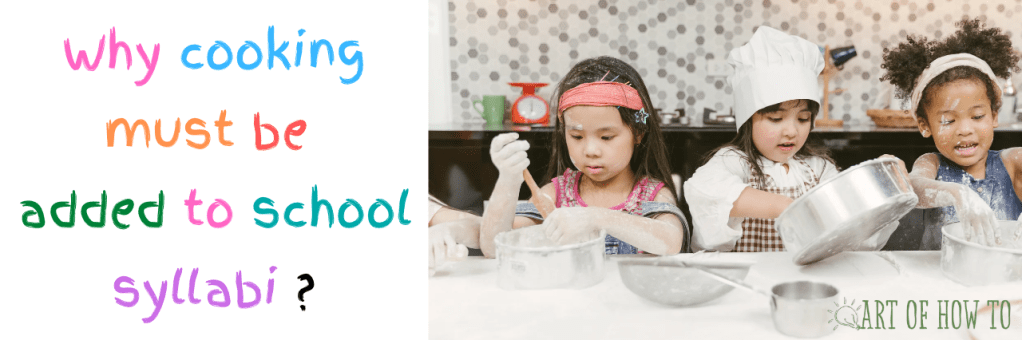
Little Ones Can Cook Too

“Cooking for children is not about ingredients, recipes, and cooking. It is about harnessing imagination, empowerment, and creativity.” – Julia Child. Indeed, cooking is a beautiful experience – a harmony of the three ingredients mentioned by Ms Child and with a dash of unique aromas and tongue-tingling food.

The age of two to ten is a phase of curiosity and learning new things from external experiences. Sensorial experiences rule this age range – taste, smell, vision, hearing, and touch. Of these, taste plays a dominant role in a child’s life. It is time for the child is exploring smells, tastebuds, and flavours. Once children cross four years, their tastebuds start becoming distinctive as well. It is the “my favourite food is this” phase. You will often be hearing about foods they love at this time. 

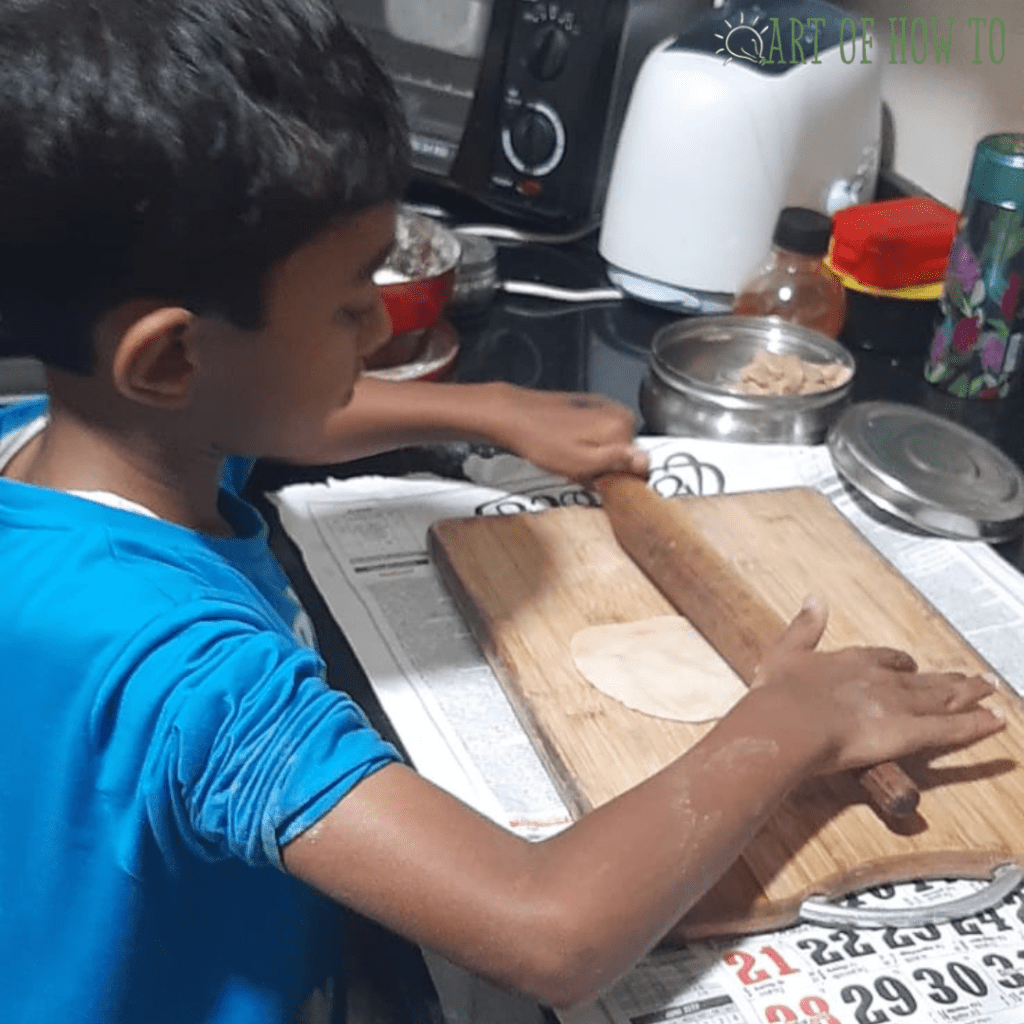
Have you thought about teaching your children cooking? Wait, most of you will gasp, I am sure, when I say this. Many of you may be thinking: “How can we teach children cooking? Aren’t they too young to learn it? Fire is dangerous, and so are hot vessels”. Well, as they say, you can never be too old or young to learn cooking. You can start with basics (minus knives, sharp objects, or fire). Yes, you can teach them how to do fireless cooking. Begin teaching basics at home, like a topping for a sandwich, encouraging them to spread the filling inside it or sprinkling from the herbs bottle (of course, all this with supervision), and applying cheese on a loaf of bread or paratha. There are many ways to introduce children to cooking at home. 

Just like home is a hearth for love, hopes, and dreams, a school is a hearth for beautiful memories and life skills. What you learn in school is irreplaceable and is for life. For example, cooking is one of the best life skills we can ever gift our children. They say you can survive anywhere in the world once you learn how to cook. 

There have been a lot of gender stereotypes surrounding cooking for years too. For instance, at home, it is a girl’s domain to cook in the kitchen, and boys need not learn to cook since a wife will cook for them in the future. Most of these myths are no longer there, but we still have a long way to go. 

Schools can do a lot to bust these myths by adding cooking to their curriculum. This way, all children can learn this valuable life skill. Have you imagined the school syllabus to have cooking as a formal subject? The higher classes in some schools in India have it as a part of life skills rather than as a separate subject. Mostly, it is only vocational schools in India that teach cooking separately as a subject. Mainstream schools do not do the same, though. 

1. Activates all senses 

While cooking, one needs to use all sense organs – eyes, nose, ears, tongue, and skin. Children will learn how to focus and concentrate on the food being cooked. Once cooking is done, they can also taste and judge for themselves if the cooked food is good or not. 

2. Makes theory practical 

Whatever the children learn at school – Maths, Science, English, and other subjects, can be applied to cooking. For instance, cooking entails a lot of precision in ingredients, and Math concepts can be applied to learn the quantities and volume of components used in a dish. In addition, children can learn to apply scientific concepts to learn more about the combination of certain ingredients and the flavours they will produce. 

3. History, values & culture 

Schools can initiate this by telling children how some dishes originated and their backgrounds. Stories will activate the interest, stimulate children’s imagination, and interest them in cooking.

4. Explore 

While teaching different types of cuisine, a child can develop an interest in tasting new foods and flavours. Many picky or selective eaters start wanting to learn cooking too.

5. Teamwork & skills 

Assigning responsibilities to each child, from adding ingredients, measuring them and mixing in a bowl, and even tasting the dish, can go a long way in children learning to cook. Children learn to cooperate better to make the meals a success. Lesser conflicts are seen when it is a team working together.

6. Builds positive food memories 

School life can be colourful and offbeat thanks to cooking classes and experiments in the kitchen. Children will have fond memories to look back at. Pictures were taken while cooking can be memoirs for both parents and children. Teachers, in particular, can beam in pride at having taught a valuable life survival skill.

7. Builds self-confidence & self-esteem 

It is a feel-good experience for children who make dishes independently or in a group. Confidence levels go up, and children also improve their focus in other subjects. They become more independent and help out their parents better too.

8. Correlation skills improve 

Learning to cook ensures children can link two different concepts better. For instance, while making a dish, they can correlate to an idea they are learning in history – a particular dish can remind them of a historical period and the characters who ate it. 

9. Spelling boosters 

Names of recipes and ingredients can add to their vocabulary. Encouraging them to write or record recipes in notebooks or diaries will help them remember the dish better.

10. Kitchen safety & rules 

Lastly, all of the above points will work only if the child is taught how to handle each kitchen tool in the kitchen effectively. Then, teachers can guide safety measures. This can go a long way in empowering children to tackle emergencies at home and outside effectively.

Parents and teachers, trust me, you will be amazed when you see these tiny kids cook you unique dishes. A message to all the children, “learn how to cook and try out new recipes. It is okay to make missteps but do learn from them as well. Make the kitchen your fun zone and help your parents and siblings! Enjoy new flavours and aromas. Happy Cooking“.

She is a quirky writer/photographer/closet poet and singer who has traversed a non-conventional path. As a former entertainment journalist who has worked in print and online media for a decade, Priya loves talking to people and writing their unspoken stories.

She is a single parent of a 8-year-old son settled in Tamil Nadu and a Content Consultant/ Communications-PR Manager. She is also an informal mentor to parents in her local parenting network. She dreams of being an author of a book and maybe the scriptwriter of a film someday!

Follow Priya Rajendran

Unplug

Plug out of the reel into the real

After being extremely saturated, I decided to simultaneously go unplugged from the real and reel world. Our friends too severely needed a break, so we chose the New Year. My son had been complaining about not being able to spend as much time with me. It was time to do it. Of course, it was not as easy to imagine me minus my attachment – my phone. Yet, I stuck to my firm resolve to unplug this time. 

As we all know, New Year is when we want to wish everyone around, and at that time, we hook up to our apps and the millions of GIFs or animations sent and re-sent to all our friends. The midnight countdown (unlike earlier when it was on TV programs) is on social media reels or memes now. No longer are we hugging our friends and greeting them at midnight or making phone calls. Social media has shrunk timelines and reduced our wishes to text messages or GIFs/animations. It motivated me to be off gadgets. It was time to usher in the New Year uniquely.  

For three days, we switched off all our devices and became ourselves – raw, organic, and authentic. We stocked on all board games, slept, read, went for a walk, swam, and did what we wanted to do consistently. Then, on New Year’s eve, we played music and danced like crazy. We did a countdown on our watches, and as the needle struck 12, we greeted each other amidst hugs and loud shouts, cheering to our sounds and the firecrackers being burst in the vicinity. 

Those three days transported me back to when we did not have smartphones and only had landlines. I realized that we never really cared about the time we went out and came back home. There was no phone to keep a tab on where we went or did. It was indeed a carefree time. Those from the 2000 and pre-2000s era would be able to relate to what I just said. During that time, we got wet in the rain without getting tensed that our phones or even our clothes would get spoilt. We moved about freely and did not have to keep checking our pockets to see if we had misplaced our phones. Ah! We did check if our wallets were intact, though! That was an unplugged time. 

During the three days, we just relaxed, shared our thoughts, vented our emotions, and lay on bare grass unabashed. If we felt like it, we danced too. None of us surprisingly missed our phones/laptops/work. It was as if that world had never existed. At the end of the third day, we returned rejuvenated, tired (only physically), and with loads of memories! It was indeed an emotional detox for us. I came out born as a new soul.

In the digital era, we are entirely restricted, and many have built virtual walls around us, resulting in emotional choking often. The pandemic made it worse. We went into a further shell. It plugged us out of the physical world as we dived deeper into the virtual world. In two years, we all got hooked to all devices – laptops, mobiles, tablets, palm tops, etc. thanks to online classes, workplaces, and even schools. Children especially took the hit, doing their homework and spending maximum time on devices. Our family time became consumed by gadgets – consciously or subconsciously. 

The awareness that we were too entangled in our virtual world came late to most of us, but we are making amends for all the lost time. Slowly yet steadily, we are all returning to pre-pandemic times – traveling, having more family meal times, going to the hall for movies, indulging in playtime with children (board games and outdoor sports), meeting friends, and having good old house parties. 

Travel and concept-based event companies across the globe are also coming up with novel ways to get us to couch potatoes, aka laptop folks, into the wild and outdoors, minus our attachments. Travel bloggers are traveling more and motivating people to get off the screen and explore new places. Holistic healing gurus and leaders are reinventing their strategies to bring back people into the real world from the reel. Corporates aren’t far behind, either.

More companies are creating “Workcations” for those who want to take a break from the usual office routines. The term means working while taking a vacation from any remote location. Bosses found that employee productivity shot up after they started going on workcations. You can quickly turn into a travel nomad while working. At the same time, it is easy to plug out and complete deadlines at one’s convenience. Plugging out is good as long as work is done and deadlines are met.

On this note, I am signing off with a cuppa tea and a beautiful Swedish term, Fika. Fika, pronounced fee-ka, means a moment to slow down and appreciate the good things in life. 

——

She is a quirky writer/photographer/closet poet and singer who has traversed a non-conventional path. As a former entertainment journalist who has worked in print and online media for a decade, Priya loves talking to people and writing their unspoken stories. She is a single parent of a 7-year-old son settled in Tamil Nadu and a Content Consultant/ Communications-PR Manager. She is also an informal mentor to parents in her local parenting network. She dreams of being an author of a book and maybe the scriptwriter of a film someday!

Follow Priya Rajendran
Tattoos Souls Reflection

How many of you have got yourself inked? Yes, you heard the word right. That is the new gen way of asking if you got a tattoo. From the millennials to the Gen Zs and Gen Alphas, it is a style and identity statement to sport a tattoo these days. As the year ends, many want a great beginning to a brand new year. So, a sparkling start is good. 

Tattoos have suddenly become a part of people’s resolutions every New Year. They symbolise what you want – your goals, dreams, ambitions, feelings, and philosophies. But, most importantly, they define you as a person. 

My affair with tattoos began just a year before I hit my 40th milestone. I got this strong calling within me to get myself tattooed. The calling had come long before that, but I could not pluck the courage to do so. Thanks to hearsay from everywhere, I kept visualising the worst. But this time, I was determined to beat my fears and go for them. I am sure you will have stories about how you got your first tattoo inked and reasons behind inking too. Here’s mine.

I had heard from friends that tattoo designs often come instinctually and from one’ soul. It was my first tattoo, and I wanted it to be remarkable. After all, it is a permanent one, and it had to symbolize something substantial. So I meditated, went deep, and imagined what I wanted. I wanted my tattoo to represent freedom, infinity, and my son. So instinctually, I drew the design on paper and showed the tattoo artist. She loved the idea. Let me tell you a secret: I have been scared of needles all my life. I wasn’t sure how much pain I could endure and if I would start screaming in the middle of the session. I kept having wild thoughts the night before. Since I strongly wanted the tattoo, I decided to give it a shot. It was going to be my maiden experience in a tattoo studio. I had envisioned it to be a dark room with dim lights and a bed where I would be asked to lie down. Thanks to my imagination running wild, I thought of all possible scenarios. But when I walked in, I had a pleasant surprise. The TV was on, and music was playing in the background. The walls were brightly painted, and lovely wall art as well. My artist welcomed me with her beautiful smile and, after that, led me to the chair. Although I must admit the sight of the tattoo machine did unnerve me for a while, I decided not to look at it. She carefully chose a new needle from the pack, showed me before beginning the session, and confirmed the design. It took a while to break the ice, but once conversations started flowing, and she started tattooing, I forgot the pain of the pricking sensation. It took about 45 minutes for the tattoo to be completed. Once it was done, it was a beauty to behold. This tattoo was a step taken toward self-love for me. 

In 2022, I ventured again and got myself inked the second time. But, this time, it was on my arm. I have often been fascinated with ancient symbols and their meanings. So, a besotted me got myself inked with a Celtic knot – it represents unconditional love and strength.

Tattoos symbolise different things for various ethnic groups and races and have multiple connotations. So how many of you know when humans first took to tattoos? Is this a recent fetish, trend, phenomenon, or an ancient art form? Let’sLet’s dive into the history of tattoos.

Let’s look into the tattoo timeline. There is evidence that tattooing is quite ancient and dates back to the Neolithic period. Interestingly, archaeological records show that the oldest mummified man to be found with a tattoo, called Otzi, the Iceman, dates back to the timeline between 3370 and 3100 BC. Otzi had 61 tattoos! 

After discovering his remains, archaeologists found more bodies from nearly 49 sites across the globe. These sites are located in the Philippines, the Andes, Greenland, Alaska, Mongolia, Siberia, western China, Egypt, and Sudan.

The inking tools used by ancient man ranged from bronze needles, chisels made from bones, sharp stones, and even piercing thorns. Ancient Egyptians tattooed themselves to protect themselves against evil spirits; hence, their tattoos were geometric shapes, animals, and gods. The ink was soot prepared by them in which these sharp needles were dipped. 

The Maoris of New Zealand have a unique name for tattoos – Ta Moko. For them, tattoos were unique as each design represented the various tribes, ranks, and statuses. The Uhi was a tool used to ink tattoos on bodies. It was bone sharpened and then attached to a wooden handle before inking the tattoos. Cuts were made in the skin, and the tool was used to carve the designs. The modern humans of New Zealand have now revived this custom which almost died in the 19th century. 

The Inuits of the Eastern Canadian Arctic believed that young girls must be tattooed to show the transition to a woman – the beginning of their menstrual cycles. For them, these tattoos on women symbolised beauty, strength, and maturity. It also was a gateway for women into the spirit world. Tattoos were mostly made on the face and other parts of the woman’s body. In the Inuit’s Inuktitut language, face tattoos are called “tunniit.”

For all tattoo lovers, there is a treasure chest of information on the web about the origins of tattoos and reasons why people got inked back then. Whether an ancient man or modern Homo Sapiens, tattoos have remained a fascinating facet of our lives. 

Interestingly, if you read more about tattoos, you will even come across why tattoos were disliked as well. Modern humans consider employees who are tattooed as unprofessional or those who slack off at work. Tattooed individuals were looked down upon as rebels too. More often than not, people started using tattoos to represent strong philosophies and ideologies in modern democratic settings, giving it a rather racist touch. Most armed forces across the world, too, do not accept candidates who have tattoos. 

So, yes, be mindful while choosing your tattoo. Let it preferably be something YOU, and something that symbolizes yourself. After all, it is inking for life! Cheers to everyone for a fantastic year ahead, and happy tattooing! Signing off with my favourite quote by Johnny Depp. This resonates with me now more than ever, “my body is my journal, and my tattoos are my story.”

She is a quirky writer/photographer/closet poet and singer who has traversed a non-conventional path. As a former entertainment journalist who has worked in print and online media for a decade, Priya loves talking to people and writing their unspoken stories. She is a single parent of a 7-year-old son settled in Tamil Nadu and a Content Consultant/ Communications-PR Manager. She is also an informal mentor to parents in her local parenting network. She dreams of being an author of a book and maybe the scriptwriter of a film someday!

Follow Priya Rajendran
New Year, New Me

Pause…Breathe…Reflect! Nature has its way of applying brakes in our life. It does send us feelers and reminders on how we lead our lives, but we tend to block the reminders or skip them. Instead, we use excuses to stave off cravings, our fast-paced life, busy careers, family time, and most importantly, ME time to get on a fitness routine. So, when all alarm clocks go off at the same time, nearly screeching in our ears, we wake up one day and realize: Uh, oh…let me pause and reflect. At least once in all our lives, we have had such screeching alarm clocks blown in our ears. 

Two years ago, Corona was one of the screeching alarm clocks sent to us to pause and reflect. It doesn’t matter who sent it. Either way, the two-year break in all our lives (for some, it is still ongoing) made us think about the value of things in our life – us, our families, our special moments, career milestones, and even educational milestones. It made me wear my thinking cap too. I had completely ignored my fitness and stamina until two years ago. I would not remotely look at the weighing scale, grandly declaring that I am sure I am fit. Yes, I do annual health check-ups and have been given clean chits. But it made me realize that these reports aren’t precisely measuring my stamina. Having all vital stats in place is excellent, but I still needed to recover my lost stamina and endurance. Running around my 8-year-old son made me realize the importance of fitness even more and a stark reminder of aging. 

I had ignored myself for far too long, thanks to years of body shaming and other reasons. Body shaming is one of the key reasons many people stop looking at themselves in the mirror, considering the calories they consume and their sedentary lives. The pandemic made me re-look at myself in a new way. I started facing the mirror daily, looking at my body each day I had a bath. I started acknowledging my body, accepting its flaws, and speaking to myself, saying – “It’s my body, and I am proud of it!” 

The next I asked myself: “Am I fit enough? Can I do something to respect my body better?” Again, I got my answers from within. Another response I got from my gut was that being fit isn’t only about physical fitness. It is supposed to be holistic – an amalgamation of physical and mental wellness.

10 Reasons Why
We must set self-fitness goals 


Trust me, your gut/inner voice will also give you answers. Once you get the answers, you will take action instantly. So, I chose Zumba since I love music and dance (my inner calling). This helped increase my cardio fitness, but then I realized I needed to work on all body parts to increase flexibility. Also, since I am people-oriented, I wanted to join group fitness classes, and another pre-condition was timing. Luckily, things worked out, and I began an active workout regime with my gang and our trainer. So, I suggest you choose your mode of workout – something you would love to do consistently, and kickstart your new routine. It will be exciting for you to fall in love with yourself.

1. Having a checklist of health goals

It is an excellent time to make your soft board attractive with colourful sticky notes. Write all your health goals. For instance, stamina, flexibility, weight loss, etc. It could be different for everyone. 

2. Keeping tabs on physical parameters

Consult a physical trainer/coach to see if your physical and vital stats are in place. It includes the following:

  1. Cardiovascular fitness
  2. Muscle strength & endurance
  3. Body flexibility & composition
  4. Makes measurable fitness plans

For instance, if your goals are like joining yoga, meditation classes, or starting jogging and running, they must be measurable too. In other words, mention the number of days you will achieve these goals. It makes you acc

3. Prevents over or under workouts

Once you set these goals, you will stick to exactly how much you need to work out to lose or gain a certain number of kilograms or pounds. It makes sure you will work out right.

4. Ensures consistency in workouts

If you work out at the correct time intervals, achieving these goals will be your next top priority. Regularity makes a difference when you have to achieve goals.

5. Having workout buddies

Sometimes you aren’t motivated to do workouts on your own or achieve your workout targets. A like-minded gang helps boost and push each other to reach their respective goals.

6. Enjoying your wellness journey

It is vital to enjoying every step that you take towards improving your fitness levels. Therefore, you should choose and chalk out achievable health goals of your choice (without looking at Instagram/Facebook profiles). Then, keep them pinned on a soft board.

7. One step at a time

The aim must be to go slow so you can enjoy a longer and healthier lifespan on Earth. Setting fitness goals will ensure that you plan baby steps.

8. Tuning to your body signals

The essence of your fitness journey must be to listen to your body closely. Go inwards, listen to your inner voice, and feel what each part of your body says. It is essential to do it daily. 

9. Make your body your best friend

Self-love is the key. Start speaking to your body, repeat affirmations – positive statements about how you enjoy your fitness journey for your beautiful body. The first statement must be: I love you for what you are and accept you for all the curves and valleys. Hug yourself tight after that!

10. And Don’t Forget to Live

Always remember to be kind to self. If we are not kind to ourselves, we cannot be kind to others. Remember to smile to yourself and self-care is not selfish.


Signing off with this food for thought for all of you: “Don’t wait until you’ve reached your goal to be proud of yourself. Instead, be proud of every step you take toward reaching that goal.”

To Blame or Not To


When a relationship fails, a zillion theories float about what transpired. Relatives and friends do a mini post-mortem. The moment spouses or partners part ways, judgments are passed, and the famous blame game begins. What, Why, When, and How are the favourite questions asked in turns? Ideally, what happened at the time must remain between the duo. But rarely is privacy maintained thanks to the “concerns” of families and friends.

There are myriad reasons for the disintegration of relationships, breakups, separation, and divorces. Once the honeymoon phase ends, the next stage is crucial. It is when the foundation of trust and mutual respect is built. The second phase of the relationship is where people start showing a side of themselves they never revealed during the initial days of dating or courtship. The feeling of being unwanted, taken advantage of, and abused by the partner mostly begins in this stage. Next, a lack of trust and misunderstandings make their way. Where there is abuse, the first instinct is often to forgive the first occurrence. The power play also spoils relationships. A sense of feeling superior overpowers the equality between partners. Then there are well-meaning friends, families, and relatives who decide who is right and wrong the moment they know a relationship is going awry. Finally, unwanted, unsolicited advice affects the couple’s ability to reason. As a result, it is a crazy mess of a beautiful bond that could have been saved if there had been clear communication.  

Recently, reading about the reasons behind marital discords and divorces in India provided some insights. Money ranked as the top cause of divorce. The other reasons were intimacy, deviant peers/buddies, poor division of labour at the house, parental ideological differences, addiction, and lack of communication. 

But I am sure the list is variable. It can differ in all relationships, including dating, marriages, and live-ins. But unions and live-ins are the only relationships that come under society’s scanner since they are the only ones legal in India now. Society generally perceives relationships other than marriage as casual; hence, they should not be taken seriously! 

While old-timers will blame an unmarried couple for having relationship issues because they aren’t married, ironically, married people are also accused of not treating their partners appropriately or doing “enough” for the relationship to be stable. In other words, no matter the relationship status, society is bound to blame them. Often, couples are judged and labeled unceremoniously when the relationship isn’t taking the route “it should be taking.” Then, instead of allowing the couple to sort their differences out, the connection gets further messy, with people interfering, offering unsolicited advice and pities.

As they say, “it takes two hands to clap” it does take two people in any relationship to put in equal effort to make it work. So if I were to rearrange the order and add some more to the reasons for marital or relationship discords/divorces, these would be my order:  

Intimacy –

When there is a lack of physical and emotional intimacy, especially physical, the relationship does suffer. The lack of connection between partners causes a rift between them. 

Poor communication – 

Relationships take a hit when communication breakdown and invisible walls are built between couples. No transparency and honesty remain in the relationship.

Lack of mutual trust – 

Walls between couples become a perfect recipe for a breakdown in faith.

Division of labour at home – 

When the responsibility of household chores and children falls on one person, the partner in question buckles under pressure. Frictions arise, and conflicts spiral into daily fights.

Parental ideological differences – 

There are inter-generational clashes, and more often than not, it affects relationships. Couples come under the pressure of family expectations to behave or live a certain way, much against their interests. As a result, more often than not, partners don’t see eye to eye and end up going their separate ways.

Substance abuse & addictions –

In almost every family, the following habits are commonly seen: gadgets, liquor, drugs, and even social media. Couples are getting distanced because of these addictions.

Poor peer influences – 

They say bad companies can destroy people and ruin good relationships. It is one reason most couples who parted ways on bad terms quoted. Interference by such “friends” can spoil everything around.

Out of all these mentioned above, I would say parental ideological differences and peer influence can be held as least responsible for a crumbling relationship. However, substance abuse (liquor and drugs) contributes significantly to deteriorating relationships. More often than not, people abusing substances get violent and abuse their partners. 

Domestic violence increased a lot because of this during the pandemic, and it was sad to see people remaining trapped in relationships thinking their partners would overcome the addictions and tolerate abuse. The recent cold-blooded murder of a girl by her live-in partner sent chills down the spine and shook the nation. It is a shocking example of one of the many cases where substance abuse proved fatal to the partner. She kept giving the benefit of the doubt to her live-in partner, a drug addict, thinking he would change. Sadly, her friends are now slowly opening up, saying they saw the red flags in the relationship but failed to stop her. She had rebelled against her family to live with her boyfriend. Following this, her family cut her off, and when she started suffering abuse, she couldn’t return to her own family, which was her safety net. This isn’t to say that live-in relationships are wrong but to make people aware that they need to see red flags when they enter a relationship.

After this horrific incident, more cases of abusive partners are reported, and people are opening up about the abuse they suffered in their relationships.

A healthy relationship entails open communication, trust, honesty, mutual respect, and unconditional support. Of course, love remains on top for a good relationship but with healthy boundaries and space set by each other at the beginning.   

Divorce/breakups must be the last option, but if it breaks you from within, it is excellent to walk away from it. Toxic relationships only scar you, so please do not blame yourself for it and walk off immediately. 

Signing off with a recipe for a happy Sunday. Take a big pot. Add a scoop of communication, respect, acceptance, empathy, unity, boundaries, choice (yes, u do have), efforts, honesty, and garnish with love. If you have the above ingredients in your relationship, ask yourself: “To be or Not to be” with your partner.

Follow Priya Rajendran

I Am Possible


“I am fabulous.” “I am awesome.” “I am good at solving problems.” “I can do anything.” “I am strong.” How often do you say this to yourselves? Yes, you may have your good friend telling you this, but do you do this for yourself? If you answer yes, then it is impressive. But if not, please start doing this. 

The statements mentioned earlier are called affirmations. In other words, they mean “the action or process of affirming something.” It means statements reflecting positive energies with a focus and an end goal of achieving something. Affirmations are also linked to emotional wellness; to be an emotionally thriving adult, we must first be emotionally healthy as children. Gentle affirmations are not toxic. They are simple ways to remind ourselves we are going well. We can do it, a subtle way to boost our inner self – a moral boost to our confidence.

Children are the most affected in this competitive world and changing social fabric. Thanks to stress and pressure from adults and external surroundings, children subconsciously become shock absorbers of all negativity and negative emotions. As a result, children end up mimicking their caregiver’s and family members’ behaviours, little knowing how to deal with them. 


For instance, if kids see adults screaming at each other or going into silent mode, there is a high tendency for they will start doing the same. Likewise, if adults suffer from self-esteem and confidence issues and do not know how to cope, how do you think children will learn to manage? Whatever family structure the kids belong to – single parent, nuclear families, co-parenting families, or joint families, all are affected synonymous. 

So, how can we help our children grow in a healthy environment? How do we boost ourselves emotionally and pass on similar positive energy to our children? In other words: how do we self-empower? Adults do so by journaling, writing affirmations, self-care, quality sleep, physical activity, avoiding alcohol and caffeine in the evening, cutting chords with toxic people, etc. The tips mentioned above can be taught to children as well. They can be taught simple ways of expressing themselves and encouraging positivity.   

So, when can children start writing affirmations? Do we have any age/time limits to create positive affirmations? You guessed it right, as early as they began learning to write. 

quick tips for children to write affirmations

1. Request them to think about dreams/beliefs they want to include in their life. You can tell them to say it to themselves aloud. Most importantly, believe in them while saying.

2. Once you know what you want, start writing the messages in complete sentences.

3. Jot statements in the present tense with an active voice – "I am enjoying a stress-free vacation" or "I am building my blueprint the way I want it to be."

4. Use positive words in statements. Avoid using negative tones like expressing doubts in the comments you are writing – "I wish," "Not sure if it will happen," or even future statements like "I will do XYZ" or "I will start believing XYZ."

5. Keep telling them "Never indulge in self-shaming. Be proud of who you are." 

6. If writing differs from what your child likes, try asking them to draw on the mirror with their fingers or even draw anything they want to achieve on a piece of paper. 

7. If writing or drawing also doesn't interest your child, suggest the child orally frame affirmations, sing them aloud daily, and dance to their composed tunes.

8. Have you heard of a money box or a piggy bank? Make one colossal piggy bank of a cardboard box where affirmations (small one-liners) can be written on chits of paper/cardboard and dropped in as and when they write. They will be like currency. Every week, they can open it and re-read whatever they wrote. It can be one affirmation per day.

Children can read these statements daily when they begin their day. Another thing is you can continue to add to this list. Affirmations change with various milestones; hence, the child can be encouraged to form the statements minus grammatical corrections/any editing by an adult. After many years, these very statements will become beautiful memories for a child after turning an adult.

If your children are too young to write, you can write/frame the statements for them. Take their suggestions when you write them. You can use colourful sticky notes (with small messages) pinned on the refrigerator/soft boards/cupboards and all places where they are likely to see them. The more they read them, the more the positivity absorbed by them. As they say, children are akin to a sponge. They will absorb all that they are exposed to. So why not surround them with positive messages? Of course, it doesn’t mean you overprotect them with toxic positivity – avoiding reinforcing unrealistic beliefs. These positive messages must be realistic and achievable. They will keep them grounded and help them develop a healthy emotional relationship with themselves and others.

10 Reasons Why

affirmations are suitable for children

1. Builds self-confidence – As children, these statements mean a lot and help them take up challenges to do things they consider problematic. Since they are framing it themselves, it is an "extra edge" feeling for their self-esteem.

2. Helps handle big emotions – Affirmations can help children label their feelings better and cope with them.

3. Improves focus – Children can create goals for themselves by writing them down. It isn't only enough to list them. Affirmations can be framed so that the child knows they need to achieve the goal at any cost, and the only way is improved concentration.

4. Ability to resolve conflicts – Whenever they have a problem, these affirmations will come of help. They will find new methods to decide issues vis a vis running away from them.

5. Encourages positive self-talkEach time they hear a criticism, they will remember the affirmations, which will trigger inner positive conversations. This will help reaffirm their own beliefs.

6. Energizes the mind during classes – For students, these positive statements or phrases can be recalled at any point of time in the day, especially in school. It will help them re-focus on the subject they are learning, especially if it is difficult to master.

7. Helps in team motivation – Children can use affirmations to boost each other's spirits before beginning their group presentations and even use them effectively during the activity. 

8. Resolves body image issues – In almost every school, children tend to body shame others – some subtly, some directly. Children get badly affected by listening to such conversations. Affirmations help resolve body image issues and restore self-esteem.

9. Setting new challenges – While learning to do a new task or activity, positive phrases are a powerful tool to reinforce confidence to do new things they haven't done earlier.

10.  Self-Esteem matters – As a tool, these statements instill a feeling of accomplishing a task – big or small. That feeling remains for a lifetime. 

Leaving you with my favourite line – “Nothing is Impossible. The word itself says I’m Possible.”

Follow Priya Rajendran

My Goa Diaries


Sun, Sea And SandIn my 40th year, I had almost given up on this dream of mine until this plan manifested. Yes, I feel somewhere, the Universe finally conspired to send me to Goa. It was my best gift to myself before 2022 concluded. Yay! I screamed and fisted my hand high in the air. It was super thrilling and surreal. 

My college buddies and I had carefully crafted a Goa plan! In our final year, we made a pact to reunite in Goa yearly (our own Dil Chahta Hai goal), drive around on bikes, etc. Unfortunately, neither the reunion nor the Goa trip happened. The plan sank amidst all our life plans. I moved out of Mumbai and went south for my education. My crew also scattered, each dragging into their life and career goals. Goa ended up being a part of my endless bucket lists of “places to go, and I wish to go.” 

So, when this plan emerged, I did hesitate a bit, but in the end, I just gave into the squad spirit and got in headlong! The best part about this trip was that it was not only a maiden trip for me but the same for most of our gang. I have to mention that our bunch is an exceptional community for me or, rather, a like-minded tribe that connected and bonded like fire with a matchstick. Most of us were meeting each other for the first time after a long gap, making it positively memorable. 

For those who have been to Goa endless times and those who haven’t stepped on Goan soil (like me), it gave me a different perspective of Goa from what I had heard from friends. It exceeded my expectations about this tiny state ruled by the Portuguese centuries ago. The beauty of this state will leave you mesmerized – waves, sand, greenery, and extreme calm, even amidst the loud party music! It took me 24 hours to thoroughly soak in the atmosphere and be myself. 

So, after we landed in Goa at midnight at the Dabolim airport (most of the band reached late at night and others in the wee hours of dawn), we were busy catching up with our sleep. Once refreshed, we started exploring our nearest surroundings. Some of us took a walk around. We were put up in a place called Verla, Parra. It’s located in the quaint Bardez taluk, a scenic countryside where you can take endless long walks in its winding lanes that eventually join the principal roadway.  

Once all of us got ready, we all got set out for a late lunch. En route, we also caught a glimpse of the famous Biker Mania event, where dozens of bikers were seen racing in the dirt tracks. 

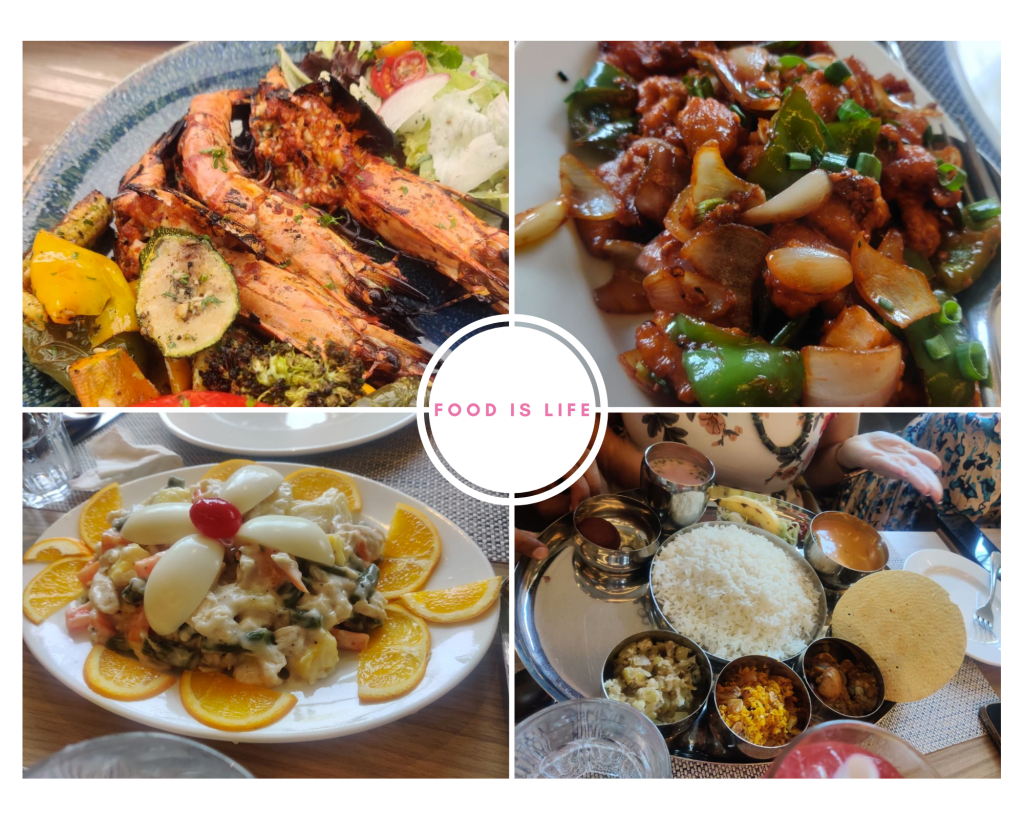
Our lunch was at a Mediterranean-style hotel on the Ozran beach road, nearly seven kilometers from our place of stay. The peppy music added to the beautiful ambiance and made us sway to the beats and be lost in a trance. But since Dil maange more (heart demands more), we quickly finished our food and made our way to the sea – our much-awaited part of the trip…. the beach. 
So, for all new to Goa, Ozran is also referred to as Chota Vagator or a small Vagator beach. It is an extension of the famous Vagator beach. In north Goa, it is one of the most captivating and panoramic beaches. When we finally descended to the beach, we were welcomed by a gorgeous sunset and skyline, where we melted with the waves and the crowd. A quiet beach compared to the others in the same stretch, Ozran is a relatively rocky beach with some unique carvings done possibly years ago (do watch out for those). We relished our dinner there with blissful music from the shacks and returned only after midnight. 

On our second day, we had planned a morning walk in the old areas of Goa, beginning with Panjim. Any Goa trip is incomplete without a walk in the legendary Latin Quarter or the Fontainhas. We got an excellent travel host who helped us explore these old lanes and see old houses. The three-hour walk soaked us into the centuries-old history of the state that was once ruled by various Indian empires, including the Kadamba Kingdom, Vijayanagara Empire, Bahmani Sultanate, and Bijapur Sultanate. During the Bijapur era, the Portuguese invaded Goa and ruled for over 450 years. It heavily influenced today’s Goan culture, cookery, and structures. India had to annex Goa in 1961 to make her part of this great nation. The colonial influences and multi-cultural creative influences are vibrant and stunning. 

The three-hour walk started at the Panjim Post Office (one of the oldest landmarks of Goa) and culminated at one of the oldest Goan-Portuguese bakeries and cafes called “Confeitaria 31 De Janeiro”. The area also houses old cafes, taverns, and colourful houses. The Confeitaria’s name has a fascinating history. The Portuguese meaning for Confeitaria means confectionary, and the second part of the name was kept after the date it was established: January 31, 1930. This cafe still has one of the oldest wood-fired ovens where they prepare all the baked delicacies. We gobbled and enjoyed all the traditional Goan delicacies and desserts like Bebinca (all-purpose flour, coconut milk, and egg yolk/white), Perad (guava and cheese), dates-walnut cake, and also their mouth-watering puffs and mushroom quiches while enjoying some melodic music played by our travel host on his guitar. 

We returned to our rooms, refreshed ourselves, and prepared for another evening on the beach. This time, we chose to explore Mandrem beach, a relatively quiet beach compared to its popular party hangout, Arambol beach. The best highlight of the beach is the drum circle, which happens there daily. It is a unique circle of drummers who play drums and customized instruments. Anyone can join the process and play away! A mesmerizing one-hour experience. Playing the drums for me turned out to be highly meditative and surprisingly calming for my mind (towards the end of the circle). Some of our crew leisurely did beach shopping; some got their hair braided, while others went for a comforting massage. Some masseurs offer their services at negotiable prices, and you can comfortably lie down and doze off. Make sure you take advantage of this experience as well. 

We enjoyed the sea, had our dinner at the shacks there, and lazed around with music till late at night, staying on till the early hours of dawn. Then, finally, we managed to catch up on a few hours of sleep and be refreshed for another day. 

Goa possesses an energy and vibe that makes people stay energetic despite not getting enough shuteye. The sea air does some magic to the soul. We survived most of the days with little or no sleep! 

One of the must-dos (apart from partying) is a trip to Chorao island, one of the biggest islands in Goa. The island is a natural biodiversity of birds and mangroves. So, on our third day, we had a beautiful ferry ride to the island and a memorable clay bath in a freshwater lake on the island, arranged by our travel host again. A three-hour experience there made us want to be there longer. We returned by evening back on the same ferry to the mainland. A small tip here for travelers: for any visit to the island, make sure you book a vehicle/cab, which can be perched atop the ferry boat to the island.

Since it was our second last day in Goa, we wanted to make it memorable. So, we finally hit the most happening beach in the area – Anjuna beach. The market starts right at the opening of the beach. You can get apparel, trinkets, and all sorts of memorabilia here. So, make sure you haggle well! After our satisfying retail therapy, it was time for sea and food therapy again. We spent the last few hours bathing in the sea, dancing to the tunes of our playlist (on loop) with drinks and a sumptuous dinner at a shack. Then, we played Secret Santa, exchanging gifts with our friends.

As a squad, we bonded so much. By the end of the trip, we wanted to sidestep parting ways so soon. So the last day was a potpourri of tearful hugs, goodbyes, promises of yet another Goa trip, and loads of selfies (apart from the million pics we had already taken during the trip!).

So, ticking off my bucket list, I sign off with a traditional Goan greeting in Konkani (language)while parting ways with ever-loved friends. “Mog Assuni” (Keep the love)

Follow Priya Rajendran