Friends And Friendship

A candid essay about friendship.

It's a new week and what can I do to make your day special? How about we talk a bit about friends and friendship. What does friendship mean to me? 

Friends are the family we choose, the beat to our hearts, the reason we laugh a lot, cry a little less, and smile a lot more.  And I believe friends bring more happiness into our lives than anything else in our days. Friendships are most successful if the expectations are natural and no ulterior purposes are set. When there is a motive behind it, normally we all have experiences of it failing and crashing too soon and creating heartburns and agony. For me, my good friends, ease my stress, give support and delight, prevent loneliness and seclusion.

I can warmly say I have made quite a lot of patrons over the years. I have had the opportunity to come across many individuals from school to college. And also to meet people through family, work, and other associates and acquaintances. And I am blessed in many ways because I am connected and in 'connect' with many and I call them all my friends. 

I will have to turn the clock back and take you back to those good old days. In those non-community living days, I had two sets of friends, one at school and one near home. This happened only because of the distance between school and home.  Remember that time, when you walk into a new class, you look for the space to park yourself for the rest of the year, and then there are those few who would look at you with wonder, and then offer the seat next to them and there you forge a pact, there begins the friendship forever.  We start looking for an affinity to connect and a few questions at home also trigger our thoughts, 'Who is your friend?, 'Where do they live?', 'Do they have siblings?'  and also important was 'What are their grades?' These questions had to have an answer to please our parents. Remember those days.
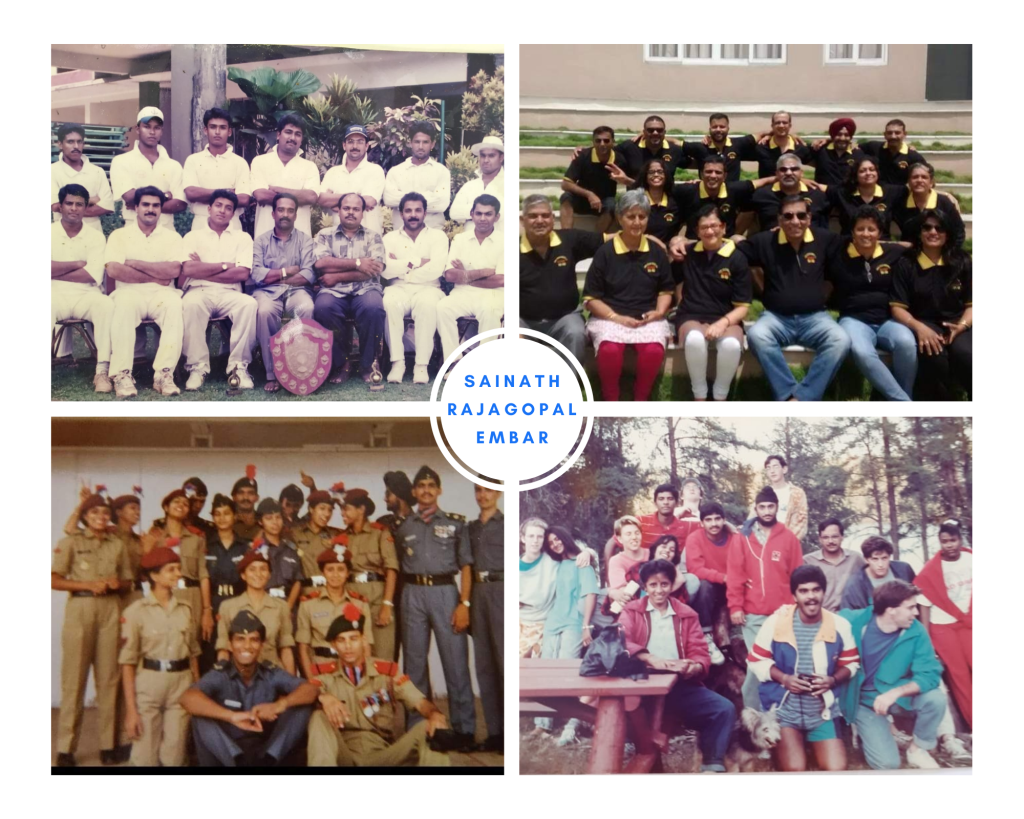
The best times of school were during recess and lunch break.  Sharing food, exchanging comic books, talking about the teacher who was super strict, movies, sports, and more.  It brought in wonderful learning of self-confidence, the ability to connect with all, and converse.  Friendship is different for all of us. There were few groups during those days, the studious in one group, studies plus sports mixed group, the sporting stars group, only fun group, and let's not forget the hooligans of our days, they made life scary and fun at those times. They were all and it was memorable. The bench friends are the closest as we move from every class till 10th grade and it's evergreen with love and warmth. The separation of school friends started after 10th and some went on to do diplomas, various streams of studies, different schools. I wish the internet was there those days to stay connected. So many of us lost connection because of the distance, accessibility, and change in each of our life's routes.

As one moves with age, oh! remember those peaks of teen years into the college space, it’s a new world. A clear feeling of an adult entering college than just being a kid. The atmosphere is vibrant and exciting and the friends one makes here are for a lifetime (in most cases). The affinity, liking gets aligned. Career planning conversations were remarkably interesting, as some of us planned to take up higher studies and few of us got into the workforce soon. Circumstances and life choices, situations, and visions made us all who we are today. 
Sport is and has always been an integral part of my life. Another big space for a new friendship to be forged, for people to develop a good connection is while playing sports, and being part of NCC / NSS, being a volunteer in certain group activities, clubs, conventions and social connect programs. I have had wonderful support from such friends across the cities I have lived and they continue to be one. Life-changing moments and life-altering people have crossed my paths due to these affiliations. 

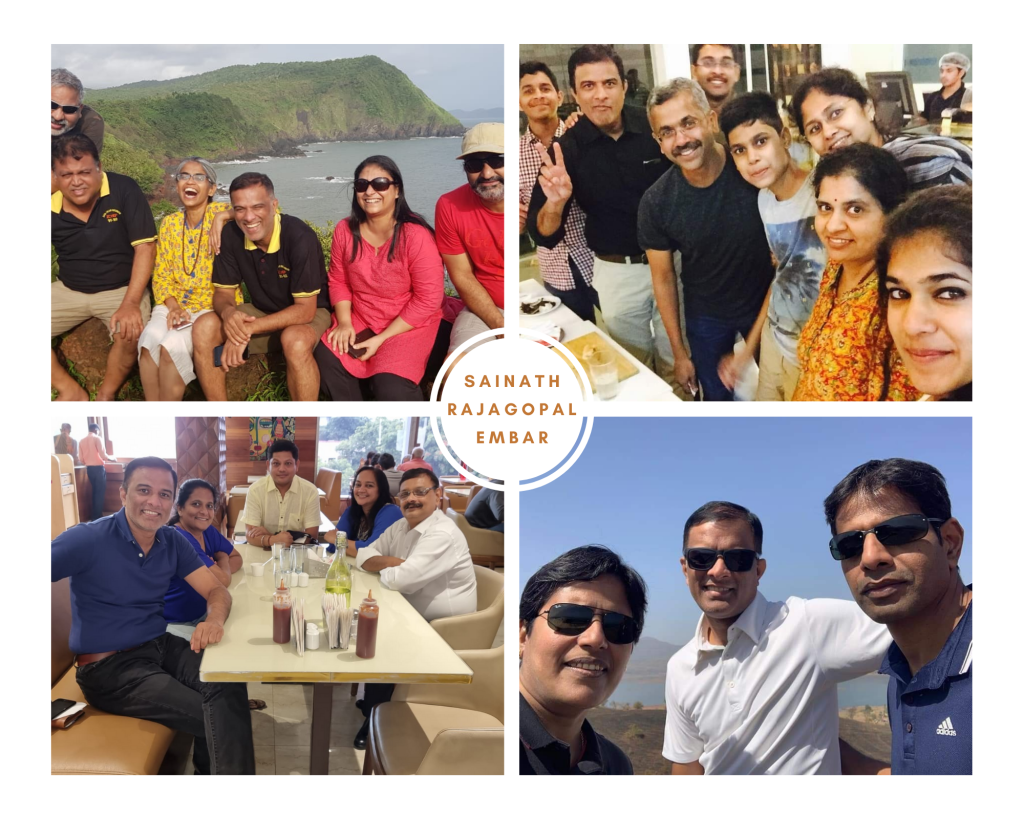
I have had an amazing friendship from my College  National Cadet Corps (NCC) days and it's so special to each one of us in the group.  We are from all parts of the country who were part of a youth exchange program in 1991 to Canada and believe me, it’s the best to have happened to all of us.  We all catch up now due to the covid pandemic through digital platforms, but when we meet up it's like going back to the days of 1991. There is always a feeling of bonhomie and even meeting up after months or years it looks like we all just met up.  Growing over the years, families started to meet up and now the next generation is part of the catch-up.  There are no words to describe the special bonding of this group of wonderful friends. Alumni meets are great moments to live up and we attempt to meet up every year now.   

Likewise, friends from the workplace – you make your choice of people whom you like to connect with for a lifetime. There is a good amount of open discussions to sort the way things look like and also a sounding board among us to understand the markets, work culture, problem-solving, outlook on career, etc. 
There are moments of support friendship brings in a big way. People find it easier to open up to friends than with relatives, purely I feel it is because they are not judging you. They accept the person as they are and try to find a way to support them at all times.  And the psychological support the friends give to one another, it's priceless and so beautiful.  The frequency is so tuned that the other person will start sharing their thoughts, issues at home, classes, workplaces, coping up with life, their aspirations, what they want to do. It’s a huge never-ending list one could relate to and remember.

There is a strong belief that you will become what and how your friends influence you. So it's important to be sure of the influencing factors which can impact you and your environment of family, community, and workplaces. 

Make good connections with people, be yourself and find your best moments of life with friends, as they will surely make you feel good and lively. Don’t look for friendship, as it has to evolve and happen as a natural progression, with good vibes, common interests, the ability to adapt to each other's situation, and more importantly comfort.

Friendship is a word of trueness and unconditional support, come what may. It is an area one would always relate their best of times, let it be school days, college/university days, neighbourhood friends, and new friends made at the workplace. Sometimes you meet a person and you just match, you are comfortable with them like you have known them your whole journey of life, and you do not have to pretend to be anyone or anything. You can just be you. So when you find those good souls, keep them close, never let them go. A genuine mate accepts who you are, but also helps you become who you should be. 

Cheers to good friends and always remember, the only way to have a friend is to be one.

Regards,
Sai
Follow Sainath Rajagopal Embar
The Trials Of Life

Introducing to you, a mother, a wife, a daughter, Sr. Clinical Project Assistant, and a survivor, Keisha Mathew.

Growing up in Ohio, young Keisha was the enforcer. She was articulate and clear on her life’s direction, partly. As she progressed in life, her path became clear and her focus sharp. During university, Chemistry gave her a hard time, yet she was no quitter. From choosing her career to choosing her life partner, Keisha had all sorted. With a growing family, and advancing career, and wonderful life, she was getting established in life. What could go wrong now! 

In life, nothing stays as we plan. There comes a time we face trials, hard as they can be. Even when the pain was unbearable, she fought through it and proved that she was not a quitter. This devastating turn in her life has made her stronger. Yes, this setback was painful, and it for sure gave her time to discover more about herself. Keisha is on a journey to finding herself. 

After a few years of battle, Keisha was back at work and was hoping for a career improvement that got stalled due to her illness. The good news is she will be starting a new position as the Clinical Research Study Management Associate where she will be running sponsored clinical trials. Life is incredibly amazing.

Sharing her unbelievable story of survival, triumphs, and trials and the everyday battle for endurance. We are in conversation with Keisha Mathew from Houston, Texas.

A conversation with Chippy & Keisha Mathew,
Sr. Clinical Project Assistant, Texas, United States of America. 

CKC———–Keisha, How are you? What have you been upto?
KMI am doing well. Thankful. It has been an eventful few years and Covid has given me a little bit of time to reflect on myself. When you said why you are doing this project and about your intent to uplift people and to help when people are stuck, I feel that. I am currently in that boat right now. I Hope that something new and more fulfilling will come along. 
CKCHope is what drives us. How was life during Covid?
KMIt’s like, trying to put a fire out and everywhere it starts. You are holding the extinguisher and trying to fight the fire around you. But no one is putting the fire out on me. Challenging times. I had to perform at 100% all the time in too many roles at one time. 
CKCAre you not able to find a space for yourself?
KMI just don’t have time for myself which is sad. I guess, after work, household chores, caring for the family, and tucking my kids into bed, I am exhausted. I definitely could find time for myself but I fear that it would just become another task for the day, and not something energising or fulfilling.

I have a routine but when I am out of my routine, I don’t know what to do with myself. That’s actually my “me” time, but I don’t know how to just focus on me. I talk to my mom often and I will tell her, ‘I am bored, I don’t have anything to do.’ She will tell me, ‘you need to find a hobby.’ That’s true, ‘I need to find a hobby.’ 
CKCWhat is your favorite pastime? 
KMMy life is surrounded by work, taking care of the kids, spending time with Rohit, my husband, taking care of the house, and being in touch with our families. Right now although I have a whole lot of friends and am friendly and I meet people everywhere I go, I don’t have hobbies.

Growing up I was into books. I used to read a lot. I know I should just do it. Lately, I have been reading for a little bit. Just random things, articles mainly. Then I started getting into audio books. The only reason to shift to audio books was to have something on when I was working. But did I really enjoy the book? ‘No’. It felt more like a chore. Also I was part of a book club a few years back. Maybe I should just join once again. At least it will get me to read again.  

The fact is I found it very difficult after becoming a mother and with my illness to find out exactly what it is that I like doing for myself, what it is that I want, and want to be. I am in search of that drive or motivation. 
CKCBefore we delve into your life, tell me who Keisha is today?
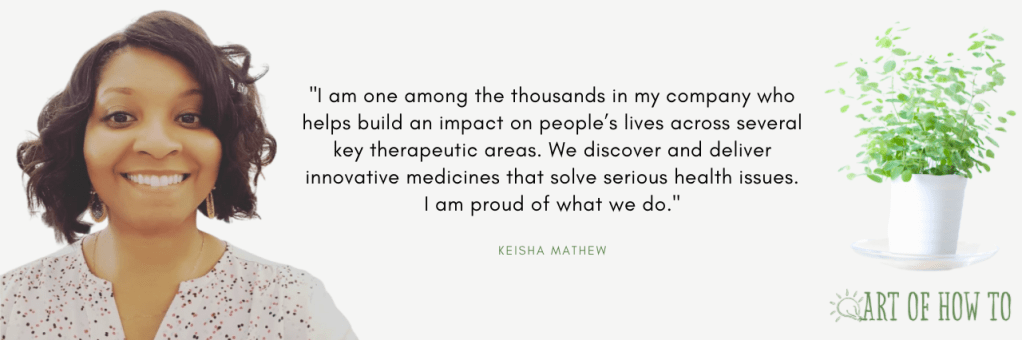
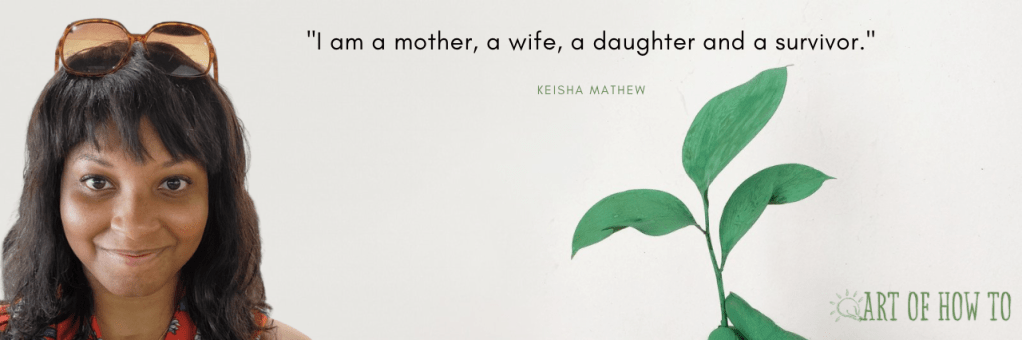
KMPersonally, I am a mother, a wife, a daughter and a survivor. Professionally, I am the Sr. Clinical Project Assistant for a Pharmaceutical Company just promoted as the Study Management Associate . I am one among the thousands in my company who helps build an impact on people’s lives across several key therapeutic areas. We discover and deliver innovative medicines that solve serious health issues. I am proud of what we do. 
CKCAt work who are you?
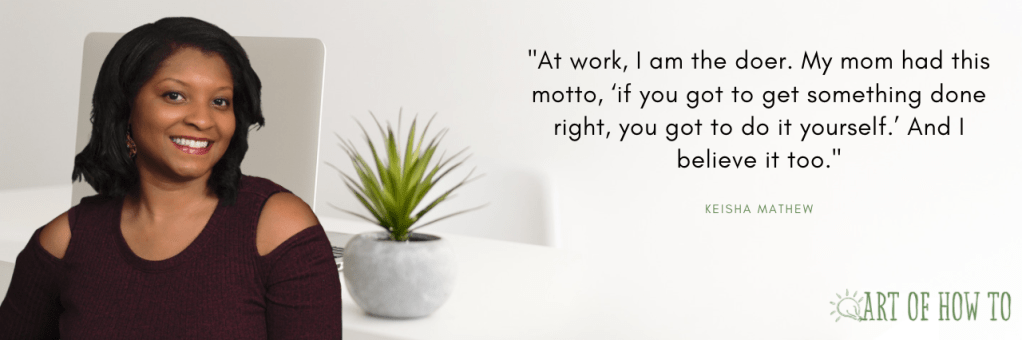
KMAt work, I am the doer. My mom had this motto, ‘if you got to get something done right, you got to do it yourself.’ And I believe it too. That’s why I say I am a doer.

What I do basically is help the clinical teams get trials started at investigative sites like hospitals, private practices, and so on. The team manages the study and I provide support to the sites to start the study at their location. Eventually, this support will lead to a marketable drug or device, and even a treatment or cure for a health issue.  In the end, I am giving them the drugs, or for better wording, investigative products to start the clinical trials. I feel like I am doing all the work, asking all the questions, and even to the point of thinking for other people. The latter is one of many pet-peeves of mine.
CKCWho was Keisha when she was younger?
KMBossy. I am the oldest out of my siblings and of the cousins from my mother’s side. I was always kind of put into the enforcer role, making sure that others don’t get out of line and if they do tell on them. My siblings and cousins called me the second mom. I hated that term, but I lived up to it.
CKCResponsible at a very young age. What did you want to be when you were younger? 
KMWhen I was my daughter Eliza’s age I wanted to be a doctor, an artist and a ballerina. 
CKCWow… That’s very specific.
KMYes, yet Ballerina was never going to happen because I never took classes. I realised I could not really draw, so being an artist was out of the picture. So I was wishing to be a doctor, so all my academics were steered towards that. 
CKC———–How did things pan out after school?
SMAt 18, in High School I got accepted to an Apprenticeship at Wright State University. This program was based on science, engineering and math. We were paired with Professors of the University specifically towards “our” interests.

Who knows at 18 exactly what they want to be, right? Well, during the introduction for this program I was listening  to the different professors discuss their research projects with their potential apprentices. Upon hearing a specific one about genetics,  that project gave me a clear idea of what I wanted to do in life at that time. I requested to be paired with Professor Dan Krane who was a Geneticist and also a Forensic Scientist. The interesting fact at this stage was that he brought back a memory that was not an important memory to me, but it triggered an experience I had as a pre-teen.
CKCNot an important memory but significant.
SMYes. When I was twelve, there was this big case about this football player, O.J. Simpson. The case was a national headline. I remember being in 6th grade and in class we all were glued to the television. It was literally the case that stopped the nation. Just to watch the verdict. We were 12 years old, and we don’t know this person at all. All we see is a black football player and knew nothing of him up until what he was accused of doing, which was murdering two individuals. I remember, everything stopped for the day, traffic was stopped, the whole nation was in front of the TV, waiting for the verdict. That was impactful. He was found not guilty, and there was a sigh of relief from my teachers. I guess to my teachers, he was their hero growing up.

Going back to the apprenticeship, I got to work under the doctor that worked on that trial. He was the one to help get O.J. acquitted. That intrigued me, so I worked under this doctor’s supervision, and I picked up what he was doing.
CKCWhat did you work on during this apprenticeship? 
KMMy project was identifying the genes of  an oak tree from Germany. Why was this specific tree important? Well, when Jesse Owen, the black track star that made history after he destroyed the Nazi myth of Aryan supremacy at the 1936 Olympics, he brought home four gold medals, and four oak saplings originating from Germany. It is believed he planted one in his mother’s yard in Cleveland, the second one at his old high school, the third stands on All-American Road at The Ohio State University(OSU), and the last one died. 

Our project was to do a genetic analysis of the tree that was planted on OSU’s campus. Even though our results were inconclusive, I had so much fun during this time. Apart from that I loved what I did and gained new understanding on the subject that I decided genetics and forensic studies were what I wanted to do.  
CKCSo did you apply to Ohio State University?
KMYes. I applied. During Freshman year of college, I took biology.  This was my first class dissecting any animals and I had to dissect fetal pig, my stomach turned. I couldn’t do it. So I was certain Forensic Science is not what I wanted. That’s when my path was clear and I was sure I wanted to do genetics.

There were hiccups along the way. Many times, I thought maybe I should quit. I was having trouble with chemistry. It was very hard to put those abstract thoughts together. So I thought maybe I should major in English. I loved literature. I loved reading. I would read all the time when I was younger. I would just write because people wanted me to and whatever they wanted me to write, I wrote.  People would say to me, you write eloquently. And in college I used to make some money writing papers. It was a nice trait, but not a desire. 

I was on the verge of quitting, then the right person came along to set me straight. I found an academic advisor who was actually helpful. She pushed me and asked to join the Genetics Club at the university and that not only helped, it changed me. Finding all these resources actually helped me get over the bump with chemistry and other classes.  And I finally graduated with a Bachelor of Science in Molecular Genetics in 2007. 
CKCFive years in OSU and what’s up next? 
KMI felt burned out so I was not applying to grad school. Even though at the back of my mind I felt it was a mistake. And I don’t know if I would have succeeded then or if it would have been better for me. I don’t know. I decided to start applying for the workforce. 
CKCJob hunt, how did that go? Was it difficult to find a job?
KMAfter my graduation it was about 10 months before I found a job that I could apply my degree towards. When I started searching for employment, the United States was going through the worst economic recession. I even applied to retail jobs to at least pay off the student loan debts.  These jobs were not paying enough.

However, there were people who were able to find jobs right after college; they were smart and started looking earlier, most likely like a year in advance or so. But I was busy and focussed on trying to graduate, so that was a factor why it was a delay for me to find a real position. It didn’t stop me from applying though and I ended up getting called for interviews and finally started working as a Lab Technician in a small biotech firm. 
CKCHow was your first stint? 
KMThe job itself wasn’t hard. It was the manager. It was very difficult navigating personalities there, mainly hers. Micromanaging and the attitude of my boss did not set me well there. It was the first time in my life I wanted to quit, and this was just being on the job for two weeks. See, I’m not a quitter, but this place, I just felt defeated all the time. At first I thought it was me, I said to myself, ‘I am doing everything right.’  I began to spiral into some type of depression. Losing weight. Experiencing hair loss. I weighed as much as my 12 year old sister at the time, and I was 24 at the time. Luckily, another person joined and they also found it was hard to work in this hostile work culture. It was eye-opening and clear that the problem was not me.  It was a Red Flag and time to find something else soon. 
CKCYou commenced looking for a new position.
KMI ended applying and found an opening back at OSU.  I even took a lower pay, just to get out of my previous spot. I, honestly,  don’t even know how I survived there. It was a learning experience to grow from though. I ended up taking the offer from OSU, and worked under a Radiology Professor for a few years. Then I decided to move into a different lab, and after that my aunt who is a Clinical Research Associate, aka a Monitor  for a Clinical Research Organisation was trying to pull me over to her field.  So I decided that’s where I wanted to transition towards. I did not want to work in the lab anymore. I wanted to get into Clinical Research. In the lab I was putting my genetics education to somewhat use, it just felt very monotonous. I was there for over 3 year and now I needed a change.
CKCChange means growth and for that you will have to start the process again. The hunt is on.
KMOh yeah! I later was able to find a position in the Clinical Trials office (CTO) at OSU, doing data entry. I was transcribing medical records into electronic databases for Sponsors that were funding clinical trials for some of the most serious cases of cancer. It was kind of boring, the typing part, but the interesting thing is that you on a daily basis meet medical patients through their data. I  read their records and their treatment plans, and as part of clinical trials, you find out how they feel, what’s going on, do they think this drug is helping, and somehow you connect with them without ever meeting them face-to-face. I transcribed for  a lot of oncology studies. I saw how many cycles of chemo the patients underwent, connected with them.  Then one day as I enter the records, I see the patient passed away and/or the disease progressed. I hated the data entry part, but reading records made me want more of this connection. 

In the CTO,  I made lots of connections with the visiting monitors who come to check on trials. One day I asked them, ‘how can I get into pharmaceuticals?’ That was my turning point, when a monitor decided she would mentor me into getting into her field.

I started applying again. This time, a recruiter called and we had a good conversation and an interview date was set for the following week. I rocked that interview. I got the call from the recruiter on the same day, ’they want to hire you.’ I was overwhelmed and he said, ‘there is only one problem, they want you to move to Chicago.’ 
CKCYou are an Ohioan. It’s a big shift.
KMYes. Now I was only married for a year. Rohit & I had a chat and we decided we will take a leap of faith. We called our parents and told them and they were like, ‘take it’, and  I know my parents were sad to see me go. But they were happy for me. I have been at my present company ever since. Even though the contract was with an external company, I got into a full time position less than 5 months within my current company. Coming in, I soaked everything up like a sponge. I was doing good work. I was loving my job, making a new life in a new state, had my first baby girl, Eliza, life was just getting exciting. I got pregnant with my boy, Eli, two years later. At that point things were accelerating, I was growing both personally and professionally. 
CKC———–But…
KMBut then everything went spiralling down, out of control. While  pregnant with Eli, I was feeling extremely tired and in a lot of pain. Unusual pain that differed from when I was pregnant with Eliza. I remember  before I went on maternity leave, my coworkers and good friends at work would see me and they were like, ‘Keisha, you should go home. Why are you coming in? Why are you here?’ They were concerned. Apparently, I didn’t look too good to them either.

One, I had to come in because I had to work, and two, I thought it was normal because of the pregnancy. I told myself and everyone, I am fine and at that point I couldn’t even walk, I was wobbly, and once I remember my colleague pushed me in the rolling chair down for office meeting. She told me, ‘you need to go home’.  I keep insisting, ‘It’s just pregnancy. This pregnancy is different.’ It was nothing like my first pregnancy. Eliza’s pregnancy was easy, and I kept saying, ‘it’s just because he is a boy’ and I thought as well. 

I didn’t know what was in store for me. 
CKCWhat’s going on?
SMAround Christmas, things started getting worse. I started getting pain in my legs and back. I was in pain. Constant pain all the time. Rohit and I decided to go with his parents to Kerala, South India in January. Thinking the weather would be good for the pregnancy. During that trip,  one memory I have was that  I could not put Eliza’s hair in a ponytail. My hands were hurting and so swollen. It was difficult to move or breathe.

And it was when I delivered Eli that my disease manifested itself.
CKCWhat was the diagnosis? 
KMSystemic lupus erythematosus (SLE). It was hard, man. A chronic, autoimmune disease with no cure. You can control it with medication, but it will not go away. It sort of changed my life from here on. 
CKCI don’t know what to ask now. 
KMIt was hard. Especially the first months of that year. When Rohit, Eliza and I returned back to the states from our trip to Kerala, it was a revolving door, in and out of the hospital for pain, complications of not breathing, and trying to figure out what is going on in my body.

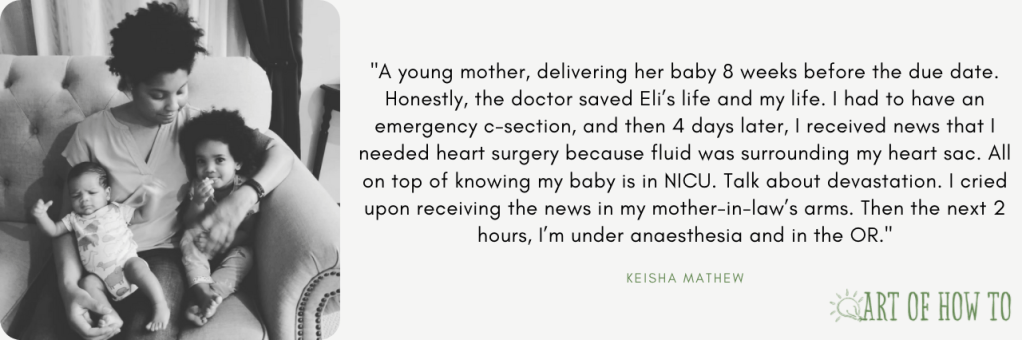
Then it happens. A young mother, delivering her baby 8 weeks before the due date. Honestly, the doctor saved Eli’s life and my life. I had to have an emergency c-section, and then 4 days later, I received news that I needed heart surgery because fluid was surrounding my heart sac. All on top of knowing my baby is in NICU. Talk about devastation. I cried upon receiving the news in my mother-in-law’s arms. Then the next 2 hours, I’m under anaesthesia and in the OR.
I still didn’t have an exact diagnosis. So I was told, it’s RA, rheumatoid arthritis.

After weeks in the hospital , I came home, but not with my little guy. He’s still fighting to thrive in the NICU. Trying to stay hopeful because I have Eliza and Rohit to still love and prayers for Eli to give so we can be together. Fast forward to Easter Sunday, this was supposed to be one of the happiest days for our family. We get to bring Eli home from the hospital. Though that didn’t happen. Instead, I get readmitted to the hospital for double pleurisy.

I couldn’t breathe. I had a fever, and I’m literally losing it at the hospital from crying to cursing at the nurses to give me something for the pain. After what seemed like hours, my pcp, rheumatologist, and cardiologist, told me that I’ve had multiple organ involvement among other criteria being met, for SLE aka lupus.

My heart sank and then they told me I had to start chemotherapy that day. As the radiology assistants/nurses began to insert my PICC line in my arm, I sobbed the entire time. I cried so much, they thought they were hurting me. I reassured them that I wasn’t feeling any pain from their operation, but just to hear this news and to start chemo was painful enough. The male assistant held my hand tightly, and tried his best to relieve me of this burden. 

After my first weeks of weekly chemo, I was overwhelmed with pain. ‘I am in pain 24/7. I am having a hard time breathing’. The only relief I felt was sleeping. I woke up looking forward to going back to sleep.

I felt so bad for Rohit because he was trying to be my rock, caretaker, provider for me and manage Eliza. Maybe after several days, Eli was able to come home. During this time  I knew I was depressed and I would tell my mom,’I don’t want to wake up’.  Like ever. The pain was hard and newly living with lupus was just harder. 
CKCI have no words. That must have been very hard.
KMYeah! It took a long time to be hopeful. My family helped and were supportive, they rallied around, they helped. Amma, my mother-in-law, was amazing during this time. 
CKCHow are you now?
KMI am not a spring chicken anymore. I am stable. My doctors are keeping me healthy and medication keeps me moving. My kids move me forward. In the morning there is this stiffness, I don’t really focus on it now. I am busy with kids, getting them ready, to school and daycare, I work and my mind is always elsewhere. I don’t really have body self awareness,  unless it’s excruciating pain, but for now I just keep it moving. 

I am seeing a rheumatologist and as I am at the higher end of my medication, it’s been keeping me stable. Maybe we will taper it down. If this was a year ago I would say, ‘A DEFINITE NO.’ Now if you ask me,  I don’t know, we will see. I don’t want to rush into it. Hopefully maybe within the year maybe I will be ready to taper it down. 
CKCHow did your employer support you during this time? 
KMThey were extremely supportive and very accommodating. They kept my spot until I had to go on long-term disability. Lupus is unpredictable and the doctors did not feel comfortable releasing me after all the hospitalisations after the chemo treatment happened.  When I first was ill, it was during my maternity leave for Eli’s delivery. Then I was sick again and was not able to return to work, then they had to hire a new person for my spot as I had to go on long term disability. 

That was hurtful only because it was saying goodbye forever. I had to send Rohit to clean my desk. Usually meant, that person is not coming back to the office. I understand, they had to fill that position and they cannot just leave it. Even though I was hoping and praying, I can come back soon and when I get better hopefully they will have my spot still. That was sad, having to let go, and not knowing if ever I will be able to come back or work again. 

All these happened, not on my terms but on my body terms. It’s a constant battle I have on a daily basis while dealing with this illness. 
CKCOnce you got all clear from your docs, that means you will have to apply for jobs again.
SMYup. Once the doctors finally released me to work again, I began applying. I had a couple of interviews. One interview with a competitor specifically went well. There was a person I knew who could vouch for what good worker I was and I was about to transition into a project management role where I would be running the trial. This has been on my goal list for a few years before my illness took a toll on me.  Unfortunately, I had to back down because of my illness again. That was heartbreaking. 

Once I got stable again, I started applying again and also applied within my old company and I got lucky and was offered a new position with a much better prospect for growth. I went back, it’s a new role but similar task. 
CKCAre you still based in Chicago? Plans to head back to Ohio?
KMI am now based in Houston, Texas. We  moved from Chicago over this summer.
CKCIt was only a five hour drive to Ohio. Houston is a long way from home. What prompted the move? 
KMThe move to Texas was really simply because we got tired of the cold weather and being cooped up in our townhome in Chicago due to the pandemic. When we tried looking for a home big enough,  with a backyard, two office spaces, or at least 5 bedrooms, it was difficult and pricey. Houston wasn’t even on our list to move to.  It was really Dallas or Austin,  but nothing panned out. It just so happened that my brother-in-law and his wife talked us into considering it.
CKCYou are back at work now? 
KMYes. Working 100% remotely. When I was offered the new position it was partially remote, and I only had to go to the office twice a week. Once Covid became a pandemic, it was imperative that I stay remote.  I am on Immunosuppressants, which makes me more at risk, so I put in a request to my manager, and told her ‘I am not able to come into the office’. With my illness, simple things like people sneezing or coughing put my health at risk and build my anxiety in the office. She said ‘I could go remote’, and offered me to go remote fully. I would probably have waited longer to go remote if Covid never happened, but it worked out well for me and us as a family. 
CKCYou have been in your company for the last 6 years. You had to slow down due to your illness, I am sure there is room for progress. 
KMYes. I want to be the one managing the trials one day. The goal was always to progress in that direction when I started. I am thankful that I am able to come to work now. When I got sick, I was not even able to tell if I was going to come back to work. I was planning for the worst and thought it would probably be a while before I could get back into work. 
CKCAspiration for the future? 
KMCareer-wise, I still WANT to run Clinical Research trials. Prior to this move, I had a little bit of motivation in myself. I have been reading Jack Canfields, Success Principles. Some of the things I read in the book gave me more to think about and find myself again. 

The book says, to be flourishing, you have to take 100% accountability for everything you undergo in your life. It says, “what I think, say, and do is required to become intentional and aligned with my purpose, my values, and my aims. And to achieve aspired results, one must substitute complaining with making requests and taking action.

I have decided to improve myself and put all those thoughts to action, setting goals for myself and my career. I am working to get out of my bubble and start networking more. As I am looking for progression, I need help, support and guidance. I also realised that I needed a Mentor and I cannot do this alone. 

I have made friends wherever I go. During the course of the last fourteen years in my career and life, I have befriended so many people, and in some of the studies I have worked on in the past, I have befriended many Project Managers.
I found a mentor that I have worked with in the past. She was my first Project manager on a trail I worked on. I know how she works and she is consistent and thorough. I heard other project managers refer to her as  the Study Guru. I recently asked her to be my mentor. She has been helping me.  There was a position opened within her department. So I applied. 

Just to get that interview and to get a do over I was happy.
CKCSo did you get the position? 
KMI got the offer to now become a Study Management Associate. I finally have been given the opportunity to manage a trial. I’m ecstatic.
CKCThis is brilliant. You deserve it. And what are your personal aspirations? 
KMI want to have more kids. But my doctors and mostly everyone, especially Rohit, advises me not to as it’s a risk. I have to come to terms with it and take care of myself. Also, I have to find a hobby.
CKCHow do you balance work and family?
KMThat’s a good question. Career wise you have to create that balance, and keep that balance. Period. Although at times, when I try to give myself a hard stop, it eases and spills over. This makes it harder for myself in the evening and the next day. So sometimes I end up working overtime which cuts into my life. I am working on making the balance right. If you find someone with the master plan for this, please send me their contact info.
CKC———–I sure will. You had an intercultural marriage.
KMYes. South Asian American and Black American. Rohit and I have known each other since 2003. It’s 17 years now. We started dating in 2006. For my parents it was about ‘is his heart in the right place for me,’ and why is he taking so long to propose? After six years he proposed and we got married in 2013. After eight years, we are blessed with two kids and have two wonderful families. It’s been a long journey.  

I have to say I lived with my in-laws, Amma and Appa for three months. During that time Amma taught me how to make Chai, Kerala Fish Fry, Vegetable Thooran. Eliza loves South Indian food. Eli only likes chicken wings. So dinner was always ‘what am I going to cook?’ especially since Rohit only liked South Indian food. Living with Amma I finally learned how to cook Rohit’s favourites. Even learned how to make Pappadam. It only took five years.
CKCYou have visited South India. 
KMI love going to Kerala. My first visit in 2014 was memorable. Even with the second with all those difficulties with my pregnancy, my time in Kerala was joyful. I love the food and I felt I belonged. It was amazing. 
CKCFinal question. What would you tell an 18 year old Keisha? 
KMIt’s really hard. I would tell her to explore more. Maybe tell her to explore a different major career wise. Ask her to go into Journalism. Urge her to find more about her family history and keep a record of that. You think you are invincible. I will also tell her to be hopeful.
CKCThank you for sharing your life so far with us. I know it was not easy but I am glad you chose to be open. There are so many out there searching for that one story of endurance and survival, a story where someone who has gone through tests like yourself. Through all these trials of life, Keisha you have come out brighter and I am sure soon you will running your own clinical trials. I wish only the best for you. Always. 
SMThank you for giving me this opportunity to share my triumphs and trials. It’s been an honor to be one of the requested interviewees. I hope that your platform brings motivation to and uplifts others to be the best versions of themselves and to stay positive in the midst of adversity. Thank you again!
Follow Keisha Mathew

Conquering the Impossible

A candid discussion about the most rooted fear and how to deal with it.

K. Syamala

Blaming others for the trashy life does nothing good. As a child, I was very passionate about riding bicycles and I hoped to ride it too. To my school. However, I couldn't do it. The desire itself was nipped in the bud. I scare my parents, the societal taboo. Later I was punished and judged for having feelings, desires which didn't revolve around others. From childhood, I have been taught that everyone else should be my priority. You're doing something that no one in your family has done before, and are not accepted.  

That didn't stop me from wishing to do things my way. Self-help, self-reliance, and self-love are my power tools. It may sound silly and mean to others. I conquer my world of little happiness by putting my soul into it, gaining momentum. I understood no one would come and help me willingly. I know I am not an alien creature who is born perfect. 
Priya Rajendran

My most innate fear was and is losing my son to my ex-husband (separated). This fear started right after my son’s birth when my ex-husband started gaslighting me saying that I am not capable of looking after my son. Each time he disagreed with me (before slamming doors and walking out for days together), he would repeat this statement, ‘kids need their mothers only until the age of 7 years. After that, the child doesn’t need her.’ He would narrate incidents of his colleagues’ divorce cases where children were separated from their mothers. Multiple incidents happened when he used that fear to make me do things. For instance, if I became late in packing for an overnight trip to his native, he would say he is taking my son away at daybreak when I was sleeping. He would add he did not care if I packed my bags or not. His statement haunted me even after I walked out of my marriage. His silence during our separation period killed me further. In my head that fear overshadowed me, making me feel stuck! Each time I woke up with a tremor and cold sweat – always checking if my son was sleeping next to me. My fears spiralled into thoughts, ‘what if my son would choose his father over me? What if my ex forcibly took him away from me?’ 

Now I have overcome that fear after I made myself emotionally stronger. I underwent hypnotherapy and Cognitive Behavioural Therapy. My close friends became my pillar of strength and slowly I lost that fear by talking to them. I will not deny that the fear is completely gone. It does rear its ugly head occasionally at my lowest points, but I do a lot of self-talk and listen to a lot of music. I started writing again too. It helped me to a large extent in coping with these thoughts. They say time is the best healer and helps reduce the intensity of the fears (not remove completely) and make scars fade (not eliminate them). My renewed self-confidence has made me stronger and helped me cope with my fears now. So, even if this thought appears randomly, I have the confidence to shake it off. 

Stella Thomas

Of the many things, I am seriously scared of failures. As a girl child, you are taught and told, or rather that you have to be certified, perfect in everyone’s eyes. No other perception is allowed or accepted. Right from your looks, dressing, grades, social appearance, your ability to run a house, your control over emotions, your tonality, and the list goes on and on. In the journey of acquiring this certificate, I have realised I was so scared of failing. Then came a point where everything started floundering in life. They say your growth doesn't happen when you are meditating on a yoga mat, it happens amid conflict, or when you are angry or scared, and or when you are thrown off balance. You hit rock bottom and you give yourself a push with all your might. You find to catch your breath. That's your growth. 

It has not been an easy journey to how I discovered to manage my fear. It took me years of unlearning and relearning to stand back with my head held high. Self-motivation, affirmations, me time, self-care, and on and on goes the rituals. Forgive yourself and know that healing is an everyday process. Yet grateful for all the very many lessons I had in my life because they helped me to know myself better. 
Lakshmi Dinamoni

I am scared to Feel. Don't take me to be Lady Stoneheart. I can laugh out loud when I am with friends, have heated debates with friends & strangers, or burst into tears during my daily commute. I am not talking about momentary reactions to a situation. But genuinely feeling all those myriad of emotions in their genuine sense. I have taken years to train myself to protect myself from heartaches & rehabilitation. How did I do that? By teaching myself not to feel anything. 

I have successfully reached a stage where the only emotions that I know are - Hunger & Tiredness. Every other emotion is just 'Meh!'. When I sat down to write this article, I realised that I have been translating all emotions into two - Hunger & Tiredness. Feeling low? Let us have French Fries! 
Feeling happy? Let us order some desserts. 
Want to break free? Let us have a drink. 
Even when Kiddo expresses her affection, I find it extremely difficult to reciprocate. Thankfully for me, Kiddo has grown to understand that I cannot express my emotions like any normal being. Maybe with Kiddo's help (and my therapist's), I will relearn how to feel.

10 Years In The Making

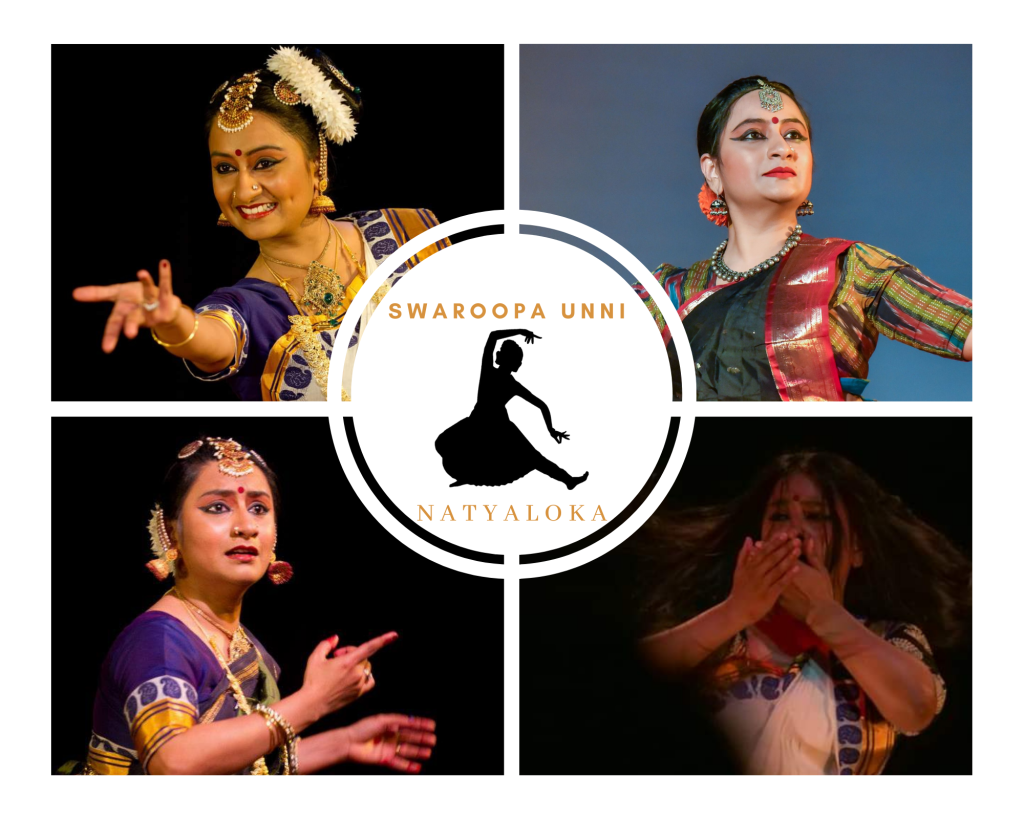
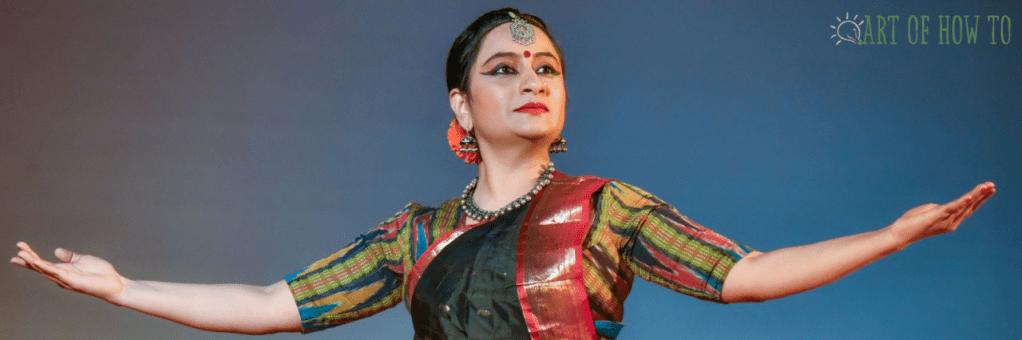
Introducing to you, Performing Artist, Dance Educator, Researcher, Student, Founder & Director, Natyaloka School of Indian Dance, Swaroopa Unni.

When asked if she could take a walk back to the last ten years and document what a decade resembled to establish as a Performing Artist, that’s where our journey began. In south India, growing up in the city of spices, Swaroopa was surrounded by dance and music. At the tender age of four, she walked into the world of dance and since then, her life has never stayed the same. 

A sea-change to Dunedin, New Zealand in 2010 brought in the most immeasurable transformation within herself. Swaroopa was determined to establish herself as a Performing Artist in New Zealand. For this, she worked tirelessly to discover herself, her art, and her growth was in the making. In this passage, she founded the first and only Indian dance school in Otago that trains in Bharatanatyam. 

With over 20 years of expertise in Indian classical dance, Swaroopa is a trained Bharatanatyam, Kuchipudi, Mohiniyattam, Folk, and Kathak dancer. She has collaborated with musicians from India, Hip-Hop Artists, Taonga Pūoro artists, and Taiko drums percussion artists from New Zealand and many more. It’s worth noting, she has started learning Māori.

In a span of ten years, Swaroopa has not only built awareness of south India’s distinct art forms in New Zealand but also made herself a part of the Dunedin community, making it her home and flourishing here as an Artist and teaching dance to a new generation of artists. No wonder, she was acknowledged as “Our Women: 125 of Dunedin’s Extraordinary Women” in the Otago Museum’s exhibition marking the 125th year of suffrage in New Zealand. Swaroopa is brilliant and inspiring, and she is a woman to watch out for. Let’s find out how aspiring to own her own chocolate factory ended by founding her own dance school.

Let’s find out how aspiring to own her chocolate factory resulted in founding her dance school. Joining us in Conversation is Swaroopa Unni,
Performing Artist, an Indian classical & contemporary dancer and choreographer, Otago, New Zealand. 

A conversation with Chippy & Swaroopa Unni,
Founder, and Director, Natyaloka School of Indian Dance, Otago, New Zealand. 

CKC ———–How are you, Swaroopa? You are an artist, was a full-time employee, and now a mother too. First, how is motherhood treating you? 
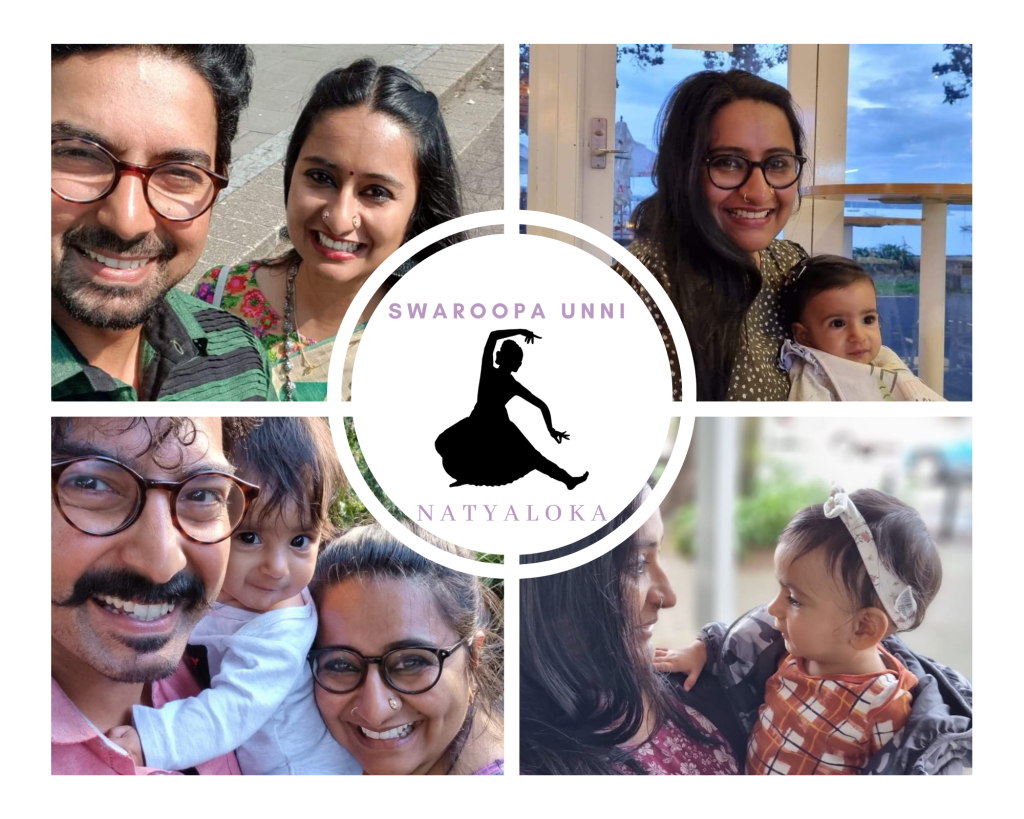
SUGreat. Thank you and we are all doing great. Yes, I am a mother now. Yes. Life-changing, yes . My daughter’s name is Nakshathra. Once the pandemic hit New Zealand, I knew it would be a different scenario. We will have to handle everything ourselves and we continued to do so. 
CKCIt must have been hard on you. How did you manage to balance it all? 
SUPandemic and a baby and life in lockdown in New Zealand were challenging. During the initial few months, it was overwhelming. I missed the warmth and support of my family who couldn’t be with us. But at the same time, I also realise that we are very lucky to be alive and well. Nakshathra’s grandma’s and pa’s have not met her yet. But video chats have helped us connect with each other. So basically we are all living in an online community for now. 
CKCGlad to know you are adjusting to a new life altogether.
SUMy wish is for life to go back to normal. Back to how things were. We all managed to balance it all well. But I cannot wait to have our lives back to normal. 
CKCWish the same. Let’s start. If I ask you ‘who is Swaroopa?’ How will you define yourself? 
SUIn a nutshell, ‘Performing Artist’. I am an Artist, Dance Educator, Dance researcher, a Dance student, a part-time employee, and now, a mother. That’s me. These define me. Also, I am the Founder and Director of Natyaloka School of Indian Dance which is the only Indian dance school here in Otago Region and I teach Bharatanatyam.

I have also become an Artist in Residence with a few major schools in Dunedin And, I am also a dance student, who is continuing to learn dance in-depth and building myself as a Performing Artist as much as possible. Learning never stops. I am currently training under Dr Rajashree Warrier and Nrithya Pillai for Bharatanatyam and Guru Nirmala Panicker for Mohiniyattam. I am also learning Marga Nritta Karanas with Vithya Arasu. 
CKCQuite an impressive resume. How did this all happen? Take me through your life. From the beginning.
SUI grew up in Kerala. To be specific in Kozhikode, South India. My whole life, childhood, and schooling until under graduation were all there. My family still lives there. 
CKCWhen did dance enter your life?
SUIn my family there was a tradition where when we turned 4 years old, we were introduced to dance and music education. I did my ‘Arangetram’ when I was 9 years old and started Mohiniyattam and Kuchipudi thereafter. I was trained in Bharatanatyam, Mohiniyattam and Kuchipudi at Nrithyalaya School of Indian Classical Dance run by the renowned and beautiful artist Kalamandalam Saraswathi. For the first five years in that dance school I trained under Kalamandalam Vinodhini and later trained under Kalamandalam Saraswathi herself.

I continued as a student and an artist in the performance troupe until I turned 20 years old with a lot of love and dedication. During my school years,I was also trained in folk dance by the wonderful Job Master from Thrissur. Then, I had to move to Coimbatore for post-graduation and for 2 years I had to discontinue.  Those two years without dance were quite challenging for me.
CKCGrowing up, what did you want to be? Did you have any aspirations?
SUAs I was growing up, I had different ideas.  Oh! My first dream job ‘I wanted to own a Chocolate Factory’.  That was when I was in my 5th grade. My thought was ‘if I had my factory, I would never have to ask anyone to get me chocolates’, I could have as much as I wanted and as much as I pleased. Anytime, All the time, Chocolate for me.
CKCThat’s not a bad dream. For a ten year old you were thinking very logically. Kudos to you. Then what happened?
SUDoctor. I wanted to be a doctor but that phase got over when I reached high school. Later, I was fascinated by history and then I thought maybe I should be an Archeologist. I was a good student but had difficulties with science, especially Physics, Chemistry, and also Math. The options were simple after 10th grade. For Pre-Degree, choose the first group, you will become an Engineer, choose the second and you will find your way to become a Doctor. So when the time came to choose a track to the future, even though I loved Biology I did not prefer it and was sure I didn’t want to do Engineering, so opted out of that as well. I was very very sure about what I didn’t want. So the question was what next? 

And guess what? All through my school years I was involved in dance competitions, mostly group competitions. The only time I went for solo competitions was when I was in Grade 10 for which I won prizes at State Level competition. And you know how competitions are a huge part of our school lives in Kerala. I was moulded as an artist by all those experiences too.
CKCWhat next? 
SUThose times there were not many options to choose from among courses in Kerala . So if not first and second, the only other option was the third group. It was a mishmash of a lot of subjects. People presume it is taken by those who are below average in studies and if you didn’t get through the 1 and 2 and it was your last and only option. 

I had great grades and I remember my friend’s parents advising me ‘why are you wasting time with the third group. It’s your future, and if you choose any of the other options you can either become a doctor or at least an engineer. And you will get solid and stable job opportunities with it’. Stable income, that’s what you should aim for, that was what was engraved in our brains those times. 

After two years of Pre-Degree I chose B.Com for undergraduate studies, and then I planned to go for an MBA. That was the pathway set, by whom I don’t know, but it was the way forward and I thought I will do so.
CKCI have heard college life in Kerala is exciting for students who are artists. How was it for you? 
SUEven though I was a Commerce student, dance was my only subject during my college days. To be frank, I was always dancing. In an academic year, if it starts in June, I get out of the class by the end of July or by August and it’s then dancing practice for university competitions. There were so many competitions around the clock, and I was just prepping one after the other. Inter-collegiate, University-based competitions, independent competitions, and then representing the college. By the time we get back to class, it will be December. The college always understood that ‘I am away with practice or competition representing the college.’ Then came College Union Elections and I was elected the Fine Arts Secretary during my final year. 

We never had semester-based exams, it was just one final exam that happened at the end of the academic year . We had sufficient study leave, so it never affected my studies. It was easy and tension-free. I juggled my dance classes, performances and all college events with a lot of happiness. I didn’t want anything more.  
CKCWhat is the next step? As planned an MBA? 
SUDuring B.Com, I got introduced to the world of media. I managed to do a number of anchoring stints. I handled and anchored TV Shows and also Live shows as well. I don’t know where I got the courage, not sure if I will do it now but I did it those days. So I thought maybe Media Studies is a good option,  so with my limited knowledge I felt maybe Mass Communication could be a great path ahead.
CKCThat’s how you landed in Coimbatore.
SUYes, I joined for a Master of Arts in Mass Communication. I could not continue my dance. It was rough two years without what I always had, dance. I missed dancing, I could not practice and life was quite dull. 
CKCSo now you’re heading for a career in Media.
SUYes. After graduation, I moved to Bangalore. There I worked for Indian Express & later with Bangalore Mirror. But I couldn’t live without dance. So I joined a new dance school in Bangalore – Abhinava. I learned Kathak under another renowned artist couple Nirupama-Rajendra. I was part of the Abhinava Dance Company, and toured across the country. There, I was trained in handling different aspects of being a professional dancer. 
CKCAll these while you never had thought of dance as a career.
SUIt was never in my radar. College And dance schools nurtured my artistic drive within me. But the fact there is no career in dance was always blocking myself from pursuing or even thinking about a career in dance. So I believe, I also went behind a stable career like everyone else.
CKC ———–So now your life is in Bangalore as a Copy Editor. How and when did your life shift to New Zealand? What prompted that move?
SUSiddharth. We met during my postgraduate days. After our graduation, we both took up jobs. Siddharth moved to Chennai and me to Bangalore. It was a long-distance relationship for a long time. Siddharth always wanted to work with wildlife and was passionate about natural history filmmaking. So he decided to do further studies, either at Otago University or in the USA. We got married in 2009. By then Siddharth was accepted to Otago University, he came here first, and I followed.
CKCWow. Love makes things happen. Now, you are in an entirely different county, how were the initial days settling? 
SUIn 2010, I moved to New Zealand. I am in a city called Dunedin in the South island. Beautiful city, the architecture and cultural heritage is absolutely wonderful. But super cold! I felt that Dunedin was completely cut-off from the rest of the world, amazingly isolated. In the first few months, I loved it here. So calm, peaceful, and serene. 

Then slowly loneliness creeps in. Before it dragged me down, I made sure I pushed myself, so I started to build my life here, and after giving a lot of thought, I aspired to establish myself as an Artist. I made myself what I am today with my dance. I made my life here with my dance. It’s the truth.
CKCHow did you build yourself?  Dance was never in your vision. How did you decide this is what you wanted to do in life? 
SUI never had ambition as such, I didn’t have one and if I had, it kept changing, it’s only after I moved to New Zealand that I knew I wanted to do something with dance. But what? As I was figuring it out I realised, all this while I have been dancing, and I never thought much about pursuing a career in dance because dance is never a stable career.  I thought to myself, ‘I am not sure how but I want to establish myself as an Artist’
CKCEstablishing yourself as an ARTIST, how did that go? How challenging was it? 
SUWhen I came here, it was a huge culture shock. It’s a student town.  And people of my cultural background were hardly here. There were about ten families among the Dunedin residents that were my people. In the University nearby there were students from different cultural backgrounds but they were cut off from the actual community.

Once I had a clarity on what I wanted, I reached out to the Dunedin community, and there were some wonderful artists. I would go and introduce myself as a Bharatanatyam Dancer and people didn’t understand what Bharatanatyam is. For them, Indian dance means Bollywood dance. So I was always perceived as a Bollywood dancer.
CKCOh! That’s hard. Must have been had to handle.
Initially, I used to be disturbed by this assumption. Then I thought, ‘Bollywood dancing is also a style of Indian dance and it’s a lot of fun. So, I will choose this route and take on Bollywood dancing and see where I go.’ The dance community here was very helpful and they invited me to perform for them. During one such performance, I introduced myself and opened my routine with Bollywood dance and ended with Bharatanatyam. I planned in a way they can see the difference and the similarities  in the two dance forms. I always explain in the beginning that ‘I am going to do a mix of two styles and start with Bollywood and end with Bharatanatyam, which is a south Indian dance form.’ I will explain the meaning of my performance. Then they see there is a different dance form.  That’s how I started breaking into the wider Dunedin community.

Later, I started giving volunteer dance workshops. Again, people expect Bollywood dance,  so I start with a two-minute Bollywood dance and move on to Bharatanatyam and end with  exploring hand gestures in Bharatanatyam. Slowly people realised and accepted that there is another dance from India that I practice apart from Bollywood. So now, my art reached out to more people.
CKCIs that the beginning of your school?
SUYou may say so. It was not intended, so a few parents from the South Asian community approached me and asked if they could send their kids to dance class. Initially I didn’t think much about starting a school. I wanted to be an artist more than be a teacher. To be a dance educator  is a huge responsibility. But then everyone insisted and I thought I will give it a try. 

In October 2011, I founded my own dance school called Natyaloka School of Indian Classical Dance. I started dance lessons in a spare room in my apartment with eight students.  
CKCIt’s 2021. This is huge, you just crossed ten years.
SUYes, and for our tenth anniversary we celebrated by being part of Dunedin Arts Festival. Today, Natyaloka is a multicultural dance school. Over time, I moved into my own dance studio. 

For the many parents, sending kids to my class  was a way to connect to their roots, and culture and for those students who are not from a South Asian heritage it is pure appreciation of the dance form and wanting to know more.
CKCNow your school is open, how are you succeeding as an artist?
SUIn 2012, I did my first solo performance for the Dunedin Fringe Festival. Siddharth did my light and sound design for the show.  I worked hard on publicity work. As part of the promotion, I went around and did a lot of push to promote my show. At the volunteer workshops, I gave my details about my upcoming performance and also did door to door campaigns. I was the only South Asian artist, a brown artist, a minority artist in the Festival.

I understood, there was quite a lot of curiosity but I was not sure how many people would turn up. We sold 10 tickets via online sales and a handful of complimentary tickets were handed out. I said to myself, ‘it’s alright, 10 is good. THIS IS IT.’ I was happy but then came the heavy downpour. I thought, ‘Now the chances of the 10 confirmed are also in question.’ I would be really at peace if they turned up. My heart beat was audible to everyone around me. I was nervous. 

Suddenly I saw Siddharth rushing and coming to the green room, ‘did the organisers cancel my show because of no turn out?’ I asked him. He said, ‘no, we have a problem, we have to turn people away. The hall is full and I am trying to find seating for a few more people who have come till now.’

It was a small theatre, it could only accommodate 80 people. ‘All seats are taken. I managed to add a few more chairs, also convert the passage and the steps as seats and now the theatre is filled,’ Siddharth told me.  Somehow we managed to get some extra chairs and we managed to squeeze in more people and the rest we had to turn away. It felt bad but we didn’t have any other option. All came and were curious to know what this is. I did Bharatanatyam and Kuchipudi together. People did not realise the difference. That day I decided I will concentrate on one dance form. And I chose to focus on Bharatanatyam. 
CKCThe fringe festival changed your life around. 
SUYes, it helped me create an identity as an Artist in Dunedin. 
CKCWho are your students?
SUIt’s a multicultural classroom of  students from the age of five onwards. Age has no limit. Apart from the Indian community, some of my dancers are French, Irish, British, Americans, Sri Lankans, Bangladeshis, People of Indian Origin, from South Africa, Malaysia, & Fiji who have never been to India. Some join to connect to their roots, for some it is only now that they got a chance to learn the dance form, for some it is about being part of a creative community, for some it is a celebration of physical movements. So many different reasons but the link is DANCE.  
CKCAge is not a barrier.
SUYoungest student I have just turned five years old, and the oldest is above sixty. Natyaloka is a safe space for anyone who wants to learn dance in depth and be who they are without any inhibitions.
CKC ———–Dance School is open during weekends only.
SUYes, only weekends. I do take during weekdays when I can squeeze in some time for some classes. 
CKCDay Job. All these 10 years you had worked a day job. 
SUPerforming Artistry is never a solid career, and dance is an expensive medium of art. So I knew I had to have another job to sustain my dance. So I let a stable income come from a day  job to establish myself as an artist. 

I worked full time for 5 years so I can freely do my dance. Even though I was successful in getting grants from funding bodies, to sustain as an artist, you have to have a job here. Especially my kind of artistry. Another point is that Indian dancing is very expensive. From music to costumes to jewellery and apart from that, when you are planning a performance, you have to also foot in money for finding and hiring the venue, the stage, the lighting, the equipment, the sound system, everything you have to fund. So a job helps me with some sort of back up. Also helps pay my bills.

After having Nakshathra, I started with a new part-time job. It’s a lot of balance, you have to do as an artist, especially when you don’t have many opportunities, as well. Paid performances are null. Being in Dunedin, you have to hustle all the time. If Artist Residencies are available, I will apply for that. If there are paid performance opportunities or workshop opportunities or there are dance festivals, I apply for them as well. That’s how I sustain my career here.
CKCIt’s not easy being a performing Artist.
SUNot at all. Not anywhere and especially in Dunedin. And during these pandemic times it’s not at all easy. At times it sure is frustrating in a lot of ways because there are not many opportunities.  Being a niche artist myself and trying to be part of the New Zealand mainstream dance platform, it is a lot of work but something that I am determined about. You have to understand that not many people do this, because it is very hard to get into, to sustain the audience and also to push the audience to come out of their comfort zone and watch me. So I have to get out and get talking and invest time to network. Out of all this, I find networking the hardest to do. 
CKCWas there anyone who encouraged, supported and, cheered for you?  
SUInitial years, I shamelessly used to knock on doors for opportunities. And one of those doors was opened by Alison East – a scholar, educator and a trail blazer! She just took me under her wings and has been absolutely amazing. She is there for all my dance projects – supporting and cheering. Lisa Wilkinson who gave me my first performance opportunity along with her and a few of our peers. I also taught Bollywood at her dance school for 5 years. My first teaching gig! Kathryn Olcott who included me in all dance projects and performances that she organised.

So many from the creative community in Dunedin and the wider Dunedin local community as well who always turn up with a lot of goodwill and support. Grateful to all of them. My students, who push me to be a better person and an artist. My family back home, my parents, my brother, especially my mother. From my childhood, taking me to every dance lesson after school to being always there with her silent support at every performance. She has been my strength. Also friends, my Gurus, my fellow artists from all over the world and Siddharth who always asks me questions so I dig in more into my practice. 
CKCWhere did you get the courage to knock and seek? 
SUMy upbringing was such that ‘if you want something you should approach, you should go for it. No-one else will do this for you, so you should do it by yourself.’ My dad is a go getter and I think I am inspired by his attitude and his style of making things work for him, I think I definitely am inspired by him. To go out, ask and look for opportunities.
CKCPure push from your side.
SUOh yeah. Constantly pushing is exhausting to be frank. I am from Dunedin and most of the mainstream dance projects happen in Auckland and Wellington. So unless I push myself, I am not part of anything. I know that now, being part of the online world and globally connecting with dance is the thing. But I am not ready to explore that yet.  
CKCHave you collaborated with other Artists? 
SUYes, I have worked with Sandeep Pillai and Jyolsna Panicker , renowned musicians from India, collaborated with Taonga Pūoro* artists from Dunedin, with Lisa Wilkinson (Hip Hop/Contemporary dance artist), with O-Taiko, a group of percussion artists who play Taiko drums and so many more. 

*Taonga pūoro are the traditional musical instruments of the Māori people of New Zealand
CKCI believe you are leaning a new language now.
SUTe reo Māori. Yes, I am a basic learner, Te reo Māori is the native language and one of the official languages in New Zealand. I am learning the language to know more about the history of this land that I am living in.  
CKCWhat is ahead for you?  Your future.
SUI am influenced by what I see/hear/feel around me. I want to humanise my dance form. Perform stories about socio-political and cultural issues that we face. Explore more feminist stories using my movements. There is this belief that we have to use contemporary dance movements to convey these stories. No. I want to use Bharatanatyam or Mohiniyattam vocabulary to dance these stories with the help of spoken words. I would like to tour with my solo dance theatre Ātete – Resistance in New Zealand and in India and anywhere else globally. I want to continue learning my dance forms more in-depth. 
CKCYou said you want to humanise the dance form. How do you achieve it?
SUMost of the Indian dance forms that we see now have a very complex history. It is a product of nationalist, colonialist, patriarchal ideologies that were used to marginalise the traditional dancing communities of women. A history riddled with caste and class injustices. Learning that history itself has been a huge eye opener for me. From then on, I have been on a quest to dispel the myth that our dance and the dancer are these really traditional, pure, divine women who dances only in the name of God, Sanskritised books and Bhakti.

Personally, I want to humanise the dance form and bring it back to a level where the audience can actually interact and not see us as Goddesses. I want to negotiate that space of being part of a mythology or a certain kind of woman – an ideal woman – the docile woman who follows patriarchal or casteist rules . Being a woman myself, I can embody the women’s’ stories.
CKC ———–How do you handle criticism? 
SUI always try to take what I would like to improve in my craft from the reviews which can be verbal or written. I am all for constructive criticism. You need that constructive feedback to learn and grow. Negative feedback for the sake of negativity can be ignored but it’s hard not to notice. We tend to hang on to it, right? There were negative criticisms that were directed towards me about establishing myself as an artist here, patronising, doubting if I will make it, for sharing more about the complex history of the dance forms, but those kinds of criticisms can actually fuel our ambitions.
CKCHave you thought of moving away from Dunedin to pursue and for better opportunities?
SUI have thought about it a lot of times. At the same time, I know I have worked so hard to build my identity here, to create a name for myself, here in Dunedin. And to leave all of that and go one day. I am finding it hard to come to terms with. I don’t know if it will ever happen. Then, one may never say never. 
CKCSpeaking of children, what are your dreams and hopes for Nakshatra? 
SUI will let my daughter be what she wants to be. I will definitely give her a taste of all things possible, like arts, music, writing, sports and more.  And let her choose what she wants to pursue. She loves dance, I know that. She has sat throughout my dance school programs and she has enjoyed it without crying or sleeping. But who knows.
CKCShe has one more person to look up to.
SUSiddharth, yes for sure she can go that way too. He is a Producer now, he is involved in creating and producing works for channels like NATGEO, and Discovery. He makes her watch all these documentaries on nature, wildlife and he shows her all the animals and I have noticed she is keen. 
CKCOne last question. What will you tell your 18 year self? 
SUI would tell her to place her passion of being an artist in front, even though it’s a struggle, it’s satisfying. The satisfaction you get from dancing, the adrenaline rush you get from doing a performance,  learning a dance, sharing your knowledge about dance, or learning under more just go ahead and do it. There were a lot of inhibitions that I had, and also had this self doubt within me that I don’t have that much talent. Do I have the talent to teach dance? I will tell my younger self, ‘don’t doubt yourself and just go for it’.
CKCWell said. You said you prefer a live audience. Everything is online now. Right?
SUThat’s true. I want the audience to interact with my art in close proximity and that is very important for me. I thrive as an artist from that connection with the audience. And yes, for me it makes a big difference. But the last 18 months and the foreseeable future online performing is life. Having a baby during pandemic has kept me a bit busy as a mother and I am currently in pursuit to enter the online platform. I have started reaching out and I am also keeping my fingers crossed. Hopefully, next year we will learn to live with this virus and live performances will also come back to popularity. 
CKCI wish and hope for life to go back to normal. Hope you will soon be in front of a live audience too. Thankyou for sharing your incredible journey. You are truly inspiring, encouraging and amazing.
SUMy pleasure! Chippy, this has been wonderful. Look forward to a better future for all. 
Follow Swaroopa Unni

The Voice Inside

Presenting to you, people person, portfolio manager & a person propelled solely by the inner voice, Smita Scaria.

Driven, intense, and quiet by nature, growing up Smita was focused on her studies, her dance, and was lost in the world of books. From Kolkata to Kochi, the Middle East to Kerala, Bangalore to New Zealand, India to Australia, Smita moved around a lot before finally settling in life. System Analyst to Business Analyst, Business Consultant to Project Manager & now a Portfolio Manager, Smita’s experience of 20 years extends across project lifecycles from negotiations, funding, scheduling, development, resource planning, management, and project completion. And she is the best.

Smita and her inner voice hold a strong connection, ‘if I do not listen to my inner voice, I would be disappointed with myself.’ Smita will eternally listen to her inner call. She has made it through her life because of her internal sensation and judgment.  

The curly, frizzy-haired girl was constantly picked on while growing up. She has learned to love herself, her locks, and she now walks tall with grace and attitude. From figuring out what she wants in life to what she has set for the future, Smita is one woman we all need to follow.

Join us in conversation with Smita Scaria. Discover how the power of her inner voice made her the woman she is today. 

A conversation with Chippy & Smita Scaria, Portfolio Manager, Melbourne, Australia.

Chippy Hey Smita, How is life down under in the world’s lockdown capital? 
SSWe have accepted the new norm. In Victoria by now, we have spent over 200 days in lockdown. 
CKCFor a person who is always on the move, this must be challenging. Growing up, you have moved quite a lot. 
SSThat’s true, and yes. We’d moved quite a lot. My family lived the first few years of my life in Calcutta. Bengali was the first language I learnt. Initially I didn’t know my mother tongue, Malayalam. When we moved to Kerala, that’s when I learned Malayalam. After four years there, we shifted base to the UAE, and within the Emirates we moved every 2 years. Later during my senior school years I came back to Cochin, and later moved to Bangalore to pursue a Bachelor’s degree in Engineering. After I got married in 2001, I moved to New Zealand to join my husband who was working in Wellington and lived there for around 15 years. We are settled in Melbourne, Victoria currently after a couple of stints back to India in between.
CKCInteresting. From outside it definitely looks fascinating. All those travels and shifting and moving must have been exciting as well as challenging.
SSIt definitely was.
CKCSmita, what’s your story? Take me to your early life. What sort of a spirit were you? 
SSI was an introvert, focussed, driven, and a private person. Always focused on studies, my dance, and lost in the world of books.
CKCWhich books were your lifeline as a kid? 
SSI was very much into crime fiction, thrillers, and detective novels. The books I grew up with were Nancy Drew and Famous Five. Books let your mind travel to places you cannot physically. I was very, very thirsty for reading material. I would even read the food label on the back of a jar at the dinner table if there was nothing else to read. I just had to read something all the time.

At the moment I am reading ‘The Way of the Seal” by Mark Divine. Over the last year or so during lockdown, I have been able to get back to my reading habit, and I am the better for it!. It opens up your mind to new ideas, thoughts, experiences.
CKCBecause you were always on the move, did you miss out on having friends? 
SSYes, in ways. I mean I was never the kind of a person who needed a big group of friends. Always one or two friends, and we were very close. But it was not easy to keep in touch with folks with multiple moves including international moves. Things are so much easier with social media now!

I am very different now. I would probably be perceived by some people as an extrovert now and tend to be able to connect and relate to a lot of people.
CKCAfter your 10th grade did you decide what you wanted to do in life? Or as it happens in Asian culture, did your parents decide your path ahead for you? 
SSNo, not really. Up until the 10th grade, I wanted to be a doctor. I wanted to help people, I had all those lofty ideas. You know how it is if you are good at studies in India you are expected to go down the path of either medicine or engineering. So my heart at that time was set on becoming a doctor. Those days we didn’t have Google or any sources for information, so you talk to your grown up cousins for information. I had a couple of cousins who were doctors, specialised in Obstetrics and Gynecology. Both of them had advised me at some point that if I went down the medicine route, I would not have much of a family life.
CKCIs that the reason you chose Engineering? 
SSAs a kid, I remember telling my mother, ‘I don’t want to get married but I want to have kids.’ I have always wanted to have children. Always. So somewhere in my head, the fact that family life will be difficult to accomplish stuck, and so I put the idea of medicine aside and went on to do engineering. I did B.E. Telecommunication from Bangalore. 
CKCHow did life progress after studies? 
SSIn terms of my career, similar to my life journey, a lot of my moves/choices at the start, were based on what I didn’t want to do. If you think about it, I was already in Engineering, which I wasn’t enjoying. I was thinking, what am I going to do? I want to work and I do want to have a career but what am I going to do? I didn’t really know but I knew what I didn’t want to do.  
CKCHow do you know what you want to do?
SSIf it’s not something I feel passionate about, if I don’t have the spark inside and if I am doing it for the sake of doing it, then I lose interest very quickly. I should feel I am making a difference. For example, most of my batch mates went down to programming and got into coding. Coding was interesting but did I want to do it as a full time job,’no’ was my answer. I did know by then I wanted a job that let me work with people primarily.
CKCSo how did you choose your pathway? 
SSAt that point of my life, I was not sure what I wanted to do. A job opening as a System Analyst came through. In this role, I was the person in between, connecting the developers and the users. It was an HRMIS system we were developing. That worked out to be the first job. It felt good. I believed my technology skills were utilised, and I was also working with people. So that sort of piqued my interest.
CKCWell, you figured out what you are interested in.
SSSort of, and by then, I got married to George, who was living in New Zealand at that time. Soon after marriage in 2001, I moved with my husband to New Zealand. 
ChippyIn New Zealand, were you able to adapt quickly? What were your challenges? Culture shock, finding a job !!!
SSYou know how it is in India, moving base between states is almost like moving between countries, a completely different culture, and language. In New Zealand, adapting was smooth, language was not a barrier  but I was wondering what I was going to do. 
Difficulty finding a job was the usual.  I was new to the country and I did not have New Zealand experience. It took me a year to find a job there. 

I did stick to my guns and waited for the role that called out to me.  There were people who would tell me ‘why are you being so fussy and why don’t you pick up something and gain experience.’ But I stuck to what I wanted to get into. 
CKCSo how did you start over your career in New Zealand? 
SSI had figured out by then that the role of Business Analyst seemed to be closest to what I wanted to do and what I would like to continue to do. One thing I have done when I look for jobs, I do not look at just the job title or position that it comes with. I look at the responsibilities that come with the job description and when I sift through them, do those responsibilities look interesting to me and is there a spark within me when I read them. 
CKCHow did you land your first job? 
SSThe Business Analyst role I applied for was looking for someone with NZ experience. I lacked NZ experience but I was able to articulate my thoughts and what I would bring to the role. One thing that worked in my favour, I think, were my communication skills. I consistently got through to people and they were able to relate to me. That was a distinct advantage. 
My first job was as a Senior Business Analyst in a department within the New Zealand government. That was the first opening in my career there. 
CKCGovernment job means you are set for life.
SSTrue yet after about three years, I decided I wanted more, further exposure across the industry. I had worked in the government sector and had wanted to gain more industry experience, across disciplines. I had just been promoted to a Lead Role within the group and also had a young baby by then. This was, therefore, quite a risk I was taking but was determined to get going.
CKCWow…you are a brave soul. How was your professional journey from there on?
SSI found a contract position as Senior Business Analyst, within the  IT Service Delivery department with one of the banks in New Zealand. My contract work was an infrastructure role completely new to me but it would give me an entry into the banking industry. From there I moved into the space of online banking and then to working with cards – chip profiles and NFC technologies.

That’s when NFC Technology for payments was just starting to hit the NZ market. I had the pleasure of designing the chip profiles for contactless payments for the Bank and then was part of the team that were piloting NFC technology on phones so they could be used as payment instruments. Exciting times!

Payments technology turned out to be a really exciting space and I absolutely loved it! One of those avenues where one can instantly see how technology impacts the day to day lives of the ordinary person.

By this time, I had been in the business analysis space for 10 years and had two young boys. 
CKCYou have definitely found your way. Experienced Business Analyst and an expert in what you are doing.
SSTrue. At this point and I do actually remember, it was 2012 when that voice inside me started telling me that there was more to do and I needed to do more. I wanted to be able to drive the end outcomes.  

When my inner voice got quite loud, I reached out to people within the bank, including my manager, and started having conversations about what other roles I could do. 

Project Management was something I had looked at in the past but had put it off because there seemed to be a lot of reporting involved and I was not quite sure I had wanted to do that.
CKCYou are in a very comfortable position now. Making a change, this is a big risk. 
SSIt is always scary when you are doing well in a particular role, you are in a comfort zone and the fact that people trust you. You build all this up, and your inner voice tells you to throw all that away and move on to a completely different thing. It sure was a scary move. 

But I had to listen to myself. I did tap into the network I had at work, and was offered a Project Manager role for a major transformation program at the Bank. I took up the role with gusto. Some folks saw the role at a promotion, I saw it as a side step. You know how it is when you switch, you often have to start at the bottom in terms of creating trust with your stakeholders and then go from there. Interesting times but I learnt a lot, worked quite hard and had a very supportive network at the Bank.  
CKCWhat would that mean if you don’t listen to your voice? 
SSIf I didn’t listen to my voice, I would end up disappointed with myself, knowing that I am not doing justice to myself. I had to listen to my inner voice. I always do.
CKCSo you were challenging yourself. Every step, every time your inner voice converse, you are setting a new bar for yourself, a challenge to yourself for more. 
SSI do and it also has its challenges. By 2015, my health took a turn for the worse and I decided to take a break for a year. During this time, we decided to relocate to India. I went back and resigned and we moved to India as a family. 
ChippyRelocating to India after almost 15 years in New Zealand, that must have been a big decision. Have you ever had the idea to settle back in India for good?
SSWe actually did. The idea was that we would settle back in Cochin after many years abroad. The plan was that my boys could join the school in India and George and I would find new jobs as well. Closer to family and home, that was the idea. But when we started our life there, none of us settled well, the boys didn’t enjoy school either. 

It was tough on all of us for a while and all of a sudden George found a job, but it was in Melbourne, which was further away from what we intended. If it was Dubai or Singapore, it would have been easier but moving alone to Melbourne meant keeping the family apart, so we made the decision to relocate as a family to Melbourne. That was not a career decision but for our family to stay together.
CKCDid you settle well in Melbourne ?
SSActually, we did. I like Melbourne a lot more than Wellington, in many ways. New Zealand is a beautiful country, the people are beautiful, honest, trustworthy.  Australians tend to be straight up with everything. This works for me. I am pretty straight up. I am a lot more comfortable if I can be direct and honest.

The weather here compared to New Zealand has worked out to be better for me and the boys. They are happy, healthy and doing well here. They enjoy their school, they were able to make friends and quickly adapted to school and friends here. At the end of the day, it worked out to be a good decision. 
CKCAnd what about you? 
SSIn Melbourne, after settling in I started looking for roles and my first opportunity came up pretty quickly via LinkedIn. A couple of chats and interviews with the then CIO at this global fin tech. I was quite excited to be working for this organization as it would give me exposure into the products and services industry, something I had not done before. I was excited to be part of a great team here.
CKCWas there room for growth?
SSThere always is, if one is keen on growth. I joined as a Project Manager in 2016 taking on the client delivery face for a key project. Since then I’ve progressed to Program and Portfolio Management roles. I am currently looking after a few clients for Australia and New Zealand on one of our flagship platforms. 
CKCDo you have any future aspirations, you are a Portfolio Manager, what is ahead for you, any aspirations, next five years ? Or it all depends on your inner callings again….
SSI think so. As I said earlier, I have never really aimed for a particular title. At this stage, I am not thinking of what title I want to have in five years, etc. Only that every day is an opportunity to be better than yesterday.
CKCIt’s not the title.
SSYes. I got into my current role quite recently. This could keep me very busy and for quite a while. If something completely different comes along, I am open to it. We will see where we go. 
CKCYou are a strong woman and you are very articulate and clear on what you want. You do come out strong, you do know what you are talking about. Did you have to deal with sexism at work? 
SSSexism is very much there. Anyone who claims it is not there, either is very lucky or is not being honest with themselves. For example, just a couple of years back, it was one of those days where I was working late, and this colleague from work came over and said, ‘you are still here, still working, so who is taking care of the kids and who is cooking’. I am sure he would never ask a man that. Never. 
CKCNo man would ever be asked that. Is it a challenge as a woman? Is the tech world a hard place for women ?
SSLet me be honest, it can be. To thrive you have to be very confident, of who you are. I am not a tech geek, I am not a developer, I am not a specialist techie. I am a generalist, which makes it even more difficult. End of the day, it’s about being really clear and confident and being able to voice your opinions. And to be honest, I was not always this strong. 
CKCI look at you and I see a confident woman. It’s hard to believe otherwise.
SSIt has been a journey from my introverted self to a person who cares deeply about what she does on a daily basis. And that passion and commitment overrides any nervousness or apprehensions. The other day one of my seniors referred to me as a gun! 

If I go into a meeting, for example, I am just simply clear on where I need that meeting to go, what are the objectives, what I want to achieve, and what we need to achieve. I have no problem listening to anybody’s feedback. But I will not let someone bully me or corner me. I make sure everybody’s viewpoint is heard, and we get the objective done. It’s never about one person and should never be.
CKCHow did you overcome your apprehensions and gain confidence? 
SSMy internal GPS has always been strong, even as a child. That plus life and it’s twists and turns and curveballs. Every twist, turn, curveball, failure, loss, everything is an opportunity to learn. And I have had several opportunities.

One of the most pivotal experiences was when I was selected for a Women’s Leadership Training program in New Zealand, which ran for several months. Being in that network and meeting women from a wide spectrum gave me a very unique perspective. We often think because we are from a different culture, we have unique problems. Actually, no. The problems are pretty similar, the intensity might vary a bit. Coming together with other driven women in a safe, focussed, environment was empowering and life changing. Suddenly my mind had been opened to all these different perspectives, different ways of how to frame situations and come to peace with them and/or claim victory over them.

The experience also showed me how different we all were. For example, one of the guest speakers at the program was a C.F.O. at that point. She was telling us how at the age of eleven, she decided she wanted to be a C.F.O. She knew she was a numbers person, even at that tender age she had set her sight on the role. She said she knew where she wanted to go and she worked for it. Understanding and respecting differences is critical for success.
As a woman, you always have to find people – men/women, within your immediate network who you respect and are potential role models. Having a support network and one that could provide a mentoring aspect is essential.

Over the years, I’d realised that every time I took a risk and put myself out there, I got stronger and more confident. The more confident I got, the more I understood myself, and now I know a lot more about what I want. Now, it’s a bit simpler that way. It’s still scary but simpler. 
ChippyI am sorry, I have to say this. I love your curls.
SSHahahaha…..it took me so long to accept my hair in all its glory and strength. I have been called “Kapiri”. As you know it used to be a term that people used as an offensive and derogatory term.
CKCDid you lose confidence because people made fun of your hair? 
SSOh yeah! Absolutely. Probably from 9th grade to 12 th grade I had zero confidence. My hair, my weight. I used to dance Bharatanatyam upto the 10th grade and I stopped just before 10th grade, as studies were the only priority in our lives that time, and then I piled on weight. My weight, my hair, not being your regular kind of girl who talks to everybody, people always picked on me.   
CKCMust have been difficult teenage years. How did you cope with all this?
SSTo be honest Chippy, I have gone through so many phases, if I think back probably until age 15, I was pretty self centered. I was never arrogant, just lost in my own world. Moving back to Cochin during 11th and 12th grade, that really shook my confidence. The weight and the hair and people. It was a trying time. But the connections and friendships from that phase are still strong after 25 years. 

I think I changed when I left home for the first time and went to Bangalore for my under-graduation. My friends back in Cochin used to tell me, ‘you are so much easier to talk to now’. I must have opened up then.
CKCHard times but you made it through. Wow!
SSChippy, there have been so many things happening throughout life that, I felt every time I took a step further, I kept going down. I had battled with depression for years and I was on medication. One day, I got up, and I decided, ‘I have to change or else I am going to completely lose myself’. I stopped taking the medication, and from there on I have been building myself back up again, brick by brick. Building myself up. When that happens naturally, you become a lot stronger because of whatever you have done.  
CKCIs there anything Smita Scaria is scared of? 
SSFor sure. Just that I go ahead and do it anyway. One of my biggest dreams while growing up was riding a motorbike. Even though I told you I was a bookworm, the other side of me was into speed. I’d always wanted to ride a motorbike. In India, we had those kick start bikes, I was never tall enough or strong enough to do that. So, when I turned 43, I decided to go get a learners licence for motorbike and I got a Harley. People called me crazy, some said I was having a mid-life crisis. Whatever!

It’s a good question you asked. I wrote down in my book a couple of months back ,’I have finally conquered fear’. In fact, in terms of personal growth I believe that if you ask yourself,  what do you fear the most, and if you did not fear it, then what would you be doing? The answer can give you a lot of insight into what you actually want to do. If you ask that question to yourself and you are  honest with the answer, you could find out a lot about yourself. 
CKCNow I am thinking,’Am I honest with myself?’
SSChippy, we owe it to ourselves to be honest. Who else is going to do that? Nobody else. So, we owe it to ourselves to be absolutely honest to ourselves. Growth comes from being honest and asking those questions, what do I fear, if I don’t fear what I would be doing. 

Also we need to put an end to making excuses. Stop making excuses by saying I am doing this for a certain person, for kids etc. At work sometimes I feel some women, even though they have so much potential, and have the right attitude, are so much confused between being a mother and working full time, being a mother and not able to spend time with their children vs doing what it takes to make it.  Some women get so confused, conflicted and that’s holding them back. You have to make a call and then stick with it. Sure, you also need to have open conversations, arrangements and agreements with your spouse and children. Growth is a journey everyone goes on together.
CKCHow did motherhood change you?
SSLife changing and in many, many ways. As I said before, I always wanted to have children. With my first one, however, I suffered from postnatal depression and motherhood was anything but the wonderful, blissful experience books describe. Of course all of that made me feel terribly guilty as well. We were in Wellington that time, it gets very quiet and you get awfully isolated as well. By the time, my baby was six months old, I somehow wanted to get back to work. I was dying to get back to work. 

At six months my boy started crèche, and I returned to work. Of course, it was difficult at first, you take your little one to daycare and you feel guilty. One of my colleagues once told me, ‘if you are a working mom, get used to the fact that you are always going to feel guilty.’ 
We have to make a call. You are always going to feel guilty, because you are not there for their morning teas, afternoon teas and day care parties. You will miss out on those bits, as you don’t have time. Don’t worry about it too much. Don’t let that bother you, just accept it. 
CKCIn 2015, you decided to take a break from work for health reasons. Do you recommend taking a break when your body says rest?
SSYes. For me, balance is not something I am good with. To be very honest, when I pick up a project, I get very, very focused and I lose track of things. Sometimes I do drive myself into a place where health fails because I put it through too much. I am not good at that balancing act yet. If I get into something, I have to see it through. I do recommend a pause when your body says so – you’ve got to learn to listen to your body.
CKCWhat wisdom do you have to share with people who are currently lost or trying to figure it out?
SSYou have heard about people talking about finding your purpose. For me, from my personal experience, choosing your purpose is more apt (inspired by “The Way of the Seal”). Finding your purpose could take you your entire lifetime. 

Clarity and commitment in choosing your purpose and to keep working at it, and being open to finding something else on the way and being brave enough to be honest to tell yourself, ‘hey I found this other thing which I think will work much better for me.’ Doesn’t matter who else you are honest with, you have to be very honest with yourself. That’s my personal experience. Everything comes from being honest with yourself. And I always, always follow my internal GPS.
CKCSounds interesting. Please can you share in detail. 
SSA few techniques that I picked up at the Women’s Training I completed in New Zealand and via books I have read. I use these principles on a daily basis.

Transitioning for maximum efficiency & Power.
As women, we are very uncomfortable with the word power. You typically think it’s a man’s space. Power comes from being present in full, you are present in full – mind, heart and spirit. When all of you is present, in a consolidated form, that is power. You can tap into what you have, and not worry about other people’s opinions. You are simply there to do what you need to do, that’s power. Next is transitioning, every time before you take the next step, reflect on where you were, make peace with it before you move into the new, so you actually feel you are ready for the new.  Otherwise it keeps holding you back. I use this technique even in between meetings. I take a couple of deep breaths to kind of center myself again, before going to the next one, otherwise you carry the energy from the previous meeting to the next one and to the next and on and on. So, that’s transitioning. 

Choose a purpose
Work on it and keep refining it, get really into it and be good at it. Be open.

Make a stand.
What do you stand for? For example, I am in a leadership position. My personal stand is that I will achieve my objectives in the most inclusive and kind manner that I can. It’s about what’s your bottom line. If it all crashes down, what will you not negotiate? Being very clear about the bottom line. 

I am okay with not being liked.
Worrying about being liked can take a lot of energy. Lot of women asked me how do you do that? I am nearly 46 and it has taken me time to get here. I was not naturally born like that. Coming from an Indian background, it is ingrained into you, especially women,  to worry about how others see you. And at some point you have to get over that and say, “I’m going to be okay even if I am not liked.” It is important that this is not coming from a place of arrogance. Just that there are things to be done and things to be achieved and just got to focus on the same.
 
Turning up everyday as me and my fully authentic self.
All those other steps help me do that. I am okay with not being liked, I am aware what my bottom line is and what I will not negotiate on, I have a purpose or I have chosen one, and I am being there, being present. Which means I can turn up as I am and I am not pretending to be someone else. I am me, just me. 

These are the five principles I use, my internal GPS.
CKCMuch to think about and work towards. One final question. What will you tell your 18 year self?
SSThat’s something I do quite a lot. When I meditate, I make it a point to go back to my  childhood and tell myself, ‘you will be okay. You will make it, you will be fine.’ I say to my younger self, ‘just enjoy where you are at, and you will be okay.’ Now if I look back, and if I had the time to reset, I would try and enjoy my eighteen year old phase a lot more rather than think about ‘what’s next, what’s next!’ 

All throughout, each of my life’s phases, childhood, finishing school, college, getting married and then moving continents, each of those phases when I look back, there was so much anxiety around what was next! So now if I could reset the clock, I would say to my younger self, ‘just chill where you are at and enjoy it and the next bit will come. You are going to be fine’. I would tell myself that.
CKCWow…that’s a very positive note to end our conversation. It’s late over there, I have taken a lot of time from you and am glad you did this with me.
SSI do hope this helps someone out there. If we are able to just talk about things and share experiences, it could help someone out there feel not alone.
CKCI know for sure your journey will inspire and be that hope for that one person who is searching for support, help and guidance.
SSLet’s hope for that. Fantastic. It was lovely talking to you, feeling very refreshed.
Follow Smita Scaria

A Girl, Dark And Beautiful

‘This is it. This is my last time dressing up for another man. The next man who says yes to me, I will marry him. No matter what,said ‘A Girl’ to herself. Growing up in India, I have come across several women who have gone through this mortifying phase in their life. ‘Meet the Bride’ is a pre-scheduled event most in their marriageable age go through, arranged by families who are looking for a potential partner for their adult children. At times this episode can be traumatic. This is so common that it is normalised in our society and many people say, ‘none of those who came to see you will ever remember you. So why do you feel so upset?’ It is not the case, everyone remembers everyone they met, especially most remember those who rejected them for the very many silly and heartbreaking reasons. Much has changed due to the advent of the internet yet no much.

The only tolerable pathway by society standards for marriage, always arranged. I know, I fell in love and to marry the man of my choice was quite a task. Trust me. And arranged in the ’90s and even today, it means dolling up to be eye candy for about twenty minutes in front of ‘A Man’ and his entourage. Oh! They are ‘A Man’s’ support, who are there especially to access you, grade you and check you out.

‘Why don’t the boy and girl step outside? These are modern times, let them get to know each other’, said an elderly man. ‘A Girl’, by now, has already seen thirty-six men. She stepped outside to the verandah and No. 37 followed her, she was cold, disheartened, unenthusiastic, and knew what the outcome would be. ‘If this person also rejects me, I will for sure remain a spinster, a burden to my siblings and family, a lifelong sob story for all’, said ‘A Girl’ to herself. One cannot blame her for feeling this way because she has served tea, answered questions from every entourage before, and did get to know all 36 men in this same verandah. And all said, ‘we will let you know.’ 

‘A Girl’ knows, ‘It’s my dignity I am letting you play with. My self-respect.’ The waiting game is on. Day 1, no response. Day 2, no response, Day 5, no response. With a heavy heart ‘A Girl’s’ mother will push her father to make the call to ‘A Man’s’ family and seek their response. ‘Oh! We thought we called you. We have been busy seeing so many girls, we must have missed calling you. And our boy, he prefers a much fairer girl. Your girl is beautiful, she will find someone soon.’ ‘A girl’ after her fifth rejection experience, stopped expecting, so as usual, she did not foresee any other response from No.37. This time no one from her family was bothered, they too had given up.  

A cousin of a cousin called, ‘the boy liked our girl. They want to know what our answer is.’ ‘A Girl’ without a second thought said, ‘yes. It’s a yes. I will marry him.’ Her mother immediately said, ‘but he is very short, shorter than you. To that, ‘a Girl’ said, ‘maybe he is in the same boat as me. I am fed up with hearing from every other person the reason for rejecting me, ’my dark-skin. I want to marry him and we shall never discuss his height further.’  He was not just short, he was inches shorter than her. Within a few months, the marriage happened, ‘kullan & karumbi,’ (the shortie & the blackie) that was the nickname given to them by their family members. ‘A Girl’ survived it all, it’s now twenty-two years and she is now the mother of two beautiful kids, a strong and supportive wife, and a working woman. We will catch up with her later. 

I am sure I would have also been rejected for my colour and weight. I never had to go through such an ordeal. I am not sure how I would have coped in her situation. But ‘COLOUR’ has always been the central part of my growing up too. You introduce your sisters and the first question all ask, ‘Are they your real sisters?’ Are you seriously asking me that? I always felt the cringe every time someone told me, ‘Oh you are this person’s daughter. You are so dark. Your mother is so fair.’ And my father is not. Dah! Why do people just feel so comfortable commenting on a person’s complexion? What gives them the audacity to be so spiteful? 

Recently read a post that shared the story of a girl’s struggle growing up being labeled, darkie and her struggles dealing with colour discrimination right from school to workspace and the difficulty finding a groom due to her dark complexion. The comment section was full of support except the comments were by all means wrong. One read, ‘she was a confident person. I am so happy that a man has agreed to marry her despite her colour. I am happy that finally she is getting married,’ another, ‘she is so lucky that the guy agreed to marry her, he has such a good heart.’ What !!!

We are conditioned at a tender age to believe ‘dark is NOT beautiful’. You are born into a society that accepts you only if you have fairer skin, a lighter complexion, and pale lips. When I was a baby my mother used to scoop the cream from the milk, mix it with powdered red sandalwood or turmeric and apply it on my face to make my face lighter. I know. Yes, it happened. She meant well. ‘Times were different’, we said then and ‘times are different’, we are still maintaining it now. Even though my parents never once said anything about my colour, it caused them anxiety. On the other hand, my relatives, cousins, and a few friends have always enjoyed commenting on my back, ‘how dark she is and how sad it is that she is not as beautiful as her sisters’. It was painful. It took away my confidence and it was hard to stand tall and not show your real feeling. I have seen how differently my sisters were treated and how I was treated, it always bothered me. It confused me then and it still does. 

During my childhood, because of how I was treated, it was instilled in me that having a lighter complexion is beautiful and bleaching your skin is the only option to look brighter. In India, our advertisements stipulated we need to use fairness cream to look smart and fairer so you will get selected for an interview. Your promotion depends on your brighter, fairer skin. Your marriage happens when you have fair skin. So, we were all conditioned to question our very own existence. 

My first facial was when I was seventeen. Those times, it was, ‘we can make you fair, bleach before facial. We can bleach your hands and feet and shoulders and make you brighter.’ The usual saying within the beauty parlours now, ‘it’s just to remove your tan and the glow happens only if you bleach your face’. Earlier I used to believe it and that 10 to 15 minutes the bleach is lathered on your face, it’s the worst sensation, ‘a small price to pay to look fair’, said my beautician. I stopped bleaching my face when I turned twenty-six. I am comfortable with my skin, content with my colour, with myself and I have accepted myself for who I am. So no matter what anyone says about my skin tone it does not bother me. I have learned to ignore and not be affected by it. But if someone denies me a seat at the table because of my colour, I will not accept that. That’s a different story altogether. 

Did ‘a Girl’ who married her No.37 have a happy ending? ‘I am not sure if I would have said yes if it was not for that scary feeling that I had at that time. I thought I would end up alone. Rejection after rejection took away my dignity. I felt like an object. My worry was I will be a burden for my family and siblings. My husband is extremely fair but short. If he were taller, I am sure he would also have rejected me. I know that for sure because my mother-in-law always reminds me ‘he would have gotten a much fairer girl than you but he was short and we could not demand’ I am happy but I am not. If I had the confidence I have now, I would never be worried about being single. I know now, I could have made it but I did not know then.’ said ‘A Girl’. 

One might think this colour discrimination will end with ‘A Girl’ in her family at least. No!!! You thought wrong. Unfortunately, it’s a cycle. Her kids, one is fair as their father and the second, dark like their mother. The fairer child is treated well within the family, and the darker child has so much anxiety, lack of confidence due to the constant bullying within the family. Our society has got a lot to answer but where do we start? Is there any way this can change? 

We live in a time where calling ‘hey, you idiot’, ‘not you dumbo’, ‘you retarded’, ‘you good for nothing’ are thought to be normal. Especially with children. Some say it’s just fun. I have seen and heard some folks call their kids, ‘hey darkie, pass the salt, at home and in front of others very casually. They feel the child has no feeling, ‘my child is strong, it doesn’t bother them.’ They don’t think for a second that the child is putting on a brave face but inside they are struggling. Next time, your child will be called the same word you called by another person and the name will stick on. You as a parent should know better. It’s not too late, make a change within your own four walls and maybe we can see a change. Educate yourself and make life easier for your loved ones first. People start the conversation at home.

The only alternative is to speak up, call out and constantly share stories about our experiences from our lives so we create awareness amongst our kin and friends about our struggles about matters of colour. It matters. If someone says, ‘you are beautiful even though you are dark,’ call them out. Tell them what they are stating is unacceptable and discriminatory. Just call people out and question their intention. When you see people treating one person better than the other based on their colour, call them out and root them out of your life, (if possible) if they continue doing so. Yes, it sounds simple. Because it is that easy. All we have to do is take one small step, raise our voice and speak up. If you have the platform to voice your opinion, raise awareness. Stand up for what’s right. Keep your stories coming, and never stop.   

Love Affair with Dance 

Presenting to you, Scrum Master, Dance Researcher, Dilettante Poet & Painter and Multidisciplinary Performing Artist, Bindu Rajendren.

When asked where are you from, she said it was a difficult question to answer. As our conversation got deep, I realised why. Though born in the middle east and migrated to New Zealand, and presently living in Australia, Bindu Rajendren is truly south Indian, without any doubt. Her links to her roots are deep, not because of a traditional upbringing, because she craves for it. She stays connected and makes every effort.

Her desire to learn is unfathomable, and she keeps digging for knowledge at every opening she gets. At present, for a broader understanding of the Natya Shastra, she is exploring dance lessons from her Gurus in Kerala. She also part-takes in workshops with great performing arts masters based in India. If you describe, she is in love with dance, that will be the most under-valued statement. 

Bindu works full time to sustain her passion for dance, and after years of saving, she found a dance space and built a Kalari. She named her Kalari, Sowparnika, her ‘go-to space’. Her daughter affirms if you cannot find Amma, all you have to do is look for her in the Kalari. 

Bindu has premiered her work at global, regional, and diasporic festivities and performances in Australia, London(U.K.), New Zealand, United Arab Emirates, and India. Last year and a half, the pandemic has induced a new space in the digital world for her. She has performed to a much wider audience, collaborated with artists from different genres. 

Today, I have with me Bindu Rajendren. Let us dive into an incredible story of a wannabe dancer who had to change course to be a nutritionist, who got lost on the way only to find her path afresh. Working full time as a Scrum Master and a Multidisciplinary Performing Artist, how did she make it? Let’s find out.

A conversation with Chippy & Bindu Rajendren,
Dance Researcher, Dilettante Poet & Painter and Multidisciplinary Artist. 

CKChippyHey Bindu, it’s been almost a year since we first met during the Zola Talks on ‘Kerala Performance Arts & Mural Painting’. Covid allowed us to make space around us closer. 
BRYes, it’s true. We are all connected now more than before. I work from home these days. Even pre-pandemic, I had negotiated early working hours from my employer. I start work at 7 am and finish at 3 pm. 
CKCAustralia has had a few lockdowns and has been isolated from the world due to Covid. How did you cope during this time? 
BRPandemic was a blessing in disguise for me. I used this time and space and opportunity to learn and constantly learn dance. 
CKCDance is your passion!
BRUm…I find the word passion overused. And to be frank, I have not found a word for what dance is to me. How we breathe, that’s what dance is to me. I love dancing. I hear a song, I break out into dance, wherever I am, be it on the sidewalks or a shop. Once in a Dubai shopping mart, I heard Jaya Prada’s famous song ‘Barsaat main jab aayega sawan’, and I had to dance. When the beats hit, I could not resist myself. I stood in the aisle and did the steps while my sister made sure no one was walking towards us. As the music played, I happily danced away.
CKCIt’s your pulse.
BRYes, maybe that’s the word. It’s there with me, always. Dance is life.
CKCDance is not your profession. 
BRI will say I have two full-time jobs. I work in a company here and I also dance. I usually refer to myself as a multidisciplinary artist with dance as my main focus.
CKCCrazy for dance…  How did this happen?
BRChippy, honestly I don’t know. There are no dancers in my family, from my mother’s side or father’s side, and no singers either. As a family, all were interested in arts but no artists in the family. I am probably the only one.  
CKCWhat’s your earliest memory of dance ?
BRThe earliest memory is a vague one from my Dubai home, maybe around three years or older. I remember dancing on top of a teapoy. I stood atop and danced while watching television. My mom stood behind me and told my dad, ‘this girl, she has got something, we need to send her for dance classes.’ It was my Amma who took me to Guru Kalamandalam Mohan at age four and enrolled me in dance class. I learned to dance from him for a total of 17 years. Am still in touch with him and he is so proud of me. He never thought that I would pursue dance even though I loved it.

I was born, raised and lived in Dubai till my 12th grade. I never used to miss dance classes. As much as I could I would continue to dance, even throughout my grade 12 year when typically all Indian kids are dropped from extracurricular activities to concentrate on studies. I refused, just said ‘I have to dance’. Amma was the one who took me to all my performances and to this day she encourages me. Amma never pushed me, she let me do whatever I wanted with my dance. Except after grade 12, she wanted me to be self-independent and be able to stand on my feet. 
CKCWhat were your plans after school ?
BRAfter 12th grade, I wanted to go to Nrityagram and learn dance. Ma’m Protima Bedi had just opened her school, and I was longing to join. That time, it was a different period altogether.  All I wanted was to dance, but at the same time, my parents asked me to do other things so I didn’t go to a dance school to pursue dance. My school Principal, my parents, and my teachers said in a synchronised tone, ‘no, no, no no, no, no.’ All were against me choosing dance. Hence, landed in Delhi to do B.Sc. in Nutrition. 
CKCBSc. Nutrition… Wow! What happened here ?
BRWhen I went to Delhi University’s Lady Irwin College to do B. Sc. Nutrition, I became the Music & Dance Society Secretary and President quickly. Any function I used to dance and any events I am representing the university for intercollegiate festivals and competitions. 

Oh… and there, I met my first Dance Goddess, Ma’m Asha Singh, an Odissi Exponent. She was amazing and she still is. She took me under her wings and allowed me to learn folk dance. The number of folk dances she taught me in my three years in Delhi, gave me an insight into a different aspect of dance and a good understanding of folk dances of India. I used to live in the hostel on campus. Ma’m Asha Singh who used to teach at the university, lived across the road from my hostel. Any chance I get, I will go across to her apartment and learn dance. I was privileged to learn from her. In those three years, I was introduced to contemporary dance, dances from Mizoram, Himachal, Odisha, & Kashmir. 

Once during my university days, Ma’m Asha, produced a dance production of different dances of India. I was in about six states in her production. The adrenaline was rushing those times, complete one folk dance and dress change and rush backstage for the next costume, and makeup, finish the next and the next, and then the next. It was unbelievable. 
CKCYou were the most wanted artist in your college.
BROnce for the intercollegiate IIT dance competition, our theme was a performance on different yugas. For this work, we were dancing 8 to 9 hours a day to premiere the work in the competition. Just before the final act, I collapsed on stage and I was in incredible pain. My teammates had to lift me. I could not do anything myself, my father had to fly down from Dubai and take me to Kerala. I was completely down, this was during my second year at the university. At 18, diagnosed with sciatica. I was put on tractions for a long time. I had to be careful after that. Always.

During college, my classmates and college mates supported, encouraged, and screamed for me to get up on stage and be me, whether it was a dance, fashion show, and on-demand request of Madhuri Dixit’s ‘Chane ke khet mein.’ Now that I think about it, the whole college, from juniors to seniors, teachers to lecturers, all of them supported me. They all knew my dance craze. I was happy to dance because of the encouragement. My outgoing student sash read, ‘Madonna Payalwali.’ (Madonna on anklets)
CKCAfter Graduation ?
BROh! I was lost. After B.Sc. I moved back to Kerala and was not sure where life was heading and did not know what to do. I was in a ‘what am I doing’ phase. Due to health reasons I was not able to immerse myself in dance at that time. I remember enrolling for a management course but didn’t even know why I did that. I was lost, no one to properly guide me, direct me. 
At that time I lived with my grandmother and she introduced me to Raj. Everything happened quite quickly after that, we got married and we moved back to Dubai. 
CKCYou never got time to find yourself. So after marriage what did happen ?Did you have a conversation about your craze for dance with Raj? 
BRNo, we did not have a discussion regarding dance before our wedding. I was twenty then, what do I know then. Raj knew about my passion for dance. After marriage, we moved to Dubai and I got into a job. Once Raj asked me if I would like to continue dancing. As soon as I heard that I called my Guru Kalamandalam Mohan and resumed my dance lessons and also did work full time. My Guru stopped coming to teach me after my seventh month of pregnancy, as he was too scared for me. After my daughter was born, I stopped dancing for two years and by then we had migrated to New Zealand as a family.
CKChippyHow did things move in New Zealand ?
BRI landed a job as an Administrative Coordinator for a Degree Programme at the University of Otago. What I did when we moved to New Zealand was to take part in community-based performances, every chance I got I used the space to perform my dance. That’s where I met my mentor, Alison East, Lecturer at the University of Otago. She is a teacher and choreographer with more than forty years of experience. She once saw me dancing at a community event and enquired about my background, we had a good conversation, and we parted ways.

My husband, Raj, was very encouraging. Even though he doesn’t come from an artistic family, he understands my craving for dance. He said, ‘why don’t you pursue your studies in dance’, and that’s when I was like. ‘Wow, okay‘. So I did not waste any more time, I enrolled for Masters in Dance Studies at the University of Otago, and I have never stopped dancing since.
CKCHow did masters change you?
BRWhile learning Indian Classical dance all my life I never got the depth, we learn items. Alarippu, Jatiswaram, Shabdam, Varnam, Padam, Tillana, all items after items after items. We never learn the theory of dance. 

When I did my Master’s, I got into the abyss. While learning I got into the depth of dance. Alison East held my hand and introduced me to the breadth of dance. During my studies there I engaged in independent research, workshops at the dance lab with guest artists and lectures, and the teaching approach combined theory, movement practice, and lectures. My thesis was on Theyyam and I completed my master’s degree studying part-time and working in the university as an Admin Coordinator. 

Rather than moving my body, I started moving my mind for dance. I became a thinking dancer. I started connecting movement to intellect. I found my niche there, found my sense of belonging there. I found myself. I was lost and found myself.
CKCYou said you got lost after graduation and did not have a direction. So, It took you that many years to find yourself. 
BRYes, to know what I want it took me years. 5, 6 or more… I was married very young, had my girl and moved to New Zealand, worked and studied. It took me a long time to find myself. 
CKCYou worked and studied…must have been full on.
BRIt was. I had to take my daughter to school, take her for music recitals, and I will be in the car studying, then get to work at University and also manage the chores at home. My Raj was my biggest support and constant companion, he is the reason I am standing tall. He was a great help then and is the greatest support now. 
CKCAfter your masters, how did things turn out? Was there a career you could make in dance?  
BRNo. One of the things I realised early on is, ‘I can’t dance and make money.’ So I did not want to associate what I love with a monetary benefit.  I wanted dance to help me be who I am. Dance has been my companion since I can remember and dance has never failed me. So she is my best friend and I always go to her every time. I am constantly thinking about her. It’s like this addictive love affair, that I cannot withdraw from.      
CKCDid you at that time have any clear idea on how to progress with dance? 
BRI didn’t have a clear idea or path. I just wanted to dance. That’s it. I continued to work. We moved a lot in New Zealand, from Dunedin to Christchurch then to New Plymouth,  again continued to work and also continued my dance. I did not have a guru during these times but I continued to learn by myself. 

In New Plymouth I started teaching a few children and also created a small dance theatre company, we used to perform for the New Zealand Rugby Festival, and for small events. We performed at the Taranaki Art Festival, I did 16 different shows on different art forms and I was approached by Java Dance Company on the recommendation of the Council to be the guest artist. I also worked with galleries there, and more. 
CKCAll this while doing a full time job ?
BRI don’t dance for monetary gains or reasons. I don’t think it will work for me. So I work to sustain my dance. Honestly, that’s why I am working. Always working. 

I did have a gap of three years where I could not find a job when I moved from New Zealand to Australia. I went into depression at that point. There were a few months where I was just in self-pity. Once I picked up dance and started to dance, I was a happier person and I found a job, everything fell into place again. During the most difficult phase in my life, it was my dance that got me out. She is my best friend.
CKCI am keen to know what your day job is ?
BRI work in IT. I lead a group of people in the Agile methodology. I am a Scrum Master. It’s a challenging job as well. 
CKCNutritionist to Scrum Master !!!
BRThe company I work for now understands my commitment to dance. They are fabulous, they have flexible work hours as well. All you have to do is manage your time, do your job and they are pro-work-life balance. I start work at 7 am and finish at 3 pm. Initially, the time arrangement was requested for picking my daughter and dropping her to her classes and after-school activities. I finish work at 3 pm, I have a cup of tea and at 3.30 pm I am present in my Kalari. Sowparnika Kalari, ‘my go-to space’. 

At my Kalari I am dancing, learning, drawing, thinking, teaching, researching, and studying dance. That’s my time and space for dancing. Some days I spend up to 10.30 pm at my Kalari. Most days I will finish up and be home and be with my Raj and Bhadra, my daughter, and we cook, and spend time together. 
CKCYour family is completely merged with you.
BRRaj and Bhadra are so supportive. I won’t be able to do what I am doing without them. My daughter and husband are my rock. Raj is my videographer, my daughter is very much into music, she helps me with music production, mixing and mastering, videography, and video editing. As a family, we are very much invested in my art form.
CKCSo is your employer. They are understanding, adjusting and cooperative for you to make this happen and balance the act smoothly. 
BRI am so grateful that my company understands. People only see the dance but there is this whole army of human beings and nature and company behind me who hold me up. At my job, my manager is interested in my dance and wants to know more, and wants me to share links to my programs, They are aware that I am performing at both national and international levels, they know that it’s not a frivolous thing, and people understand that I am very serious about dance.  
CKCThey are all rooting for you.
BRWithout my family and my company’s support, I would never be able to do what I am doing. Not even a little bit of what I am doing. 
CKChippyHow do you prepare yourself for the performances you do? The stories, the music and what art to perform, is there a process?
BRThere are two paths to how I perform. Currently, I am studying Mohiniyattam from my Gurus in Kerala and also taking master workshops. So the first way of choosing a performance is to perform what my guru teaches. Performing lineage of a great guru’s artwork is a beautiful thing to do and I like that. My second way is to do my music and my ideas, and create a performance and design based on my thought process.
CKCHow do you develop an idea ? How does it work?
BRHow it works. The whole process starts with an idea. I may or may not be actively looking for ideas, and sometimes I am just spontaneous. In the middle of the night I think of an idea, I jot it down immediately. I may have a choreographic moment that comes to me at night. I keep a journal on my nightstand and I write it down immediately. 

I just premiered my latest work Prithivii Tatvam, a call to action in response to climate change for the Erasing Borders Dance Festival 2021’ organised by the Indo American Arts Council, New York. The idea has been simmering in me for the last five years. It happened while I was reading. I read a lot and am often inspired by images and stories. This latest work was inspired by the Atharva Veda, a topic written in ancient literature.

The process is long. From concept to research to music direction, arrangement and vocals to direction to choreography to performance to videography to final mixing and mastering, when everything falls into place you are content. I enjoy the process and it keeps me alive. There are moments of spontaneity within this long drawn-out thought process and that’s how I work. 
CKCAny favourite music?
BRFor the last year and a half, I have been gravitating towards sopanam music, the indigenous music of Kerala. I am finding my movement striving in sopanam music. My body enjoys sopanam music. 

When you create your music composition, you will need a Music director, which means you have to have a violinist, veena, mridangam, edakka, and keyboard players. It’s an expensive affair. Now you know why I need work, only to sustain my passion.
CKCDo you have any hobbies?
BRApart from Dance, I am a spontaneous writer. I write poems and I paint as well.  I always saw these hobbies as separate from each other. They were all compartmentalised and they never saw each other. Last year I got an opportunity to create a work and with the encouragement of Ma’m Anita R. Ratnam. During this process I realised I can mix my creatives and let them layer themselves to bring out something greater. I used some of them to create a layered sense of understanding of my work. That’s what you will see in my Erasing Borders Festival performance. 
CKCHas covid disrupted your world of dance ? What were your most recent projects ?
BRIt was a blessing in disguise for me concerning my dance studies and research. The pandemic allowed me to extend my space for dance and research into the digital world and so far it has been great. Some of the noteworthy projects, if I have to say, are from 2020 and 2021. Ma’m Anita R. Ratnam commissioned me for Boxed 8.0, Mini Dance Series. She and her curators handpicked 40 dancers from around the world to create something in response to Covid. My project was titled ‘Hope’ and I collaborated with dancer musician Niharika Senapati. Again I also performed ‘Dance to the rain clouds, Andal’s Garden, a project commissioned by Ma’m Anita R. Ratnam again. Early 2021 collaborated with five artists, three Mohiniyattam artists, and two musicians from around the globe for a video production called ‘Vanasthali: Dance of the Forest,’ collaborative choreography in Mohiniyattam conceptualised and produced by myself. 
CKCYou have done quite a few work with Anita R. Ratnam.
BRFor a dancer of her stature, reaching out to help other upcoming dancers and established dancers, and writing about dance, I find her an all-encompassing dance world, how she tracks and extends it out, to others, I find that beautiful. Very few dancers can do that. As dancers, we are all focused inwards, and I find Ma’m Anita R. Ratnam’s focus is outwards and not egotistical. It’s ecoistic, and I find that beautiful. She is someone I admire.
CKCAny dancers you are inspired by or a role model for you ?
BRAnyone who dances inspires me. There are so many dance forms and multiple levels of dancing. Be it the technique, be it with ideas, everybody has a better skill in one or more areas. I am always looking for that little extra that I can get inspired from. I have created this Frankenstein model, where I take a little from here and there, a certain element from various dances.  So I created my own Frankenstein dance model. So thats’ my role model. 
CKCAny word for advice for people who pursue dance as a passion? 
BRWho am I to give advice? I don’t have any words of wisdom. My circumstance is such that people around me were rowing the boat along with the flow. For me, it worked. 
For anybody who loves dance, and feels that’s where they belong, they should work within their circumstances to make it happen. My belief is if you love something and if it is dance, you have to go after that.

Nothing beats hard work. I promise you nothing can beat perseverance and hard work. Even when nobody acknowledges you, you know you have worked hard. Your conscience that’s the most important thing. That’s where I find my true sense of happiness. After I finish rehearsals, my feet are sweaty, my clothes are drenched and I have to think about washing my hair, even though I washed in the morning, at the end I go to bed happily. Because I know I have made my heart and soul happy, just doing what I want to do. 

I didn’t have shows for a very long time and all I did was dance at home and was perfecting and practicing and perfecting, doing what I can because no one can take away what you worked so hard to get. So, if someone wants to pursue dance they should. But, they need to work out how they are going to sustain their dance.  
CKCDance is an expensive affair ! 
BRIt’s like running a small business. Unless you are paid well to perform, you cannot pay your accompanying artists, or to create music or to produce music, or to learn. If you are producing music yourself, you have to pay. You have to pay all artists. You have to pay all the accompanying artists who perform with you. Sometimes you need to work to sustain your passion.

My daughter is all grown up, she is artistic, independent and she now needs me less and I have the time now to completely immerse myself in dance. My husband is incredibly supportive and he has learned the skills to support my work. He worked hard on his photography and videography skills to support me. He invested money in his gear to support my dance. We need all this to work out to support dance. If I had all my hard work and everything and my husband and daughter didn’t have the skills to do the video and music, I would have to engage someone else to do the video and when you have to bring in external resources you will have to think about the monetary cost associated with dance.  I always pay people who I work with. I can do that because I work. If I am spending on my dance and doing it is because I can.

In all honesty, unless you come from a wealthy family, or you have another means of support, to continue dancing, it is an expensive affair.
CKChippyYou made the world around you work for you in a positive way. 
BRThere was a time, I was told I cannot dance. Remember my collapse during the college festival. I had sciatica and had to put traction on my legs for a while. It was hard after that incident. After my marriage, even though I started dancing, I could not sit in aramandalam for a while. I had to work through it at a slow pace and I did fix it.

When you are in this frame of mind where you are constantly worrying about your health you are not in a position to be creative. That is a big hurdle to get over. I have had health issues for a long time. I had depression and associated with that I had health anxiety, all of that impacted my creative thinking. 
CKCAnxiety is a hurdle.
BRWhen you have health issues and when you are scared it’s going to be something horrible, how can you dance? How can you be creative? It takes lots of perseverance to get past that. 
CKCHow did you silence that voice in your brain?  
BRIt’s not easy, it’s very hard. Three years ago I lifted a suitcase while in India and sprained my psoas muscle. Without realising what happened I returned home to Australia and I started getting this lingering pain. I was so sure I was going to die. My husband had to take me to the emergency room and I was hospitalised for two days and doctors advised two months of bed rest. 

Chippy…In 2 weeks I will be premiering a new show,  and it was a sold-out show. My brain was in anxiety mode. I sincerely took a break from all activities for one week and then the next week I somehow got to work and managed everything and performed to a sold-out audience. Sometimes you just have to believe in yourself and just do. These voices can tell you so many things and the moment you listen to these voices, it becomes horrible. For me when I feel sick, if I dance, I feel better. My husband always says, if you are feeling blue, go see green. For me, if I am feeling blue, I go to my Kalari.
CKCAs an artist, you must come across people with opinions and some with judgement. How do you deal with criticism ?
BRInitially, I used to get affected a lot and get upset and when situations like this occur, I used to say I am going to stop dancing. The moment I started dancing for myself, my happiness, when I am sure I made my heart and soul happy, I stopped caring. Of course, I value opinions. If my Guru instruct, ‘Bindu, work on your movement at this point’, I will listen and take their suggestions seriously. Unsolicited and unnecessary advice, unless it is of any value, I don’t see anything in it and I just let it slide like water off a duck’s back. That’s the only way I can maintain my sanity and from my experience of knowing who I am and how I deal with things. 

People are allowed to critique. They should. If it’s not coming from a place of ego or malice there is so much value in the criticism. Constructive criticism is acceptable. Sometimes it’s okay to ignore and it’s fine. At times, we need to agree to disagree.
CKCYou are still figuring out a lot about yourself through dance. Your desire for learning dance is intense.  You were constantly working towards your purpose. 
BRLearning and getting in deep and finding how I fit and where I fit and why I fit. I am still trying to figure it out. The more I discover knowledge, the more I realise I am ignorant. I am working towards a space of enlightened ignorance.  I am eager to learn. 
CKCYou are working two full time jobs. How are you balancing your love affair and work?
BRWhen you are having a love affair, you make time. Right!!! 
CKCI have to agree, you are having an affair with dance ! 
BRDance constantly excites me. You can see from this entire process that I was lost. Only dance was the commonality. When you fall in love for the first time, you feel flutter and flurry, I feel that every second with dance. Even now. 
CKCButterflies in your stomach.
BRAbsolutely, I am always excited to dance and even when I am sick, dance can cure me. I dance and it helps me. 
CKCIn sickness and in health.
BRExactly. 
CKCYou meet yourself at 18. What would you tell her?
BRI would tell her not be too hard on herself and that it is ok to be a wildflower and bloom where she lands, the best way she can. The sun, rain, wind and love will always follow her if she is true to herself.
CKCThank you, Bindu. It was so good to connect with you again. I am so glad you agreed to be part of my new adventure. Your love for dance is spectacular. I love you for that. 
BRAbsolutely. I am so happy that you chose me. I hope it’s of value. Thank you, Chippy.
Follow Bindu Rajendren

Happening By Chance

A coincidental journey into the world of People Management & Operations.

Clever, confident, articulate, and always with a smile, that’s how most will remember her. Our paths crossed in 1998 when we started our Bachelor’s program in Visual Communication. Never in the front, always at the back, researching, coordinating, directing, organising and delivering what she said she will. She is a born leader, and takes pride in her reputation as a creative problem solver and an out-of-the-box thinker, then and now.

In 2001, fresh out of university, a brave soul embarked on a journey from Kovai to Chennai to learn graphic designing. After lectures, to kill boredom, she decided to work part-time as an Event Manager. When an opportunity came by to move to Bangalore, she found a role as the Assistant Film Coordinator with an advertising firm. Not fond of the limelight and being a technical person, she decided to try her luck in satellite radio as a Radio Computing Software Programmer. As her career in media was taking off in India, her family had other plans. Marriage happened, and she had to move her base back to Kuwait. 

Life changed, and adjustments were made. A year-long search to find a break in the media did not take away her spirits. With no opportunity to pursue a career in media, she understood that she had to find other options. Without hesitation, when an opportunity emerged, she embraced the chance and dived into a world of uncertainty and decided to start from scratch.

Meet Richlene Edison, Senior H.R. Business Partner, at one of the world’s leading brand franchise operators in Kuwait. Today, Richlene is an insightful People Management professional with over sixteen years of experience. As a person who places her skills to work for the benefit of the organisation and the people, in our interaction Richlene will be sharing her path into the world of Human Resources and how it changed her life.

Join us in conversation with Richlene Edison & let’s find out, how did a person with a potential brilliant media career make it in the world of People Operations & Human Resources?

A conversation with Chippy & Richlene Edison, Sr. H.R. Business Partner, Kuwait.

CKChippyHow has life been? It’s been twenty years since we parted ways. So much has happened. Tell me how has life been and what have you been up to since graduation? Shall we take a walk down the memory lane.
REGood. I am good. It’s been twenty years already. Wow. Time flies. Where do I start ! From Kovai, I moved to Chennai to join a Graphic Designing course. The course was only in the morning and I was quite bored after my class, thus I decided to work part time. Fond worked at Blues Power, an Events Management company. I was delighted by the experience I was offered.
CKCHow long did you work here?
REI was there less than a year. An opportunity to move to Bangalore came about, and I started working for Saatchi & Saatchi in their Film Production division as Assistant Film Coordinator. We were only two of us, and I was assisting in coordinating all the films and it was an amazing time. We were on the sets, directing and it was so cool. I enjoyed my one year there. 
CKCFrom there you made an unusual shift.
REI went to Radio. 
CKCThat was bold.
REOh yes. What I realised with all of the jobs that I did was I did not like being in the limelight. I liked the technical side of things. With the Film Production what I loved was the fact that I was behind the scene, looking at the lighting, editing, and working with editors, I enjoyed that bit of it. 

So when the opportunity came in World Space, which was the satellite radio, I went for it. It was easier than live radio because we are programming and then it goes live, so I had a chance to learn how to program. And again, I tried both. I tried being an RJ and I was doing the programming at the back. Again realised, I enjoyed the programming and the technical side, so I started doing more of it. And I was really good at it. I worked here for over a year.
CKCWhere did you move to next ?
REKuwait. The typical Indian way, got married and had to move to Kuwait for good. I lived all my life here so it was not a strange land for me. If given a choice I would have stayed back in India pursuing a career in the line of Programming but I had no choice at this phase in my life. 
CKCWhat direction did your life go, after marriage? Did it take a different path? 
REIn 2004, after marriage I moved back to Kuwait. Ever since, I kept trying for a job in the same avenue that I had worked. Let me be frank, at that time, be it in Event Management, Radio or Television, it was quite difficult to get a break in the Middle East, especially for a woman. In Event Management, everything was overnight, and here it’s a very male dominated industry, not that in India it wasn’t, but it was easier for me to embed myself in India than it was here.

I tried the radio as well, the salary they were able to give me in the Radio station was not at par with the industry standards then. At the Radio station the Director told me, ‘Richlene, I cannot hire you because you have more experience than the people here, and I cannot pay you half as much as I pay them.’
CKCA creative person who is too qualified for a job.
REToo qualified and cannot get paid equally.  
CKCHow did you take all these rejections? Your forte is in creative fields, and you were great at it.
REHow did I take that?  I understood and did not waste my time thinking too much about it. I had to think out of the box.
CKCNow where are you at? Did you find a job? How did the search go?
REI came here in November 2004, until June 2005 I could not find a job. Obviously newly married, we have an apartment, in terms of financial contribution, I wasn’t doing much, so I put pressure on myself to find myself a start somewhere.  Instead of being prescriptive about what I want, it was more like, let me find a job. Oh and in terms of experience in Kuwait, I didn’t have any!
CKCWhat did you do next?
REI had to do something. I heard about a role in a company. They were looking for ‘Smart, Young girls with good language skills for Administrative Support’. I said to myself, fine, whatever it is, let’s go for the interview.
CKCIt was a start from scratch situation. How did you do? 
REAbsolutely. Start from scratch. I went for the interview. I was confident about my language skills. I had the ‘I can do,’ attitude. If you have knowledge of what you want to say, when given a chance, I say to myself, ‘I can impress the person that  I am speaking to.’ I also had the, ‘I will learn’ mentality. This is very important especially when you are starting. 

I remember saying, ‘I can learn, teach me whatever you want to teach, I will learn and I will learn and I will be good at it’. With this attitude I aced the interview, and they said fine. Let’s get her. I joined SMS International Co.
CKCWhat was the job?
REThe hire was for a Marketing Executive. The first job I did was a combination of administrative & marketing support. I went in there to be a Marketing Executive to help with the marketing of their company, their products, and they also said, you can be the receptionist,  you can be the admin support and all in all. It was a small company and I did a lot of roles there. I used to even order lunch for everybody there. I was like a back end person of the company. 
CKCNow you are the administrative personnel here.
REI was everything. I learned a lot and after one year they saw the potential in me and placed me in the product division. It involved interacting with the clients, project leaders, contacting the project leads and understanding their needs.
CKCWas there room for growth?
REAt that particular point, the H.R. personnel went away. So the company said, ‘Richlene, you start handling H.R. as well.‘
CKCThat’s how you got into H.R, a happening by chance.
REIt was not my preference and yes, that’s the first time I got into H.R. That was my second year with SMS.
CKCYou were working there without a clear career path. Now you are placed in a new position, that you don’t know anything about. Human Resources. How did you manage this role? 
REI started learning. About payroll, labour law, understanding recruitment and hiring. I taught myself. I read and learned and did it.  After two years in the role, they made me a Manager, just to keep me happy, as they were happy with the way I handled everything in the company. 
CKCWere you not happy? You said to keep you happy they made you a Manager.
REThe thing is you see, I don’t believe in getting a title if I don’t deserve it. I was a Manager there because there was nobody else. 
CKCWhy do you feel you did not deserve the title?
REDo I know everything about H.R.? No, I did not know. I learned everything that I could, and because of that I could support the company with everything they needed. Is that what HR really does? That was my question. There was nobody to help me or support me or tell me otherwise because no one else there knew what H.R. was. 
CKCSo you started looking for other options.
REI got an opportunity to work with my present company. There was a vacancy available for H.R. Coordinator. My company is one of the biggest companies in the Middle east. We own a lot of the retail brands and now we own home furnishing, beauty, food, we are a huge company. We have about 60,000 employees all around the middle east. We have established brands in Egypt, Russia, Turkey, Poland & U.K. We do have a back office in India as well.
CKCHow did the interview go?
REOh yes! I got the opportunity, came here, attended the interview and got the job. I was in a comfortable space and it was not giving me space to grow. I was a big fish in a small pond and here I became a small fish in the sea.   
CKCHow was the change?
REWhen I came here, it was amazing. It was not the Kuwait I knew. There were people from around the world here. It was a new experience for me. It was multicultural. It was a different world and it was fabulous. I felt I came into a different world. I saw the world here.
CKCWhat was your role?
REI came as a H.R. Coordinator for Fashion & Footwear. I worked with people from the U.K., South Africa, Australia, and many other countries, and I started seeing the world here. This was a new experience for me and it was a good start for me at that particular point.
CKCYou knew nothing about H.R. Whatever you knew was self taught. What did you do to fit in ?
REI started learning about H.R. I had to make myself knowledgeable. I love talking a lot and because of that I started building my relationships within my area. I was not afraid to speak to people, or approach them. Because of that the people who hired me started seeing potential in me. ‘She is not bad, she has already built relationships, she has already got people to listen to what she has to say, let’s help her’. Thus they placed me into a program seven months into my joining.  
CKCWhat was the program?
REH.R. Development Programme. The program helped me in developing an understanding of my career path, what do I want next. This changed my life and I started getting curious about H.R.. 
CKCTell me more.
REOur H.R. Department is huge. My division is the H.R. Business Partnering department. We are the connection between the different divisions and H.R. We are generalists and the others are specialists. We are the link between the specialists to the business. I talk to the business, if the business needs something, they tell me and I tell the specialist. I started getting interested and it piqued my interest in listening to the people.

I always liked psychology and if i didn’t do Visual Communication, Psychology would have been my second choice. I wanted to understand different people, their motivation, and try to understand where they want to grow, the progression, what ticks & makes them, how to support them, how do they learn. Many things that are interesting came about through this programme.  
CKCYou had potential for growth and you were doing well.
REIn 2008, when the recession hit, I was lucky to have been retained because my managers recognised that I had potential and I was interested in where I was and was interested in making a difference to the company and the individuals I look out for. They saw that and they retained me
CKCHow did things progress from here on?
REThat point we created a central function where we supported the whole business. Earlier, I was looking at just fashion, I started looking after the business, and started supporting the business. All happened because I had support from my manager and I had the interest as well. They kept pushing and pushing and pushing and I really enjoyed being in H.R. 
CKCEnjoy. That’s a strong word.
RECommunication is always my soul. I will not say I didn’t like H.R., but if I had been given a choice and knew what H.R. was early on, I might have even chosen H.R. as my job from the start. I think H.R. fits my profile and it fits me as an individual fantastically. Where I am today, I have to think both from the business and from the people perspective. This fits me extremely well because I can think from both aspects. I enjoy it.
CKChippyNow, what do you believe you are?
REEven here, I don’t want to be in the limelight. Everybody knows Richlene. I walk around my floors just to say hello so that people know who I am, and my presence gives them the confidence that I am accessible to them. That’s what I want to believe, that people think I am accessible and they can come and speak to me when they are having an issue and I can find a solution. 

People always think H.R. or be it H.R. Business Partnering is a division of blockers or policemen. These are words that people use when they think of H.R. I don’t believe that’s what I want to be or that’s what I want to portray. I always try to find a solution to the business if I believe that’s a business requirement.

I am supposed to be the individual that brings consciousness into business propositions. If there is something to do with the proposal from a people perspective, how is it going to affect the people, bring that side to the table. To be honest my boss trusts me with that perspective and for my boss and myself to work together, our working relationship has to be clear and upright. If we are in disagreement always, we are not going to get anything accomplished.

I am fortunate enough to forge a pact and build that bridge with my boss, and we work well together as my opinions are acknowledged and valued when it comes to People Operations. That’s a good boost for me. 
CKCHaving the confidence of your boss is a strength.
REYes. I was lucky to have lots of people who supported me during my journey. That’s been the best part. People have seen the potential in me wherever I have been. 

Antoinette Sullivan, my second Manager in my present company pushed me to the core. She used to be a hard taskmaster but now that I think about it, I can see that she was trying to push me to where she thought I should be. Antoinette made you work to your bone but she is the one who pushed me towards, ‘Richlene, you need to do this and you have to do it.’ She was someone who saw the potential in me and pushed me hard to get to where I am today, and throughout that whole time believed in me and made me believe in myself. She is still an inspiration for me in spite of not working together for a very long time. 
CKCWhat makes you happy about your work?
I really enjoy my job. I come to work and really enjoy my work. I WANT to come to work. I really like giving solutions to people, finding solutions for people.

There are difficult days when you have to terminate somebody, days where you might terminate somebody you know. But there are days where you help someone move from one brand to another because they had a problem and now they are flourishing in another brand.  There are days where you suggested one person should be part of a product and they are now flourishing well and they get a promotion because of your push. There are days when you say something to your boss and they make a decision for the company because of you. You feel absolutely valued.
CKCDo you get credit for your efforts?
REAlways remember, if you are a person who wants to be appreciated, praised or thanked all the time, H.R., is not the job for you. You work in the background. Nobody sees that you are the one pushing. I call this a game of chess. What do I move and where each day is my prerogative. Nobody sees your move. You talk to person A and then to person B, suggest a solution, now A and B are having a conversation, and the result is success. They get the credit. You are happy and content.

It’s not about the credit, it’s all about that person who is flourishing because of all the decisions that were made by us. And you feel proud inside, ‘Yes, that worked. That was the right decision.’ 
CKCWhen that works, it works for the employee, the employer and you. 
REThat’s what I believe, ‘if you have a happy employee, you have a happy company.’ They will work hard for you to get there. That’s why I love my job.
CKCYou started out as an H.R. Coordinator almost 13 years ago. How did you grow to be H.R. Business Partner. How was your career growth ? Is there room for more growth.
REH.R. Coordinator, H.R. Officer, Area H.R. Manager, H.R. Manager, H.R. Business Partner, & Sr. H.R. Business Partner.

There were steps in the last thirteen years and seven months in my career. It takes time to establish yourself and the more you learn, the faster you grow. Yes. Now, I am at a divisional view. I can see all my brands. There are two more steps that I can achieve and think about. One is the Director of H.R. Business Partner, and the next is the Chief People Officer, CPO. Everything comes through experience and it will not happen tomorrow. Maybe in ten years or less. 

The whole point in H.R. is about experience. You know the theory, you know what needs to be done, you know the thoughts of what has to be done. But the experience with dealing with people, difficult, easy, different nationality, different transformation, all of these experiences builds your view point. That’s what you need to bring into the team is a greater view. It is not just your view, the view of the team that you are looking after, you have to think that wide, I don’t believe I am there yet. The minute I am able to think that wide, I will be ready for the next step. 
CKCWhat is your contribution to your team now?
REI have come to a position in my career and within myself where I am confident enough to say, ‘I need this for my division’, ‘no, I believe this will not work for my division’, ‘I want and I believe for my division this is essential,’ and, I am able to say ‘my division needs this’. If you want your team to perform, they need you to voice your opinions. I have to voice, raise and create noise, that is part of my role. I believe changes have been made within the company when you raise those concerns.

Earlier in my career, there was a period where I was intimidated by everybody around and never had the courage to raise my opinions. I was silent in meetings, general or business, and I kept my views to myself. 
CKCYou were intimidated ! What motivated you to voice your opinion?
REI was always lucky to have people with me to give the right advice, good mentors in life who guided me to the right path at the right time. Before I became the H.R. Business Partner, my manager Perdy Tungate guided me. She also gave me a book, The Chimp Paradox by Steve Peters. The gist of the book is about not listening to the other voice in your head. Everybody has this other voice in their head, when you want to do something, it says, ‘maybe you should not, or maybe you should skip’. The voice is always going to be there but it’s about tuning that voice lower, so you are not listening to it as much and you are listening to what you really want to tell yourself louder.

Perdy helped me with that. She believed in me, when I did not believe in myself. She told me I could do whatever I wanted to do and she used to support me in whatever I wanted to achieve. She did not micromanage, she used to let me be.
CKCYou stopped self doubting yourself because of that support Perdy gave you. Moral support.
REIt’s not just that. She supported me in such a way that it helped me to hear my voice. That gave me confidence and every time she spoke to somebody about me, she spoke highly of me. That gave me even more confidence. She supported me and I went from there forward, I have never gone backward.
CKCI think that’s a good way to help grow in an organisation. I am glad there was an Antoinette Sullivan and a Perdy Tungate in your life. Everyone needs people who believe in us.
REYes. Especially in my career, I have been lucky that in different intervals I have always had the right person to push me forward from where I was at that particular moment.
CKCNow, if somebody is to enter People Management & Operations, what would you genuinely suggest? What do they need to do, where do they need to start? How do they start?
REIt’s all about interest. Do you like talking to people, meeting people? If I am starting now, I would start with getting a degree or a certification in H.R.. There is SHRM, U.S., CIPD,U.K., when you are certified, you get more advantage. 

You have to be a good listener and in full control of the situation. You are going to listen to people’s problems almost on a daily basis and should be able to not absorb that negativity and sadness and must bounce back instantly whilst they are talking to you. 

You should not be a person who gets upset because somebody is upset. They should be able to think clearly. What is the solution you can give them while they are confiding in you? While they are crying, when you terminate them or for other reasons, how can you soothe them rather than crying and being upset yourself.

You should be a people person, but at the same time, at times a bit hard hearted as well. How do you get that balance is the question? You cannot be hard-hearted all the time. You should have a sense of empathy rather than sympathy.  You have to be all these to do this job. Last but not the least, don’t expect to be thanked or praised.
CKCHow do you personally do it all?
REI don’t know. I ask myself that question everyday. You have to make employees self-sufficient. That’s one of the things you have to do. With simple things like policies and procedures, how to do things, you cannot keep feeding them information, you have to make them self sufficient. 

Next,  You have to manage your time. Period. I have 7000 employees I look after all around the middle east. If there are issues with individuals, I have to look at it, these are people issues, salary issues, family issues, immigration and residency issues, I cannot say I will look at it tomorrow, I have to sort it immediately. Then and there, I have to manage time and prioritise. I am not saying I am perfect. It is about the right priorities being looked at. I need to clearly gauge my priorities and set them accordingly. 

I block morning one hour in my calendar, so no one can book out times. I have requested my stakeholder’s offices to book my meeting only at allocated times on set days. I have to have time for myself at work to get my objectives done. 
CKChippyWhat do you need most in your profession?
REResilience is essential. I have had situations where I have had to work hard to convince an idea or suggestion to the people at the top of the food chain. When I joined this division, I was at the lowest end of the chain and, a lot of people did not listen to you because you are only at a middle management level. Hierarchy vice, ‘who are you to tell me?’ is often an issue. So, you have to have the resilience to keep saying if that’s the right thing you need to say. You have to have the guts to open up and say it. You are the voice of their conscience, you have to voice for the sake of the people and your organisation.
CKCYou are the face of the company, for both the employers and employees. Sandwiched between everyone.
REThat’s right. There are days where I have had screaming contests with business leaders, and the next day is like, ‘hey how are you?.’ You have to be resilient enough not to take it to heart. And think of the cause, why you are doing this. For me, it’s always the greater good and how I can support the people.

To make it simple, I have had an individual who had an issue with a manager and who wanted to move out of the division. On the other end, the Business Leader in one of my brands needed an appointment immediately for a position. I arranged the interview for the position, spoke to the manager, re-assigned the individual to a new position. My job is to make a difficult situation better for all.

It’s all about the people, not you. What’s the greater good? The greater good is about helping that individual move to another brand and helping that guy to do well in his resources, so that everybody is happy at this point. It is not about you. You need to be that kind of a person where it is not about you. It’s about everybody else other than you. 
CKCPeople Operations is all about trust.
REEverything I do is about trust. If they don’t trust you, they will not do anything you request. I have been in this division for almost three years now. I believe I know every single person in my head office team.  Recently, I have had a new team mate join me. While we walked around the floors, I knew almost everybody by their name.  I have a lot of individuals in my head office and my colleague was surprised at the fact that I knew everyone by the name. I am open and know their names because I want to genuinely know each and everyone. I make that effort and it helps build trust. The fact that I can talk to you by knowing your name builds trust between you and me.
CKCHow did you build that trust? 
RE1. By delivering what you say. You say something, you deliver.
2. Point to note, when there is a circumstance when you are not able to, communicate that with the person.
3. Take accountability if you have messed up or done wrong.  
CKCYou are a working mother. Is there work-life harmony?
RELet me set this straight. I am a workaholic and I am good at both fronts. There are days I have had to bring work home, which I have to do because of a deadline and I will do it if my work need it. In general, I neither take home to work or bring work home.

At home being a mother, I have huge responsibilities. While my kids were growing up, I was lucky that my parents were supportive of me and were there for me and my children till they were ten years old. My mother took care of their studies and cooked for them. Being neighbours to your parents meant I could drop my kids whenever I had to work, or if I had to work late or needed a time out, my parents would look after my kids and I could work without feeling stressed out.
CKCYou have had incredible mentors who held you up when you needed guidance at work. Support from work and home are so crucial for women when they are working to achieve professional advancement. You had a great support system at home during early days of your career ass well. 
REYes. The comfort and support my parents provided cannot be dismissed, they have helped me to advance in my profession. My parents have moved back to India for good, and now my girls are old enough to look after themselves, almost. My girls support me and we are each other’s strength and support. I take care of my kids, and spend time with them. They cannot do everything themselves, I am there for them, they know that. I don’t have to worry too much now. They will always have me as their strong hold.
CKCYou take care of everybody. Is there anyone to take care of you?
REAgain that goes with resilience Chippy. I have a few friends and I hold them dear to my heart.
CKCOne last question, if you had a chance encounter with your 18 year self, what would you tell her?
REI would tell my 18 year old self, ‘Believe in yourself and stand up for what you believe and want’.
CKCThank you Richlene. This has been a long conversation. I am glad you took time and shared your incredible journey. You have always been an inspiration for me and I believe your journey will inspire many more.
REThank you Chippy and keep smiling.
Follow Richlene Edison

Staying Relevant, Staying Connected

Entrepreneur & C.E.O., Krishna Kumar on why constant learning and upskilling matter.

We shop, sell, study, learn, create, and decode everything on the world wide web. Everything is online. From flowers to fast food, veggies to vitamins, work to workout, clothes to classrooms, electronics to education. You name it, and it is just on the tip of our finger. The last twenty months saw an exceptional growth in online learning. Schools, colleges, and universities have adapted to this norm. Education has evolved during the pandemic era. Everything is on the web. Now, major universities around the world are offering free limited online modules on various courses from an array of disciplines to choose from. All you need is a smartphone and a reliable internet connection. Any of us can learn, unlearn and relearn. It’s about time we realise, ‘knowledge is democratised’. That means we have every available opportunity to upskill and upgrade our knowledge to stay relevant and reliable too. 

We have with us today, Krishna Kumar, Entrepreneur & C.E.O. of Green Pepper Consulting. Krishna is the leading expert in hiring, technology, finance, marketing, and strategy in helping leaders grow companies in a digital economy in India. With over 15 years of experience helping companies and leaders solve complex problems.

Let’s find out from Krishna Kumar his outlook on staying relevant in this pandemic stimulated digital world.

A conversation with Chippy & Krishna Kumar, Entrepreneur, Co-Founder & C.E.O.
of GreenPepper Consulting, India.

CKChippyHi Krishna, How have you been? Pandemic was unexpected. What were the challenges your organisation faced during this unprecedented time? How have you adapted?
KKFirst of all, a global health crisis like a pandemic creates uncertainty – and it leads to panic, and confusion about thinking what is really ahead. Moving from a physical office to remote work is a giant step for all. So far we have been enjoying a different life, and over the last 18 months, millions have adopted a remote work life and are quite well adapting to it. 

Being into hiring and digital services, I’ve always been working with distributed teams and have not felt much difference, though at times I miss going to the office. Coming to terms with it was quite fast, considering the possibilities to work more time, and collaborate with people online. 

I delivered more than hundred learning sessions as webinars with industry forums, startup communities and colleges. That allowed me to prepare more content, read and learn more, and most importantly interact with a wide variety of people – from CEOs to school children. 

On the business side, we automated many processes, brought digital tools to make things easier. We also started working with new teams to bring in skills to boost our services area for our clients. As a team, we realised the power of networks in the digital economy. 
CKCKrishna, you have helped hire over 2500 employees for more than 200 employers in India. Hiring the right people from competitive markets must have been challenging. Times have changed now. The last 20 months have drastically changed the hiring sphere. Unplanned lockdown, new concept called Work From Home(WFH), more lockdowns and unending WFH scenarios, it’s a challenge. In these times the way hiring is done must have shifted. 

What do you search for in your hires? How is it different from prior to Covid? And now, what are you looking for from an individual who is applying for a job you have advertised?  
We are a focussed technology hiring company and the pandemic boosted the remote work possibilities making companies to reinvent their talent strategy. 

Engineering skills for product companies are in huge demand and we are working on that space. The candidates with strong foundations in algorithm data structures and coding are more in demand. 
Generic hiring is reduced, a lot of people lost jobs. Many people can become redundant in the digital economy, if they don’t upskill themselves.

People who aspire to build careers must focus on skilling, and building communication skills, along with the ability to work with teams. That differentiates you from a solo-player to a team player. Freelancers with niche skills now have opportunities to be part of platforms, offer their services, and get money credited through Razorpay or Stripe. The world is moving to remote independent work more and more, allowing more people to enjoy work without moving to big cities. 
CKCWhat are the challenges you face now, from the candidates when they are applying for positions. And what do you expect?
KK Primarily when candidates actively seek jobs, they apply everywhere, and try to attend interviews everywhere, making them confused about the possibilities. It also results in time wasted for employers. Many candidates do job shopping, especially when they are skilled and have a decent portfolio of work to show. 

There are so many channels including Whatsapp chatbots that help candidates to apply. Remote work also brought in the independent work mode, where people who otherwise can’t work from office also opened up the possibility to enter the workforce. That is a huge boost for freelancers, and women trying to re-enter work. 

Having said that, constant learning and upskilling makes them relevant for new kinds of jobs, in an internet economy. 
CKCAs said earlier, ‘knowledge is democratised.’ And this means no one has the right to excuse themselves and say,’I did not know, I didn’t have a chance to learn, I don’t have the means to learn. I did not have time.’ 

Online learning is possible; there are many free upskills programmes available on several platforms.  From major universities around the world to LinkedInLearning and Coursera are offering limited free courses to upgrade your skills. Due to the demand for online education, the fees for upskilling are also affordable.

How is this new form of education influencing companies’ hiring process? Does your organisation value these self-learners and do employers give any preference to these individuals who are constantly upgrading and upskilling themselves? 
Massive Open Online Courses (MOOCs) are accepted by employers in the hiring process, and given extra weightage as it shows the candidate’s self learning drive and capabilities. The lifelong learning is all about constantly learning online, upgrading with MOOCs, acquiring skills through cohort-based learning and doing practical projects. Coursera, Edx, Linkedin Learning, Udemy, Udacity, Skillshare and many more have made it easier for anyone willing to start learning instantly. 

Companies are now buying learner licenses in Coursera and Udemy to help upskill their people for the digital economy. A massive reskilling program is going on in all kinds of jobs, gradually it will help millions of people to stay relevant. 
CKCHow do you see this influencing those currently in the workforce, upskilling and learning themselves?
KKThe pandemic has given time for people to think for themselves. It has also given them time to do developmental activities, like learning, building on a hobby, or even redesigning life priorities. 

A lot of young people have entered the workforce remotely, and started considering it as a way of life. The collaboration tools make it possible. Seeing people lose jobs because of redundancy has made people take learning seriously, and online learning makes learning affordable and flexible. 
CKCHow do you deal with candidates who have shortcomings in their skills? 
KKA self-motivated candidate is always driven towards learning and that makes him employable. If we do not see those efforts, they are hardly marketable. Learning includes being part of complex projects and navigating it with digital and cognitive skills. 

Skills shortage is always a problem as the economies are expanding, and systemic changes bring a lot of disruption in many areas. 
CKCExperience will always trump everything else. Now when you hire, do you look for people who self-learn also? 
KKMost of the digital economy jobs need skills that are not taught anywhere. So it requires constant self-learning. Employers are always looking for self-learned people who are active with live projects in real problem solving. 

As Naval Ravikant says, “free education is abundant all over the Internet. It’s the desire to learn that’s scarce.” 
CKCKnowledge and experience. How has that impacted hiring and recruiting? 
KKNew problems need constant ‘cognitive and technology’ muscle building considering the dynamics. More than knowledge, employers look for what unique value the employee can bring in, what skills can be brought in, to solve and build. 
CKCWith the trend that is there today, how are companies looking at candidates,  is it the same as before, or has it changed? 
KKEmployers have different channels through which they can attract candidates. Linkedin, Hirist, Cutshort, Instahyre, Naukri, Monster, Github, Dribble and many more to source tech, product and design skills. Social media hiring, employer branding and Glassdoor, all working as channels to source interested applicants. 

The process is more automated now. The biggest channel being job referrals.

The talent marketplace is competitive and employers with money and work culture muscle wins.  
CKCWill there be a change in the way employers seek their future hires due to more self-educated/self-learned candidates? 
KKAlong with performance appraisal, companies are also doing learning appraisal, what more did employees learn during the quarter, and how do they add value to the company. If they can teach others new skills, that will add to their credibility and value. 
CKCKrishna, you are in a delicate place, where you need to take care of your company, the position you are filling in for your client and also take care of the candidate who is coming in for the role. How do you do it all? 
KKIt is a delicate act. And you are right, sometimes multiple stakeholders having diverse expectations can pull us in different directions. But the goal is to make workplaces better. So the goal keeps us driving towards making things better. Managing expectations, resetting expectations and leading them to a better direction all matters in a leadership role. 

My team is focussed and disciplined, they bring in a method to the madness. And that inspires me to work more, and build better. We are also automating many processes. That helps to reduce manual efforts, and refocus those energies to strategic and creative things. 
CKCWhat more do you like to see from future job seekers? 
KKIt would be great if they can collaborate, communicate and learn better. Any step towards improving these can make workplaces better. Job seekers must build tech and cognitive skills – ability to work remotely and productively. A constant hunger to learn new things, apply the learnings at the workplace and refine the game. 
CKCWhat changes do you expect in the Job Market? And do you have any suggestions for those seeking new positions? 
KKThe job market is going to be interesting for candidates with digital economy skills. I always say that on various platforms. The only way they can remain relevant and stay competitive is through building it. 
CKCKrishna, thank you for agreeing to be part of this dialogue. This has been an incredible conversation. Could I look forward for more!
KKIndeed, having meaningful conversations help to reflect on what we do in a detached perspective, and build thoughts to make it better. 
Follow Krishna Kumar 
For more information, latest news & updates on Green Pepper Consulting India Private limited.

Expect the Unexpected

Since 1993, Expect the Unexpected has been my baseline to outlook in life. It happened overnight, and life changed. 

What happened ! After a mighty time as a student, like most, I too had a dream, a role I wished to play in life. I had an aspiration of making it in the Indian Air Force. My goal in life was to be a Pilot. My hard work paid off, and my effort was fruitful. I was confident when I appeared before the service selection board and indeed I was selected. It was an incredible moment in my life. There are no words to describe my happiness, excitement, the thought of becoming a Pilot, I was not able to contain myself. As my mind was celebrating, there came the twist. I got rejected. Yes, you heard that right, refused for a rare medical reason, and that too risk factor was minuscule. I do not have a word that could describe my feelings at that time. I was devastated, and the worst part was I had no plan of action. I did not have a plan B for my future at this point, as everything in life was happening by the clock.

What happened next? Dreams shattered, life in disarray, and planned paths unattainable. I went into a shell. For the next few weeks, I was in total shutdown, pondering on my plight, wondering how things can go so wrong, how did this happen to me, and why for reasons so minuscule. I did not prepare myself for a blow of such proportion at this phase in my life. 

As I was dissecting through my failed attempt to reach my goal, I had a strange realization, and it was simple. 

What was it? ‘It is up to me.’ I understood that my life is in my hands, I can choose to direct it wherever I want it to move. It is up to me. It’s my choice whether to complain throughout my life or learn, move on and make the best for the rest of my life. I decided to see what comes next and how I can make the best of it. 

As we all are well aware, ‘the only constant in life is change.’ We all face changes every day. Even though we know plans may sometimes never go as planned, we still get emotional, distressed and within ourselves start the blame game. The key is not to panic and be wise and be ready to embrace surprises in-stored for us.

Here are five key take aways, from my life, they helped me adapt better in life.

  1. Have Self Belief
  2. Get your hands wet
  3. Have your own view
  4. Managing FOMO
  5. Live in the moment 

1. HAVE SELF-BELIEF 

I had good luck backing up my belief that I could do things wonderfully well when I applied myself to the task. I stepped into my career as a sales trainee with one of the best Indian brands, wholly raw and understood neither nuances of sales, jargon, and techniques nor used to sales discussions and negotiations at the time. It was my self-belief that ‘if I learn the right way, I would be able to manage, deal and cope up.’

It was my self-belief that helped me navigate life through the unexpected blow early in life. This belief helped me with a fresh start in life and assisted me in turning the pages to a new chapter of my life.

Ways to boost self-belief

  1. Know who you are.
  2. Know what you want to be.
  3. Be ready to face your fears
  4. Stop comparing yourself with others.
  5. Take care of yourself.
  6. Avoid toxic people from life.
  7. Be yourself.

2. GET YOUR HANDS WET

The best part of knowing oneself, others, a process, an environment is, getting your hands wet. It is a constant challenge for a person to understand and add value to the tasks we undertake. As there is a saying,“ practice makes perfect,” and this is something I continue to believe. And this has also helped me in changing with the tide and staying relevant. For instance, I have had numerous times where I had to relocate, from Chennai to Kolkata, to Cochin, to Bangalore to Chennai. As my career progressed, change of place was constant. On every occasion, I have indulged myself in understanding the people, discovering the culture, learning a new language, and did it wholeheartedly, which made the acceptance within and around fulfilling. 

Ways to get involved

  1. Be open to do anything by yourself.
  2. Be open to self discovery.
  3. Be ready to commit.
  4. Explore your interests, passion or hobbies.
  5. Be willing to make connections.

3. HAVE YOUR OWN VIEW

Another ingredient for coping with change is to have your perspective on all matters. I learned to hold on to this vital aspect throughout my life. Not only has this helped me adapt to change but also assisted me in being fair and stable in mind. There is a catch. That means you have to own the consequences of your thoughts. Sometimes things may go your way, and on some occasions, it may not be to your liking. Blaming others or the environment for our choices should not be entertained. Be accountable and take responsibility. Own actions with its consequence, it will help in tidying the moments better. 

Ways to hold right perspective on life

  1. Choose wisely.
  2. Disconnect from social media for a few hours. 
  3. Understanding, agreeing to disagree is acceptable.
  4. Stop multitasking, focus on one task at a time.
  5. Stop complaining.

4. MANAGING FOMO

FOMO is a buzzword in recent years, and each one of us goes through a phase where we assume we are missing out. There will be moments of being left out, not being part of something current, not being considered, not being included, and many such situations. How much can we chew? How much should we take on?  We need to ask ourselves and answer genuinely, ‘do we need to be everywhere all the time.’ Could we be part of what we are interested in, and that which makes us happy? We need to be honest with ourselves. 

Ways to overcome FOMO

  1. Slow down.
  2. Disconnect from social media and reconnect with a passion or a person.
  3. Do one thing at a time.
  4. Practice Mindfulness.
  5. Avoid toxic people and places.
  6. Live in the moment.

5. LIVE IN THE MOMENT 

I am sure many of us would have heard about this and the happy people are the ones who follow it, embrace it as part of their lives. Change is inevitable and how we accept the same and move forward in our outlook, decides our journey in life. So live in the moment, with all that one would aspire, in a manner which gives immense peace and happiness. Roles, positions don’t matter as to who you are. It is important how you feel inside yourself and live the way you choose to live. 

Ways to live in the moment

  1. Give thanks. Gratitude is the attitude.
  2. Smile. That’s your best accessory.
  3. Give support and help others when possible. 
  4. Forgive yourself.
  5. Don’t live in the past.
  6. Dream and work towards your dreams.

To sum up, let me finish by saying, every turn in my life was joyful, and I took every challenge head-on, and what happened in 1993 unexpectedly turned out for the best. Presently, I will and can say with confidence, what happened changed the course of my destination, it has been a journey that I never expected and turned my life around for good. I am glad I had this close encounter with an unexpected failure early on in my life, as this confrontation set me up for life. In short, I made the best out of my situation, as the saying goes, ‘when life gives you lemons, make lemonade.’  

Sainath is currently Executive Vice President, Sales, Marketing & CRM Operations at Provident Housing Ltd, A Puravankara Group Company. His career spans over 27 years in the fields sales, marketing, and CRM Operations, having worked with names like Godrej, Escotel, BPL Mobile, Reliance Communication, & Vodafone.  Sai has worked across many geographies in India.  His interests are in sports, an active badminton player, and an avid cricket player. Sai was an active NCC cadet during college and was part of a youth exchange program to Canada as well. 

Follow Sainath